

Your monthly breakdown of the biggest news in search.
Welcome back to the Greenlane Index, our monthly recap of the biggest stories in SEO and search. If September was the month AI took over the results page, October was the month we found out what that costs. Google told investors that AI Mode makes less money than regular search, Wall Street took it about as well as you’d expect, and Google’s answer is more ads and more shopping inside AI answers. Universal Cart went live, and checkout is moving into Google itself.
October was also a rough month for anyone trying to measure any of this. ChatGPT’s referral tracking broke for a week. Google started feeding fake results to rank trackers. AI Overview labels went missing on desktop. And prominent names in the industry had a public discussion about whether AI search is worth chasing at all.
As always, we’ve grouped everything by impact level so you can focus on what matters most for your business. Let’s get into it.
Google Admits AI Mode Makes Less Money
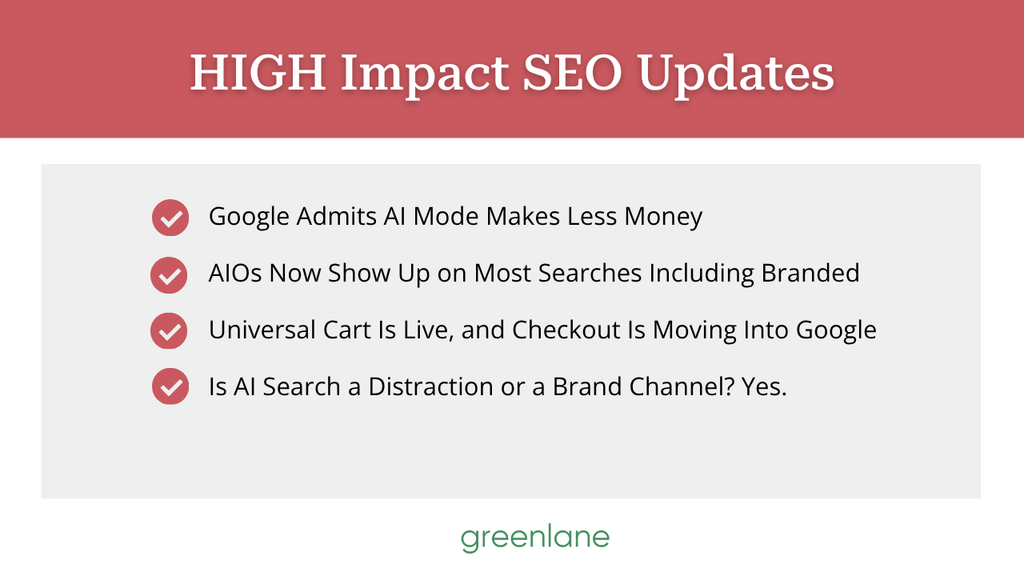
On Alphabet’s third-quarter earnings call, Google’s chief business officer Philipp Schindler said AI Mode earns less per search than traditional results, and that fast growth in AI Mode queries weighed on the quarter. Investors did not love that. Alphabet stock fell more than 12%, erasing over $500 billion in market value.
Google’s fix is more ads. It’s scaling ads in AI Overviews and AI Mode across ten countries, adding Brazil, Mexico, and the UK in Q4, and bringing “multiturn” ads to follow-up questions for US users. Google also says sponsored and organic product listings in AI Mode already get similar click-through rates. That’s Google grading its own homework, so take it with a grain of salt.
Google now has a strong financial reason to fill AI answers with paid placements. If you run Google Ads, watch for AI Mode placements in your reporting. On the organic side, expect more competition for attention inside the answer itself, not just on the page around it.
AI Overviews Now Show Up on Most Searches (Including Branded)
SEMrush data now shows AI Overviews on more than 80% of Google searches. SE Ranking found them on 82.5% of US brand searches, and seoClarity reports a range of 55% to 84% depending on industry. Every tool measures this differently, so the exact number depends on who you ask. The direction doesn’t. The brand search figure is the one to sit with: when someone searches your company name, Google now often summarizes you before it shows your site.
It’s worth searching your own brand and your top products or services to see what the AI Overview says about you. If it’s wrong or outdated, the fix usually starts with the pages on your own site that Google is reading.
Universal Cart Is Live, and Checkout Is Moving Into Google
Google’s Universal Cart, first shown at I/O in May, started rolling out in the US on October 15 across Search, AI Mode, and the Gemini app. Shoppers can add products from different retailers to one cart, get price-drop and restock alerts, and either pay with Google Pay without leaving Google or send the cart to the store’s own site. Launch partners include Nike, Sephora, Target, Ulta Beauty, Walmart, Wayfair, and many Shopify stores. YouTube and Gmail, which Google mentioned in May, aren’t part of the launch.
The plumbing behind it is the Universal Commerce Protocol (UCP), an open standard that lets AI tools handle checkout. Merchant Center now has a UCP integration hub rolling out in the US, with Canada and Australia expected next year. Google still decides which merchants it onboards.
If you sell online, look at the hub now and decide which checkout path you want. Checkout on Google is convenient for shoppers. Sending the cart to your site keeps the customer relationship and the first-party data with you. That’s a real tradeoff, and it’s yours to make. If you’re on Shopify, PPC Land reports that many stores were switched on by default in September, so confirm your settings match what you actually want. Either way, feed accuracy matters more than ever: price-drop alerts are only as good as the prices in your feed.
Is AI Search a Distraction or a Brand Channel? Yes.
October’s best discussion happened in public. Marie Haynes looked at 12 months of GA4 data from 100 websites and found that all AI chatbots combined sent traffic equal to 0.73% of what Google organic sent. ChatGPT visitors converted at 13.8% versus 3.02% for Google, but Google still drove 96.5% of conversions. Her conclusion: GEO is a distraction, and protecting your Google visibility is the higher-return move.
Mike King of iPullRank published his own piece that these studies measure a brand channel with a traffic ruler. His line: “Nobody has ever attributed a billboard.” AI answers shape what people think of you before they ever search your name, so he argues they should be measured like brand: share of voice, mentions, and branded search and direct traffic over quarters, not weeks.
Our take is that both are right about different things. Haynes is right about where the revenue is today. King is right that clicks undercount influence, and this month’s ChatGPT tracking bug (below) showed how fragile AI attribution is. Don’t pull resources away from the work that drives Google organic. Focus on the AI visibility work that overlaps with it, like accurate information, earned mentions, and pages every crawler can reach, and judge it over a longer time horizon. Both datasets are directional, and both authors sell services in this space, so read them with the always present grain of salt.
Google Spells Out What “Helpful Content” Means, and Warns Against Fake Authors
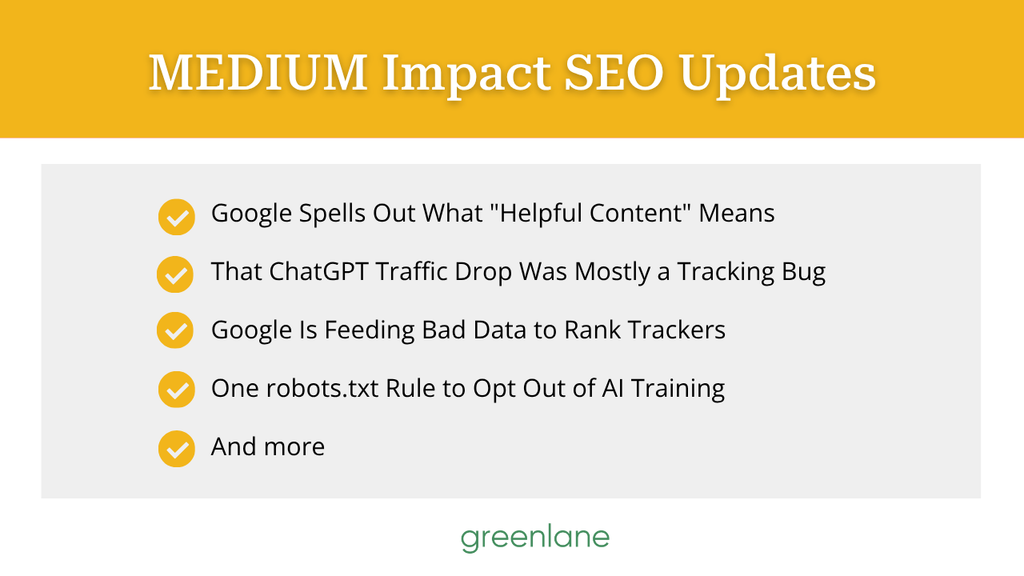
On October 2, Google updated its guide to creating helpful content with two new sections. The first defines main content: the primary text and media, interactive tools, useful user contributions like reviews, content in tabs or expanders, and page titles and headings. The second lists four things Google’s quality raters look for in that content: effort, originality, talent or skill, and accuracy. Google is blunt that mass-produced AI text without oversight counts as little to no effort, and that citing sources doesn’t replace original work.
A few days later, Google added a warning against “deceptive authorship information,” including AI-generated headshots, made-up names, and false credentials. Google once said it wasn’t worried about fake author info, so this is a change. It hasn’t said where a pen name used for privacy lands.
Audit your author pages. Real people with real credentials are the safe bet. And if you want the most direct path to “helpful,” publish things only you can: original data, firsthand experience, and tools that work.
That ChatGPT Traffic Drop Was Mostly a Tracking Bug
If you saw your ChatGPT referral traffic fall off a cliff in early October, don’t panic. After GPT-6 rolled out on October 7 and 8, links inside ChatGPT’s answers stopped carrying the “utm_source=chatgpt.com” tag and stopped passing referrer data. GA4 filed those visits under Direct instead. Graphite estimated ChatGPT-attributed sessions fell about 45%. Adobe saw ChatGPT visits drop by about 31,000 a day across roughly 500 pages while Direct visits rose by about 26,000 a day. Adobe’s Cedric Huesler says OpenAI confirmed it was a bug, and a fix began rolling out on October 15.
Be sure to annotate October 8 to 15 in your reports, and compare ChatGPT and Direct traffic side by side for that window, especially on your homepage. The bigger lesson is that AI referral tracking can break overnight with one product update. Treat AI traffic numbers as a floor, not a full count.
Google Is Feeding Bad Data to Rank Trackers
Rank tracking firm Nozzle found that since September 20, Google has been serving deliberately altered results pages to some automated tools. Since October 1, between 5% and 11% of the results Nozzle collects each day have been “poisoned,” with some days hitting 25%. Normal results kept 88.5% of the same sites across repeat searches. Poisoned ones kept just 20.7%, with more Reddit, Quora, and social media, and far fewer AI Overviews. Google hasn’t commented, but this fits with last month’s redirect change and its lawsuit against a scraping company. Google clearly wants to make bulk scraping harder.
If your rank tracker has shown wild swings since late September, check Search Console before reacting. Search Console is Google’s own data. Rank trackers are a third party reading results from the outside, and right now some of what they read is fake. It’s worth asking your tool provider how they’re handling it.
One robots.txt Rule to Opt Out of AI Training, Starting in 2027
Google plans to adopt a shared robots.txt signal, proposed at the internet standards body IETF, that lets a site opt out of AI training across multiple providers with one rule. Bing, OpenAI, and Anthropic have announced similar moves. Google expects to support it in early 2027. If a site uses the shared signal and doesn’t name Google-Extended separately, Google will treat it as blocking Google-Extended.
It’s nice to finally have one switch. It’s also arriving after the major AI companies have already crawled most of the web several times over, so manage your expectations about what it protects. The standard is still a draft, and it covers training only.
Either way, it’s worth deciding your policy now. Google notes that allowing Google-Extended is what lets your pages be used to ground answers in Gemini Apps, so a blanket opt-out could cost you visibility there. For most businesses that want to be found, being part of AI answers is worth more than staying out of the training data.
Patch Your PHP: Two Critical Security Flaws
On October 21, the PHP project disclosed two critical vulnerabilities (CVE-2026-109618 and CVE-2026-109619), both rated 9.2 out of 10, that can let an attacker run code on a server without logging in. Fixed versions are PHP 8.5.12, 8.4.27, 8.3.36, and 8.2.35. Some organizations took sites offline while they patched.
This isn’t an SEO story until it is. PHP runs WordPress and many other content management systems, and a hacked site can mean injected spam pages, malware warnings in search results, and pages dropping out of the index. Some security researchers argued the flaws are harder to exploit than the initial panic suggested. Patch anyway.
If you’re not sure where you stand, ask your developer or hosting provider to confirm you’re on a patched version. Managed hosts have likely handled it, but confirm rather than assume. Then check the Security Issues report in Search Console.
Google Business Home Puts Your Google Accounts Under One Roof
Google is testing Google Business Home, a new hub that brings your Business Profile, Merchant Center, YouTube, and Google Ads accounts into one place. It uses Gemini to suggest a “next best step,” like publishing a seasonal offer when demand spikes, and includes tools for posts, reviews, performance, multiple locations, and a brand kit. It’s a closed beta for select business categories in the US and UK, and access appears to be by invitation.
Google used to have a central dashboard for business listings, then moved most management into Search itself. Now it’s going back to a dashboard, with AI on top. For small businesses juggling several Google accounts, that could save real time. Just remember who’s giving the advice. Recommendations from Google tend to lead to more Google products, Ads included, so weigh them against your own goals. If you get an invite, try it, and keep your Business Profile basics current either way.

The September Spam Update Is Done
Google’s September 2026 spam update finished rolling out on October 8, about two weeks after it started on September 24. That means you can now run a clean before-and-after comparison. Compare a few weeks before September 24 with a few weeks after October 8, using Search Console rather than a rank tracker (see the story above about poisoned tracker data). If a drop lines up with the rollout, review Google’s spam policies honestly, especially scaled content, link schemes, and site reputation abuse. Recovery after a spam update usually takes months of cleanup, not a quick fix.
Search Console Lets You Combine Countries
The country filter in Search Console’s performance reports now lets you select more than one country at a time and see their combined traffic. Before, you could only look at one country or all of them.
Small change, practical use. If you operate in a handful of markets, like the US and Canada, you can now build one view of just the places you serve, so stray impressions from countries you don’t sell to stop muddying your reporting. What’s still missing, as Barry Schwartz pointed out, is click data in Search Console’s AI reporting. We’ll keep waiting and not hold our breath.
A New Tool for “Is This Search Feature New?”
Barry Schwartz gets a lot of messages asking whether something someone spotted in Google’s results is new. So he built a tool for it. The Is It New? AI Scan Tool on Search Engine Roundtable lets you upload a screenshot, highlight the part you’re curious about, and compare it against images from 23 years of the site’s coverage. Next time a strange box shows up in your results, it may save you a few hours of searching through old articles.
That’s the Wrap for October 2026
October made one thing clear: the money is following AI into search. Google needs AI Mode to pay for itself, so expect more ads, more shopping, and more checkout inside AI answers. If you sell online, decisions about your product feed and your checkout setup are now SEO decisions too.
It also made measurement harder. ChatGPT tracking broke, rank trackers got fed fake data, and labels went missing, all in one month. The answer isn’t to stop measuring. It’s to lean on first-party data like Search Console and real conversions in GA4, note the glitches in your reports when they happen, and judge brand-building work like AI visibility over longer time frames. Meanwhile, Google’s own guidance keeps pointing to the same basics: real authors, real effort, accurate information, and a clean site.
Have questions about how any of this affects your business? We’re always happy to talk it through. Reach out to the Greenlane team.
Share This: