

Greenlane Index: June 2026
Welcome back to the Greenlane Index. If May was Google’s month with I/O announcements, a fresh Core Update, and AI agents arriving in Search, June was the month the industry began to reckon with what all of that actually means.
The May Core Update finished rolling out just as we started the month, then Google immediately followed it with a Spam Update before June was over. We got hard data confirming what many have suspected: 68% of Google searches now end without a single click to an external site. Google Search Console finally started surfacing AI performance data. A court held Google legally liable for false statements generated by AI Overviews. And a steady stream of news made the same underlying argument from different angles; the old SEO playbook is running out of road.
As always, we’ve broken everything down so you can prioritize what matters most for you. Let’s get into it.

Google May 2026 Core Update Rollout Is Complete
Google’s May 2026 Core Update, which began rolling out on May 21, finished its rollout on June 2. The update was notable for the level of volatility it produced at the end of the rollout period — some of the highest turbulence the community tracked in months.
The May update followed closely on the heels of Google I/O and the wave of AI-driven announcements that came with it. If you saw meaningful movement in your rankings around that window, now is the time to document it carefully and start looking for patterns. The fundamentals haven’t changed: Google continues to reward original, useful content from credible sources.
Google Launches June 2026 Spam Update
On June 24, Google announced the start of a June 2026 Spam Update, and it was fully rolled out 2 days later, on the 26th. This came less than a month after the May Core Update finished rolling out, making it a busy stretch for algorithm watchers.
Spam updates target policy violations such as scaled content abuse, site reputation abuse, and expired domain abuse, rather than the broad quality signals of a core update. If your site runs clean, compliant strategies, the direct impact should be minimal. That said, these updates are worth monitoring as they can surface unrelated volatility in competitive niches. Keep an eye on your tracking data through the rollout.
Google Search Console Now Has AI Performance Reports
This is a big one. Google launched new Generative AI Performance Reports in Search Console, enabling site owners to see how their content performs in AI-powered search experiences (AI Overviews and AI Mode).
We’ve been waiting a long time for this. Until now, tracking AI visibility required workarounds: custom UTM parameters, referral filtering in GA4, or third-party tools. While having native data in GSC is a meaningful step toward understanding how AI-driven search is actually affecting your site’s traffic, Google has only given us access to impression data, not click data. Additionally, keep in mind that these impressions are included in your overall metrics; don’t double-count or muddy your reports. As always, take the data with a grain of salt, but use it for informed decision-making.
Zero-Click Searches Hit 68% in 2026
A new SparkToro study using Similarweb clickstream data found that 68% of Google searches in the US ended without a click in the first four months of 2026. That’s up from 60% in 2024, an 8-point jump in two years.
The numbers tell a clear story. AI Overviews now appear on more than 20% of searches, and when they do, click-through rates drop by nearly 60%. AI Mode processed just 0.34% of searches during the study period, but Google reported at I/O that it had surpassed 1 billion monthly users with query volume more than doubling each quarter.
The practical takeaway isn’t to abandon SEO, branded searches, local queries, and high-intent transactional searches still drive meaningful traffic. But organically ranking #1 is increasingly only part of the equation. Your listing quality, brand recognition/sentiment, and presence within AI Overviews all determine whether you actually earn the click. For many content categories, the conversation has shifted toward visibility and authority in AI surfaces rather than just SERP position.

A Court (in Germany) Ruled Google Is Liable for False Statements in AI Overviews
A German court ruled this month that Google is legally liable for false statements generated by its AI Overviews. The judges concluded that correcting misinformation is not the responsibility of third parties. Google is the only entity capable of modifying the technology underpinning its AI-generated summaries and therefore must be held accountable. The court also found that Google’s practice of encouraging users to verify AI-generated information does not absolve it of liability.
This is a significant legal precedent for the AI search era. Until now, platforms have largely pointed to user-facing disclaimers as a shield against liability for AI outputs. That framing is now being challenged in court. What this means, longer term, for how Google designs and deploys AI Overviews, and whether the impact slows down certain types of AI-generated content, is worth watching.
Reddit Can Be Used to Manipulate AI Search Fairly Easily
Research published this month found that, in the words of the headline, it is “trivially easy” to use Reddit to manipulate AI search results. Because AI systems rely heavily on Reddit as a source of human-generated, community-validated information, seeding the right content in the right subreddits can meaningfully influence what AI tools surface in response to queries.
This has three sides worth thinking about. On the offensive side, it opens a genuine distribution channel for brands seeking to build a presence in AI answers. On the defensive side, it means your competitors or bad actors can influence how AI tools describe your brand, your products, or your category. And the third side is the human element; will people continue to trust Reddit if they start realizing that everyone is “gaming the system” to show up in AI? Additionally, will AI training continue to value Reddit sources so much if users no longer trust it?
However this turns out, staying proactive about your brand’s presence across Reddit and other forum-type platforms isn’t just a PR play anymore; it’s increasingly an AI search optimization move. But don’t overdo it, because losing users’ trust is more detrimental than not being in the space at all.
Your Bad Reviews Are Training ChatGPT to Talk About Your Brand
Closely related to the Reddit story above, this piece from Joe Hall makes the point sharply: the reviews your customers leave (good and bad) are part of the training data that shapes how AI tools describe your brand. If your review profile skews negative, or if the most prominent community discussions about you are unflattering, that’s what AI surfaces.
This is becoming one of the stronger arguments for proactive online reputation management as an AI search strategy. Monitoring, responding to, and actively soliciting reviews isn’t just about star ratings on Google; it’s about what AI models learn when they encounter your brand.
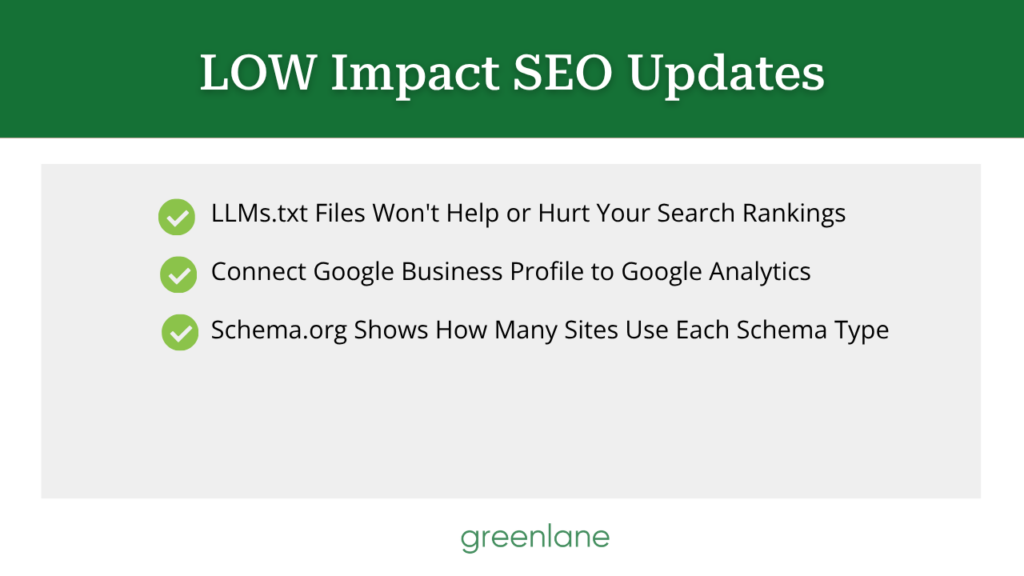
Google Confirms: LLMs.txt Files Won’t Help or Hurt Your Search Rankings
Google updated its AI optimization guide this month to explicitly state that LLMs.txt files and other similar machine-readable files like AI text files and Markdown have no effect on your visibility or rankings in Google Search. Google Search simply ignores them.
This has been a point of ongoing confusion, particularly as LLMs.txt has gained adoption as a convention for signaling to AI crawlers. Google’s position is consistent with what they’ve said before, but the updated documentation makes it more official. The short version: if you’re maintaining LLMs.txt for other services or crawlers that do use it, that’s fine. Don’t expect it to move the needle in Google.
Connect Google Business Profile to Google Analytics
Google updated its guidance on linking Google Business Profiles to Google Analytics, giving businesses a clearer path to connecting local profile performance data with site analytics. For local SEO programs, this is a useful hygiene item to check off. It improves attribution and gives you a more complete picture of how profile visits and actions flow into site traffic, all good data that can underpin strategic decisions.
Schema.org Now Shows How Many Sites Use Each Schema Type
Schema.org added a feature this month showing how widely each schema type is used across the web. It’s a useful reference point for prioritizing structured data implementations, as you can now see at a glance which types are widely adopted and which are still relatively rare.
For sites where structured data is part of the roadmap, this is a handy tool to have in the kit. High-adoption types (Product, Article, LocalBusiness) are table stakes; lower-adoption types can sometimes offer a competitive edge if they’re relevant to your content.
That’s the Wrap for June 2026
June reinforced a theme that’s been building for months: the search landscape is being restructured from the ground up, and the most important variable is now whether AI systems recognize and trust your brand, not just whether your pages rank for target keywords. The zero-click data is stark. The court ruling on AI Overview liability is a signal that the legal environment around AI-generated content is shifting. And the tools to understand your AI visibility are finally starting to arrive.
Have questions about how any of this applies to you? Reach out! We’re always happy to talk it through with you. Reach out to the Greenlane team; we’re here to help.