Greenlane Index: August 2026
Your monthly breakdown of the biggest news in search.
Welcome back to the Greenlane Index. July didn’t have much hard data to work with, so this issue focused on the bigger question of where search is actually headed. August answered with numbers, and most of them point in the same direction: AI systems are making more decisions about what people see, and we’re finally getting real visibility into how those decisions get made.
Google ran a Spam Update that shuffled rankings across every industry it touched, then kept testing ways to give AI Overviews more room on the page. On the AI search side, two separate studies gave us the clearest look yet at how assistants like ChatGPT actually decide what to crawl, what to read, and which brands to mention, while a sudden drop in Reddit’s citation share showed how fast that can all change without warning.
As always, we’ve sorted this month’s stories by how much they should change what you’re doing, biggest first. Here’s what happened in search in August.
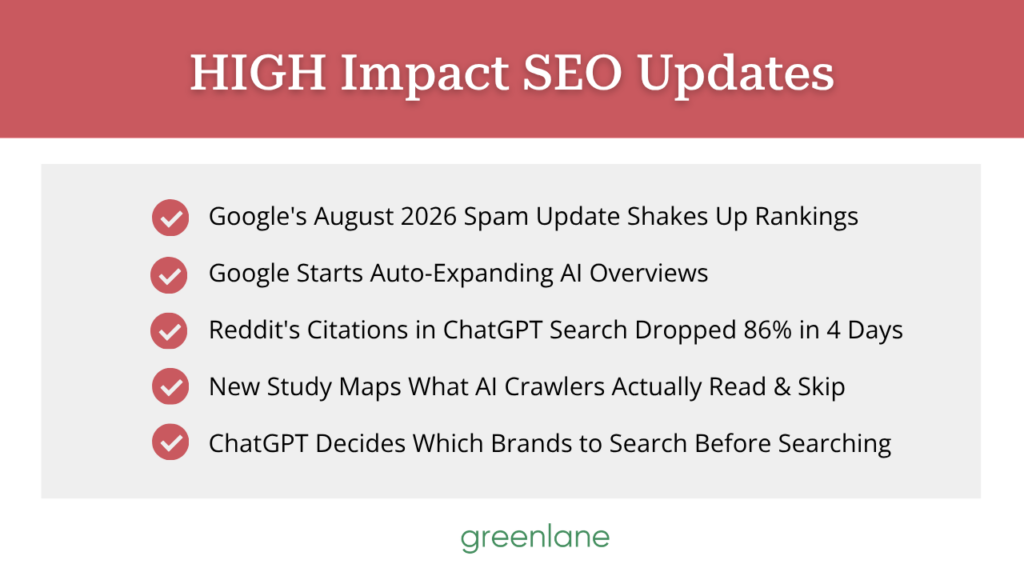
Google’s August 2026 Spam Update Shakes Up Rankings Industry-Wide
Google’s August Spam Update rolled out between August 18 and 21, and the disruption was broader than most recent updates. Top 10 URLs were 1.8 times more likely to fall out of the top 100 entirely than normal, with meaningful volatility across all 20 industries tracked, from about 75% in real estate to over 85% in fashion and beauty.
Google hasn’t said which tactics it targeted. If your rankings moved in late August, check whether the timing lines up. Spam updates typically hit scaled content, expired domain, and site reputation abuse, so a clean site should recover or was never the target.
Google Starts Auto-Expanding AI Overviews, Pushing Organic Results Further Down the Page
Google is testing AI Overviews that expand to full width automatically for certain queries, removing the “Show more” click. The expanded overview also shows a follow-up question box loaded by default, pushing organic results further down the page. Google says the expansion is limited to topics where it decides a full answer is most useful.
Less friction between a searcher and an AI answer means less reason to scroll to a blue link. If a meaningful share of your traffic comes from informational, comparison, or how-to queries, keep an eye on those terms in your reports. Impression, click, and volume movement could be indicative of changing user behavior.
Reddit’s Citations in ChatGPT Search Dropped 86% in Four Days
New data shows Reddit’s share of citations in ChatGPT Search fell from 3.83% to 0.52% in early to mid August, an 86% drop in two distinct steps rather than a gradual slide. Google’s AI products only declined gradually over the same window, suggesting this was specific to ChatGPT.
Nobody, including Promptwatch, has confirmed why. The timing lines up with a change to how ChatGPT generates queries on August 8, but that’s a correlation, not a cause. Treat the numbers as directional. The real lesson is the speed: AI search visibility can swing enormously within days, with no announcement, so it’s worth checking on more than once a quarter.
New Study Maps What AI Crawlers Actually Read, and What They Skip
A new study tested how major AI assistants handle pages where the rendered version and the raw HTML version show different information. The main finding that should change how you think about technical setup? All of the major American LLMs (ChatGPT, Claude, Gemini, Perplexity, Meta AI, Microsoft Copilot, and Grok) read the raw HTML and missed the JavaScript-rendered version entirely during live fetches. Only the Chinese (DeepSeek, ERNIE, Qwen, Kimi) and European (Mistral) LLMs executed the JavaScript and picked up the real values. Gemini is a partial exception: it does render JavaScript, but only while building its underlying index, not when it’s answering a query live.
The study also found that none of the five systems tested picked up a value that existed only in JSON-LD structured data during a live fetch. That doesn’t make schema markup pointless, so don’t go ripping it out. Structured data still feeds the index layer these systems draw from, including the knowledge graphs behind Google and Bing that inform answers well before any live fetch happens. It just means you can’t rely on schema alone to get facts into an AI answer the moment a user asks. The important content must be readable in plain HTML.
ChatGPT Decides Which Brands to Search Before It Ever Searches Anything
A study of ChatGPT’s search behavior found that in 21 of 27 test conversations, the model’s first search query already included specific brand names the user never mentioned, pulled from what ChatGPT already associates with the topic based on its training. The gap in outcomes is large. Brands that show up in ChatGPT’s own initial queries get mentioned in the final answer 68.9% of the time, while brands that only turn up through the web search itself get mentioned just 2.1% of the time.
That splits brand visibility in AI search into two separate problems. Getting into the model’s own mental map of a topic happens slowly, through years of being written about, reviewed, and compared across the open web (brand maturity), and no amount of on-page optimization will shortcut it. Getting cited once you’re in the retrieved results is a different problem, and a more familiar one. Of the pages ChatGPT actually pulls, only about 3% actually earn a citation (generally the ones with focused, well-supported content addressing a single, clear question). If your brand isn’t showing up in ChatGPT’s own queries yet, basic brand building matters more than technical fixes. If it already is showing up, tightening up your content for that second stage is where the short-term wins are.
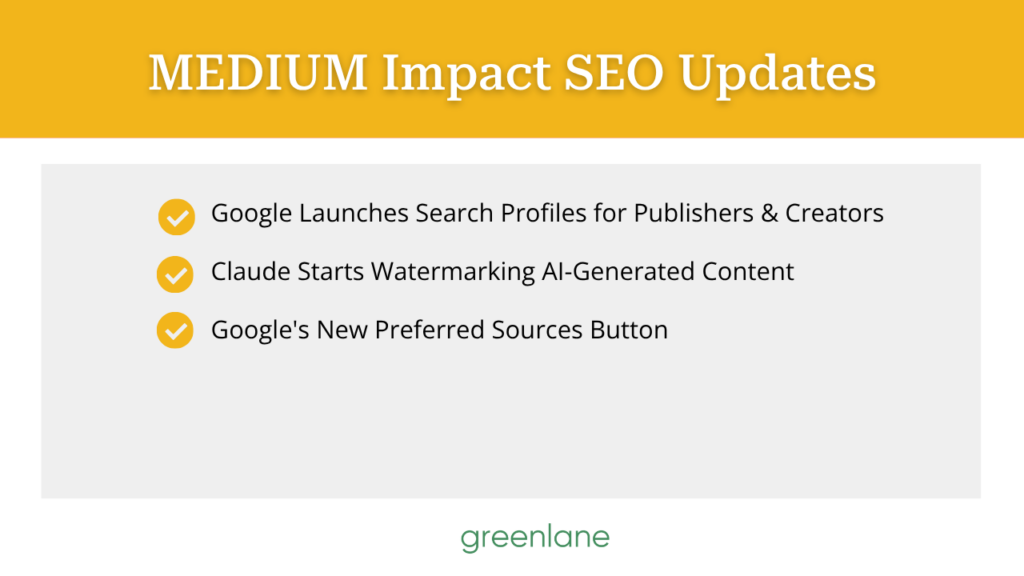
Google Launches Search Profiles for Publishers and Creators
Google introduced Search profiles, a claimable hub where publishers and creators with a following can manage a bio, links, and featured content that surfaces through knowledge panels, Google Discover, and direct URLs. Claiming one can also trigger a new knowledge panel or enhance an existing one.
If you or someone on your team has real reach on social or video platforms, claiming this early is a cheap way to get more control over how you show up in Search before it gets even more competitive.
Claude Starts Watermarking AI-Generated Content
Anthropic’s Claude now embeds an imperceptible watermark in generated text and attaches metadata to supported image files. It applies to models launched on or after August 2, 2026, and works across every Claude platform.
However, a detected watermark only means content “may have been processed by Claude,” not that Claude wrote it from scratch, and no mark doesn’t mean something isn’t AI-generated. Older models and heavy editing can dodge detection. If you use Claude or any AI tool in content production, that’s one more reason a human needs to genuinely review the output before it goes out under your name.
Google’s New Preferred Sources Button Gives Publishers a Direct Line to Readers
Google rolled out a “Preferred Sources” button that publishers can embed on their own sites. Readers who click it get that site added as a preferred source in their Google account, then land back where they were reading. Preferred sources show up more often in Top Stories, AI Overviews, and AI Mode, and Google says readers have already selected more than 600,000 unique sources.
It’s a low-effort way to turn loyal readers into a visibility advantage inside Google’s surfaces. Google Search Central offers implementation code if you have a returning audience worth capturing this way.
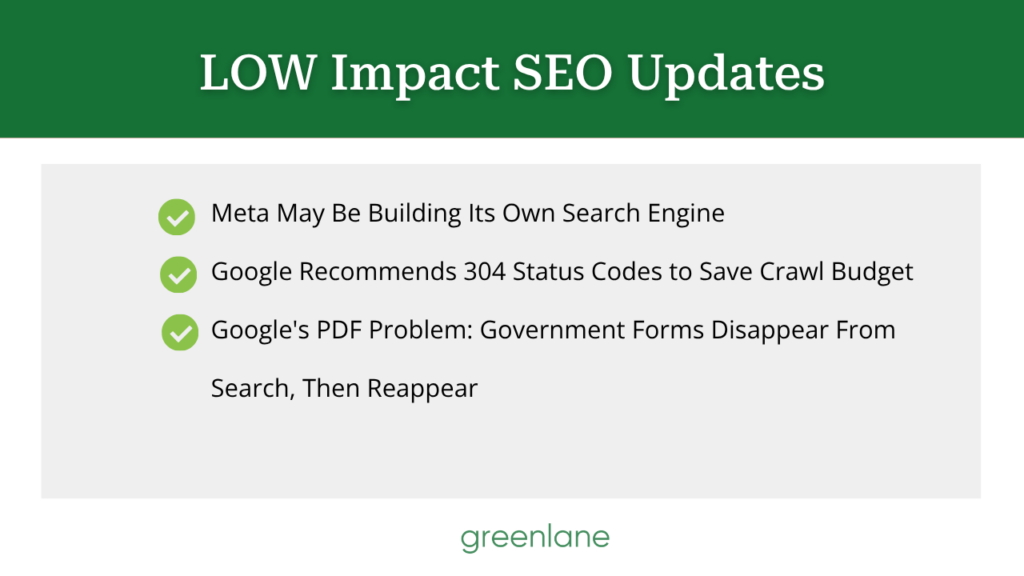
Meta May Be Building Its Own Search Engine
Screenshots showing unusually heavy Meta crawler activity are circulating, and speculation that Meta is building an independent search index is growing. Meta hasn’t confirmed or denied it, and the report rests on one person’s screenshots, so treat it as a rumor.
The logic tracks even if the specifics don’t hold up: as AI companies compete on their own models, none of them want to keep feeding search queries, and the data behind them, to a competitor like Google or Bing. They want their own pipeline of data.
Google Recommends 304 Status Codes to Save Crawl Budget
Google updated its crawl budget documentation to recommend returning a 304 (Not Modified) status code when a page hasn’t changed since it was last crawled, rather than serving the full page again. Google’s crawlers share one crawl budget per site, so freeing up resources by not crawling unchanged pages leaves more budget available for new or updated content.
This mostly matters for large sites (over 1 million pages) or medium sites over that update frequently. If that’s not you, there’s nothing to do here. If it is, the fix is proper HTTP caching headers so your server can recognize unchanged content and respond with a 304 instead.
Google’s PDF Problem: Government Forms Disappear From Search, Then Reappear
Starting in mid-August, Google significantly reduced how often PDFs showed up in results, even for queries that explicitly included the word “PDF”. The impact was most visible on government documents (IRS forms and New York State tax PDFs) that had previously generated thousands of impressions, suddenly dropped to zero. John Mueller acknowledged the reports on Bluesky, and PDFs began reappearing by August 27, suggesting a fix.
Google hasn’t explained the cause. If you publish PDFs that matter for lead generation or public access (tax documents, applications, spec sheets), check Search Console for a dip in PDF impressions or clicks around this window so you’re not chasing a problem that has already resolved itself.
That’s the Wrap for August 2026
If there’s a thread running through this month, it’s that the “black box” framing of AI search may be starting to crack open. Between the crawler study, the ChatGPT brand research, and the Reddit citation drop, we now have real (even if imperfect) data on how these systems actually decide what to read and who to mention, instead of just guessing. However, much like Google ranking information, that data won’t stay useful forever since these systems keep changing, but it’s still an upgrade from where we were at, even a few months ago.
On the traditional search side, the Spam Update is a reminder that the fundamentals haven’t gone anywhere. Google is still actively working to push down low-quality and manipulative content, and that will keep creating winners and losers regardless of how much they are pushing AI search. It’s definitely worth checking both sides of the coin this month, not just the shiny one.
Questions about anything in this issue, or want help figuring out what it means for your own site? Get in touch with our team.