

If you’re reading this article, you likely already know the terms “AEO” and “GEO.” You understand the importance of competitive analysis for AI search, and you might even be actively engaged in campaigns to increase your visibility in AI search.
At Greenlane Marketing, we’ve developed a new type of analysis that explores how Large Language Models (LLMs) discover information about your brand.
Let’s talk about what’s included in our new offering.
What the AI Brand Perception Analysis Is and Is Not
AI platforms are increasingly used to discover content, and AI is being integrated more deeply into traditional search engines. It is, therefore, important that your brand’s website is discoverable by these systems, is represented accurately, and is preferred over competitors.
This analysis reviews what LLMs, which power AI platforms, say about your brand. LLMs give different answers depending on what they already know about a user, and even the same user can ask the same question repeatedly and get different responses each time. While the answers captured during the analysis are unlikely to repeat verbatim, the inaccessibility and misinformation we find are constants we can address.
What We Want to Accomplish
The goals of this analysis are to:
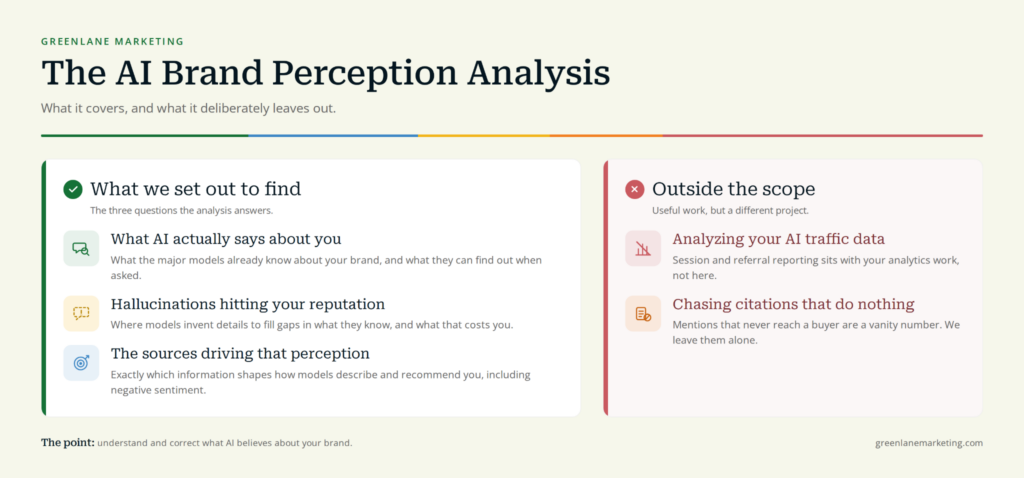
- Discover what AI says about your brand, what LLMs know and what they can find out about your brand
- Identify AI hallucinations affecting brand reputation (LLMs making up information to fill gaps in their knowledge)
- Determine exactly what information is impacting the way LLMs perceive and recommend your brand, as well as whether there is any negative brand sentiment in AI
Outside of the Scope
This analysis does not:
- Analyze your AI traffic data
- Maximize AI citations that do nothing for your bottom line
If your only goal is to maximize how often LLMs cite your brand, your vision is ill-advised. With traditional SEO, you wouldn’t optimize your furniture website for Pokémon cards; you would focus on relevant keywords and drive relevant traffic.
It’s the same approach here. If you want to understand exactly where your brand fits into the AI knowledge ecosystem and receive guidance for actions that will make you a stronger recommendation, then this report is for you.
Considering AI Crawlers
There are two types of AI crawlers that matter for this analysis:
- Training Bots run on their own. They gather the foundational knowledge an AI model has about a subject.
- Retrieval Bots, on the other hand, run only when users ask questions about a topic. They gather additional information that does not stay in the database the same way training information does.
Understanding how both crawler types can affect how your brand shows up in AI is important.
Training bots have taught LLMs what is essentially your brand “bible.” Retrieval bots kick in only once a user is already discussing your brand or industry and needs more information than training bots have found. This means the information retrieval bots gather could make or break your brand’s chances of being recommended in LLM responses.
Furthermore, training bots are becoming more sophisticated every day. The goal is for retrieval bots to be used less and less, meaning the information they discover today could be part of the training bot “bible” tomorrow.
Part 1: Initial AI Brand Sentiment Analysis
With the first series of questions, we aim to uncover what training bots have found. Our questions are tailored for finding:
- AI answer inconsistency in the responses between different LLMs
- Blatant information – such as products or services – that is missing from AI responses
- General sentiment regarding the trustworthiness of the brand
- An understanding of the target audience
- What information each of the LLMs thought was important to surface
Part 2: Measuring Brand Sentiment in AI Responses
With the second, and much larger, series of questions we ask, we aim to individually uncover what retrieval bots can learn about your brand. This is where technical SEO knowledge is key. Understanding exactly what LLMs can see shapes the questions we ask. How LLMs weigh different elements when analyzing a brand website helps us prioritize recommendations based on the answers to those questions.
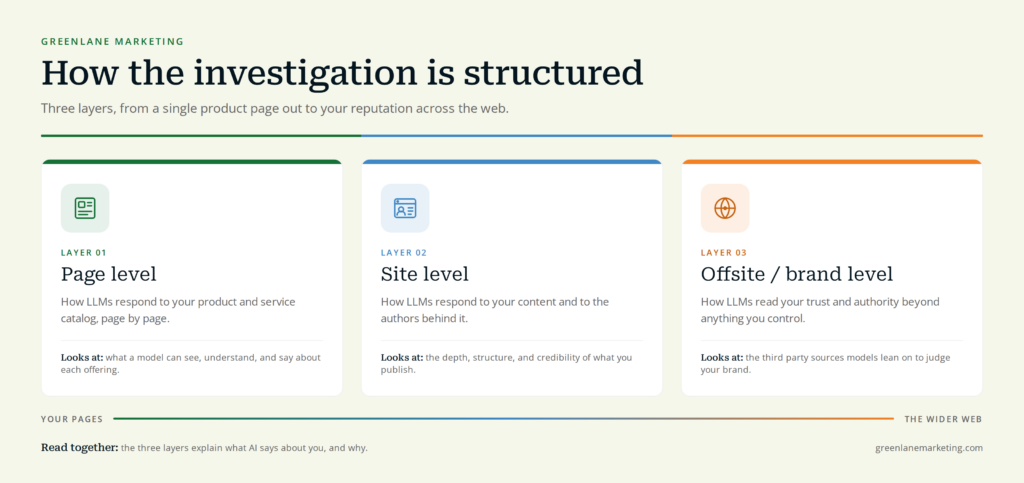
Our investigation is split into three subcategories:
- Page Level Considerations which explore how LLMs are responding to your product or service catalog
- Site Level Considerations which explore how LLMs are responding to your content and authors
- Offsite / Brand Level Considerations which explore how LLMs perceive your trust and authority
LLM Brand Perception Before & After Retrieval Bots
After asking these questions in the second part of our analysis, we revisit some of the same questions from the first part to see what difference the retrieval bots made. With the first handful of AI Brand Perception Analyses completed, the outcomes were wildly different.
- One brand received a positive recommendation when only the training-bot information was referenced, but the LLMs absolutely skewered it after the retrieval bots ran.
- Another brand went from being “one of the more reputable” brands in their industry to being “the definitive gold-star recommendation.”
- A third brand went from a very generic initial response to a much more nuanced one, where some of their product lines got strong recommendations, and others were heavily cautioned against.
These were some significant changes in opinion based on information we knew LLMs could uncover and may uncover earlier in the process very soon.
Part 3: AI Competitive Analysis
The third part of the AI Brand Perception Analysis focuses on competition. We identify when a brand might feasibly be a citation and ask the LLMs for their recommendations. Essentially, we use AI for competitive analysis.
We identify clear dominant presence in LLM responses for different intent triggers, where LLMs disagree, and why they choose one brand over another. This competitive AI positioning helps us determine where your brand can become a recommendation and where you would be wasting time chasing citations. We then tailor our own recommendations to facilitate those outcomes.
Ready to Understand What LLMs Think of Your Brand?
If your team is interested in an AI Brand Perception Analysis, don’t delay. From the analyses we’ve completed so far, we have uncovered major hallucinations, website elements visible to users but not AI crawlers, reputation issues affecting AI responses, and dozens of opportunities for clients to gain a competitive advantage in AI search.
Ask your account manager about our AI Brand Perception Analysis or contact us today!
Share This: