
Why Your Brand Needs an Off-Site / PR Strategy, Thanks to AI
Open ChatGPT or Google’s AI Mode and ask it what it thinks of your brand. Now, look at where the answer came from. It probably did not come from you.
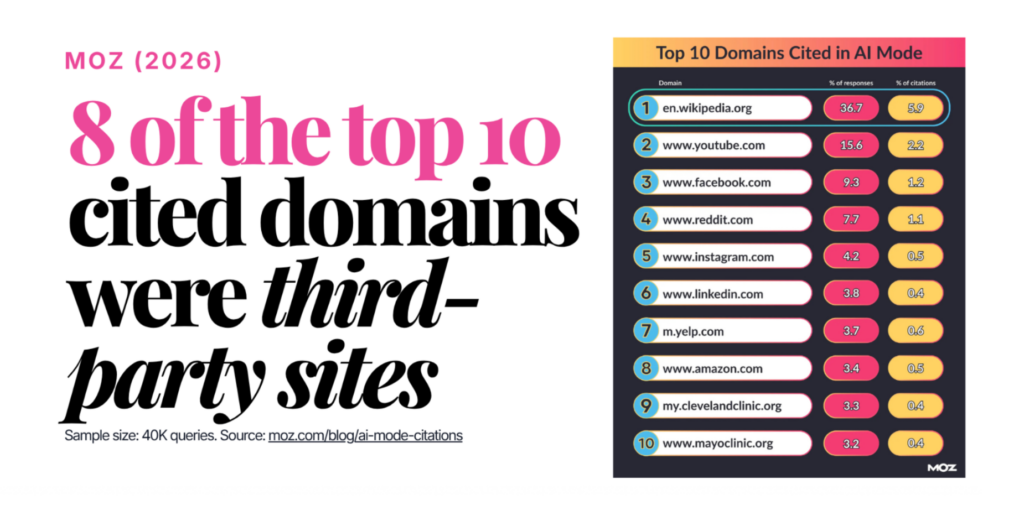
In a Moz analysis of 40,000 AI Mode queries, eight of the ten most-cited domains were third-party sites.
Wikipedia, YouTube, Facebook, Reddit, Instagram, LinkedIn, Yelp, and Amazon. Not brand homepages. Not the product pages your team spent six months optimizing.
Ahrefs, running a separate study on a different query set, found the same shape: Reddit and YouTube alone accounted for roughly 37% of AI Mode’s citation share as of July 2026.
If you have spent the last few years funding on-site SEO, it’s frustrating to see that AI isn’t referencing your site in questions about your brand!
It does not mean the work was wasted. It means the work is no longer sufficient, because the thing making the recommendation has stopped taking your word for it.
The Problem with Self-Touting Your Brand’s Own Virtues
Large language models are trained to be skeptical of marketing copy, and reasonably so.
Your About page says you are the leader in your category. So does every competitor’s About page. That claim carries almost no information, and the models treat it accordingly.
What they do treat as a signal is what other people say about you when you are not in the room. Reviews. Forum threads. Podcast mentions. A comparison article on an industry publication. A YouTube walkthrough by someone who actually used the product. This is the difference between a claim and a corroborated claim, and it is the entire game now.
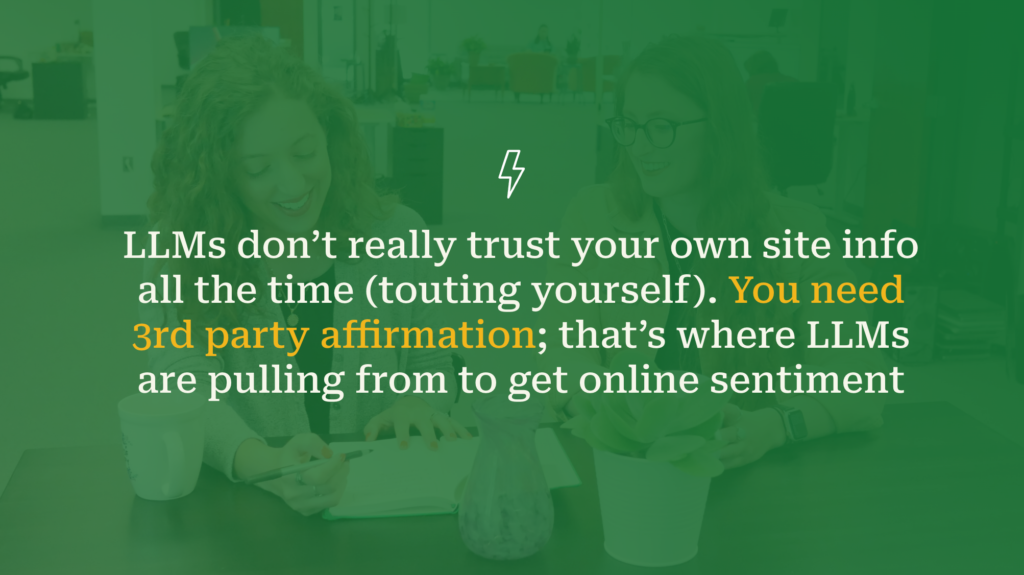
The data supports this. Ahrefs studied 75,000 brands and measured which factors correlated most with appearing in AI Overviews. Brand web mentions were the strongest, while backlinks were roughly three times weaker. Meaning, off-site mentions were more likely to get you cited in AIOs than backlinks.
The authors were careful to note that correlation is not causation and that all of these relationships sit in the moderate-to-weak range, so treat it as directional rather than as a formula. But the directional data shows that unlinked mentions of your brand across the web now matter more to AI visibility than the link-building tactics most agencies still bill for.
Pew Research found something similar from the user side. Across 68,879 Google searches from 900 US adults, the study found that Wikipedia, YouTube, and Reddit together supplied about 15% of every link appearing in AI Overviews.
Even when I attended MozCon in NYC, Moz was backing up similar claims:
In that same Pew study, users clicked a traditional search result 8% of the time when an AI summary was present, compared to 15% when it was not. Clicks on links inside the summary happened in 1% of visits. Bain reported that roughly 60% of searches now end without the user moving on to a website.
Put those together, and the strategic picture is clear. The number of people who will ever land on your carefully optimized page is shrinking. The number of people forming an opinion about you based on third-party sources is growing.
From Laser-Focusing on Your On-Site SEO to Making Time for Off-Site PR
Here is where it gets tricky, because the honest answer is not “stop doing on-site SEO.”
Ahrefs analyzed 1.9 million citations across one million AI Overviews and found that 76% of AI Overview-cited pages already rank in Google’s top 10. Inside Google’s own ecosystem, traditional ranking is still most of the battle. If your site is slow, thin, badly structured, or blocked to crawlers, you will not get cited, and no amount of PR fixes that.
Now step outside Google. When the same team ran 15,000 long-tail queries through ChatGPT, Gemini, Copilot, and Perplexity, only 12% of the URLs those assistants cited ranked in Google’s top 10 for the original query. Three of the four clustered around 8%.
Read those two numbers together, because the gap between them is the whole point. AI Overviews behave like an extension of search, so your on-site work carries over. Standalone AI assistants do not. They fan out, pull from different places, and build an answer from sources that often have nothing to do with your rankings. And the share of buying research happening in that second category is the part that is growing.
The sources those assistants reach for are not on your domain either. Profound analyzed 680 million citations between August 2024 and June 2025 and found Wikipedia alone accounted for 7.8% of ChatGPT’s citations, while Reddit made up 6.6% of Perplexity’s.
So the answer is not to move the budget out of on-site and into off-site. It is to stop treating on-site as the whole job.
Most teams are not set up for that, and the reason is structural rather than strategic. An SEO retainer covers technical audits, content optimization, and internal linking, because those are the things an agency can control, schedule, and report on cleanly. Off-site is messier. You cannot guarantee a journalist covers you. You cannot put a Reddit thread on a Gantt chart. That discomfort is exactly why it keeps sliding down the priority list, and exactly why it is now the biggest gap in most programs.
Keep doing the fundamentals. Crawlability, site speed, structured data, and clean information architecture are what make you eligible to be cited at all. Just stop mistaking the entry ticket for the strategy.
Flashback to the Content Offer
If you have been doing this longer than a decade, this next part will sound familiar and possibly a little painful.
For a stretch there, everyone was building content offers. Downloadable guides, industry reports, and above all, infographics. Some were genuinely good. Most existed for one reason: to give an outreach team something to email about.
You know the emails, because you got hundreds of them. “Hi [FIRST NAME], I loved your article on [TOPIC], and I noticed you linked to a similar resource. I have a graphic your readers would find valuable.” Sent to anyone with a contact form, chasing a link.
It worked until it didn’t. Google got better at discounting low-quality links, editors got tired of their inboxes, and the tactic mostly faded out. Good riddance to that version of it.
Here is the part worth reconsidering, though. The outreach was the problem. The asset was not.
Those campaigns started for a legitimate reason: original data is useful to other people, and useful things get referenced. That has not changed. What changed is the payoff. You are no longer chasing a link that passes PageRank. You are chasing a mention that teaches a model who you are, and a mention on a credible site counts now even when nobody hyperlinks a thing.
Journalists still want the asset, too. Muck Rack surveyed 1,044 journalists in early 2026 and found original research and data among the four things they most want in a pitch, alongside clear beat relevance, access to sources, and high-resolution images. In the same survey, 86% said PR pitches inspire at least some of their stories, while 88% said they immediately discard anything that misses their beat.
That is the whole lesson in two numbers. The material works. The spray-and-pray does not.
So no, we are not suggesting you bring back the infographic mill. Build one thing a year that only your brand could produce, and take it to the twenty people who genuinely cover your space instead of the two thousand who don’t.
An Example of First-Party Data Getting Your Brand Mentions Online
At MozCon 2026, SEO and digital PR consultant Debbie Chew walked through a campaign that shows what this looks like in practice. It is worth studying not because the tactic is new, but because the sequencing is right.
The problem was familiar: online attention spiked hard around the holidays and flatlined the rest of the year.
How She Got to the Idea
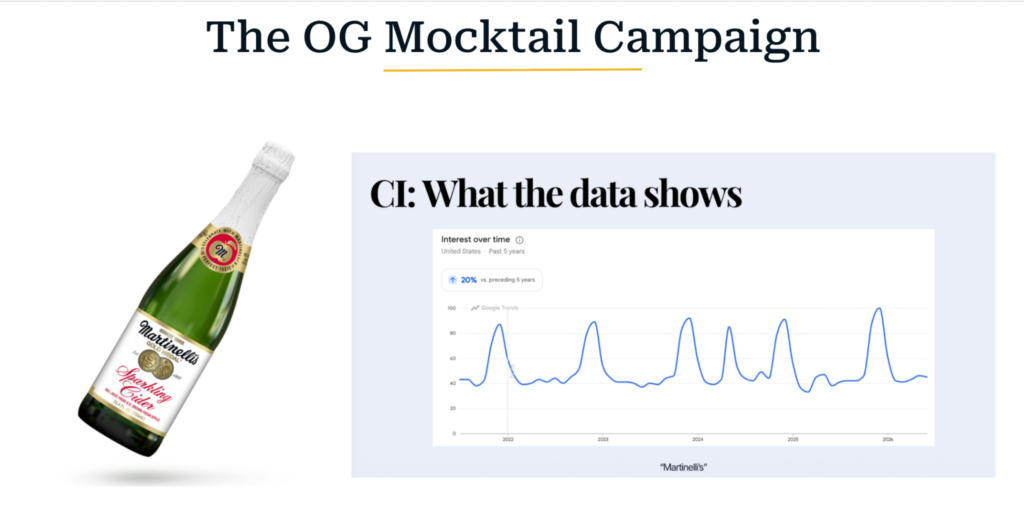
Her client was Martinelli’s, a sparkling cider brand that has made the same product for well over a century. The problem was familiar to anyone who has worked on a seasonal product: online attention spiked hard around the holidays and flatlined the rest of the year. Impressions, clicks, all of it followed the same November-to-January curve.
So Chew started where most of us would, in Google Trends. The brand-name data confirmed exactly what everyone already assumed. Big spikes around the holidays, quiet the rest of the year. People gather, people toast, people buy sparkling cider. Not a revelation, and not a campaign.
The interesting move was what she asked next.
Instead of accepting the seasonality as a fixed constraint and optimizing inside it, she asked a more basic question: why does somebody reach for sparkling cider in the first place? The answer sitting in plain sight the whole time is that sparkling cider has no alcohol in it. That is the actual product benefit. The celebration is just the context.
Once she was looking at the category through that lens instead of the brand’s, she went back to Google Trends and searched “mocktail.” Since roughly 2024, the term had climbed steadily, up around 400% over the preceding five years. Younger drinkers were cutting back or quitting entirely, and they were not doing it quietly. They wanted something to hold, something to toast with, and something that did not make them the odd one out at the party.
That is a cultural shift, not a keyword.
And Martinelli’s had a claim on it that no competitor could copy. The brand had been making a non-alcoholic celebration drink for a hundred years before anyone used the word “mocktail.” They were not entering the trend. They could credibly say they started it.
The campaign wrote itself from there: Martinelli’s, the original mocktail.
What makes this worth studying is not the idea. It is the order of operations that produced the idea. Chew did not brainstorm campaign concepts and then hunt for data to justify her favorite. She looked at data about her own brand, found something she already knew, refused to stop there, asked why the product actually gets bought, and then looked for evidence of that motivation instead. The campaign was the output of the research, not the input.
One more thing our team flagged when we talked through this internally: she picked one audience and committed to it. Plenty of people buy sparkling cider for plenty of reasons, including a lot of people who drink alcohol the rest of the time. She ignored all of them and aimed squarely at non-alcoholic drinkers. Narrowing the target that far is what made the story sharp enough for a publisher to want it.
Here’s what she learned and a strategy you too can apply to your marketing.
Step one: find the real customer concern.
Chew went to Google Trends rather than a keyword tool. Brand-name searches confirmed the seasonality she already knew. The interesting signal was adjacent. Searches for “mocktail” had been climbing steadily since around 2024, driven by younger drinkers reducing or eliminating alcohol. That is not a keyword opportunity. That is a cultural shift the brand happened to sit inside.
Step two: create an original asset only you can create.
Martinelli’s had a legitimate claim to being among the first sparkling ciders, which gave them a defensible position as the “original mocktail.” Rather than writing a blog post asserting it, Chew commissioned a survey of more than 1,000 Gen Z and millennial respondents. She asked questions such as, “How often do you choose non-alcoholic drinks? Do you feel judged ordering a mocktail? How often are non-alcoholic options offered at social events?” etc.
This is the part most brands skip, and it matters. In a market where AI can rephrase every existing article on a topic in seconds, proprietary data is one of the few assets it can’t synthesize. You either ran the survey or you did not.
Step three: share it everywhere except your own blog.
The results could have been published on the brand’s website, but publication wasn’t the campaign. The campaign was the outreach: food editors, parenting publications, lifestyle bloggers, health and wellness sites, sober-curious podcasts, and an op-ed pitch around the “original mocktail” framing.
Worth noting what the goal was, because it is not the goal those campaigns used to have. Chew was not primarily chasing backlinks to Martinelli’s. She was chasing spread of voice on sites that were not Martinelli’s, so that the brand would get referenced off its own domain when an answer engine went looking. Articles, podcasts, and YouTube videos discussing the story are worth more to that goal than a link on a page nobody reads.
Timing was the other constraint, and it is the one most teams underestimate. Search interest peaks around the holidays, which means the survey had to be fielded and analyzed months earlier so the story could land while editors were still building their seasonal coverage. Original is not enough on its own. It has to be original and timely, and the calendar for that work starts far earlier than most marketing plans assume.
The framework itself is simple enough to write on a napkin. Identify a customer concern. Build an asset worth consuming. Share it well beyond your own domain. What earns coverage sits in the overlap between timely and original. Miss either one and you have produced an expensive PDF nobody picks up.
What You Can Do to Prioritize PR, Right Now
The uncomfortable truth for marketing agencies, ours included, is that the on-site SEO silo is often our fault. Brands hire an SEO team, a paid team, and sometimes a PR team, and each optimizes the metric it is measured on. Nobody owns what the internet says about the brand as a whole.
That question now determines whether an answer engine recommends you.
A few practical shifts worth making this quarter:
- Audit what the web already says about you. Before building anything, search your brand in ChatGPT, Gemini, Google AI Mode, and Perplexity. Note which sources the answers pull from. If the answer is thin or wrong, you have found your brief. If your competitors show up in the comparison and you do not, you have found something more urgent.
- Fund one original data asset per year. A survey, a proprietary benchmark, an analysis of your own anonymized customer data. It does not need to be expensive. It needs to be genuinely yours. Stats get cited, and citations are how models learn who you are.
- Get your experts off your website. Guest posts, podcast appearances, industry panels, YouTube, and yes, answering questions in the forums where your buyers actually are. A panel at MozCon from Journey Further’s Paul Norris and Beth Nunnington made the point bluntly: people spend the overwhelming majority of their online time consuming rather than searching. If your expertise only exists on your own domain, it exists in the smallest room in the house.
- Change what you report on. Brand mentions, share of voice in AI answers, and citation frequency belong in the monthly deck alongside sessions and conversions. Not instead of them. We would push back hard on anyone treating visibility as a standalone goal, because visibility that never traces back to revenue is a vanity metric and no client should fund one. But if brand mentions are the strongest correlate of AI visibility, and AI is increasingly the layer between your buyer and your website, then not measuring mentions means flying blind on the part of the funnel that is growing.
Improve Your AI Visibility with Greenlane Marketing
If you take one thing from this: stop treating your website as the place where your brand is explained, and start treating it as one source among many that a machine will consult before recommending you.
The brands that will win the next few years are not the ones with the cleanest H1 tags. They are the ones with the most credible third-party footprint, built deliberately, over time, in the places their buyers already spend their attention.
That is a PR strategy. It has just been sitting in the wrong budget line.
Want a read on what AI answer engines currently say about your brand, and where the gaps are? We’re happy to have that conversation. We offer custom Brand Perception Audits to see how LLMs view your brand sentiment, and proven tactics to improve your favorability to AI.
Explore our AI Search Optimization services today.