Improve Your Brand Visibility in Google’s AI Search By Focusing on “Retrieval” Optimization
If you’ve spent any time looking at search results lately, you’ve noticed things look a bit different.
Between AI Overviews (AIOs) in Google and the rise of answer engines like ChatGPT, Claude, and Perplexity, the way people find information is shifting from clicking traditional blue links to getting instant summaries in organic search.
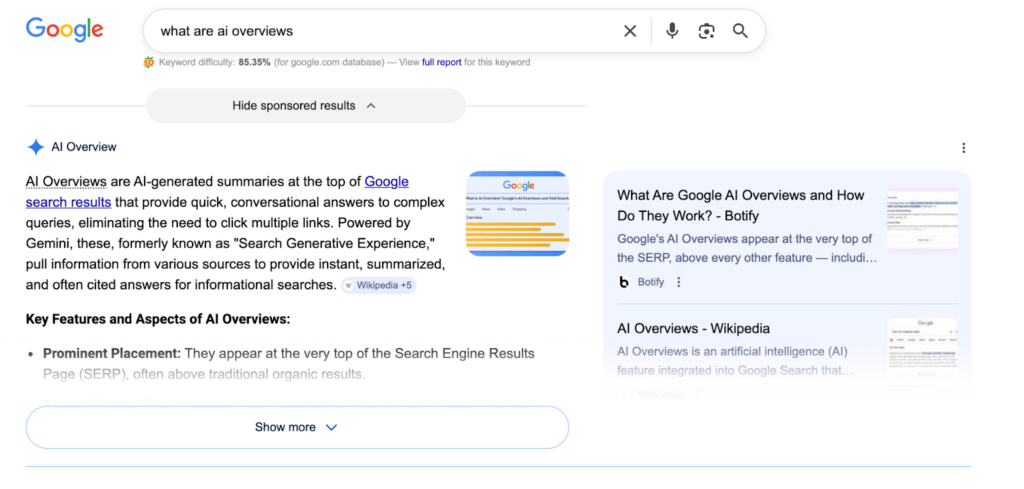
answer to a searched question, right at the top of the SERP
For many online businesses, this feels like the search engine optimization (SEO) game has just changed. Ranking as the top result in Google is now about showing up in AI-generated results. It begs the question: If the SERP playground looks different, should we adjust our SEO techniques to be more visible to AI search algorithms?
I’m here to argue that not much is really changing in SEO as we’ve known it. (I know, a bold statement).
The “secret” strategies to ranking in this new era of AI-powered search don’t require complicated, revolutionary technical hacks. They’re not some new-fangled tactics specially-engineering for “Generative Engine Optimization (GEO),” “Answer Engine Optimization (AEO),” etc.
You just need to double down on some SEO basics… optimization basics that have been the same for years.
Let’s break down what that means and discuss the current confusing chaos around AI optimization.
Summarized Results at the Top of the SERPs Aren’t “New”
I’m getting really sick of reading about GEO and AEO.
These hot buzzwords began surfacing in late 2025 and are at an all-time high in 2026. They’re being branded as this big, new thing SEO experts everywhere need to be aware of. Some people in the community are even calling for new, revolutionary techniques to boost visibility in a world rapidly being powered by AI search algorithms.
But these trendy, AI-focused acronyms are new packaging around a familiar topic. The principles of optimizing for AI search are not entirely unique to the SEO community; they are not things the SEO community has never tried. Articles about GEO/AEO are serving a whole lot of nothing new.
Google’s AIO is Literally a SERP Feature (Like We Already Optimize For)
For the past decade or so, SEO experts have focused heavily on ranking organically in the top 10 blue links on Google and search engines.
Let me repeat: for the past decade! Being in the top “positions” has always been a huge KPI to prove organic success.
For years, Google’s been experimenting with SERP Features like “Featured Snippets” and answers right inside the search results in “People Also Ask,” without having to click through to a website.
BrightLocal has an article from 2019 that neatly lists many of them. These are those bulleted lists and summaries we all know that show up in the SERPs:
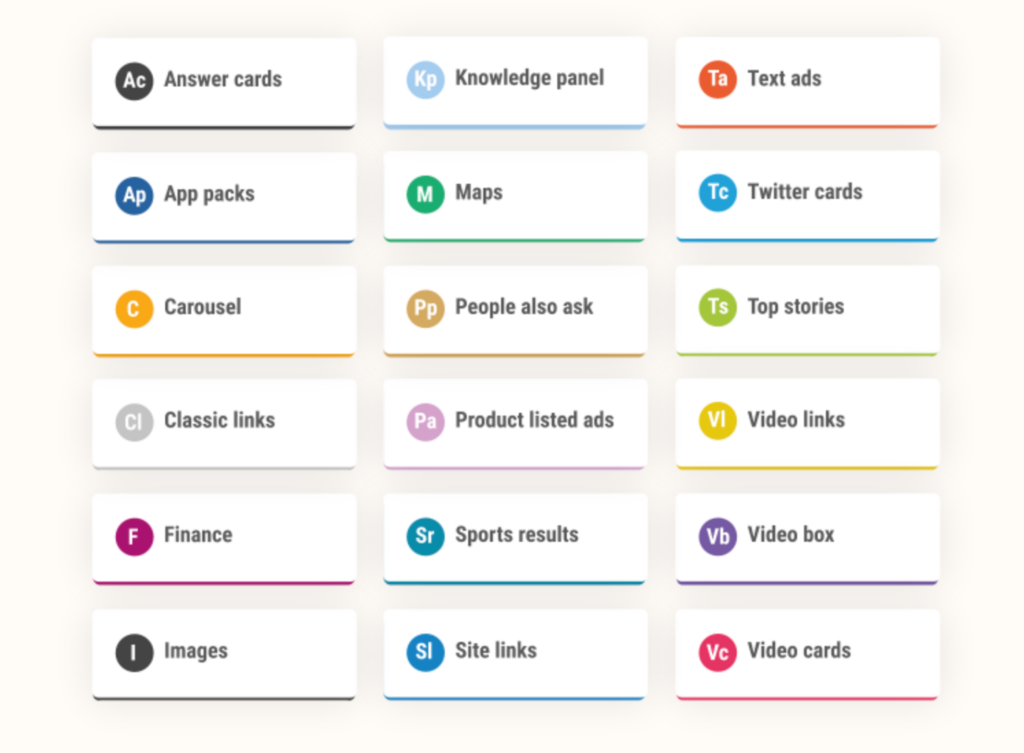
So let’s be clear: Google’s been serving short answers at the top of the SERPs for years now. The difference is that, in 2026, Google’s artificial intelligence is generating these answers in the search engine’s new packaged AI Overviews (AIOs) feature, which is arguably just another SERP Feature. Essentially, it’s just another block to add to that 7-year-old graphic above.
Like we’ve been seeing for years, people are getting their answers right on the search results page above the ads’ real estate.
What About Other AI-Powered Search Engines?
Let’s talk beyond the Google SERP, because that’s not the only way people are using AI to search for information today.
While Google’s AI Overviews are the most visible change for traditional SEOs, the rise of “Answer Engines” like ChatGPT, Claude, and Perplexity can’t be ignored.
Even though these platforms look like chat windows rather than search bars, they aren’t reinventing the wheel — they work similarly.
With answer engines like ChatGPT, we’re just cutting out the SERP. Users ask questions and get full-text answers directly in the interface, pulled from multiple sources that the algorithm retrieves and combines.
From Ranking “Position #1” to Being Retrieved: The SEO Mental Shift
So what is changing?
On Google, instead of being that first blue link below the ads, SEOs in 2026 are trying to improve brand visibility in the new top spot: AI Overviews. This new SERP Feature is scraped and generated by their proprietary artificial intelligence, rather than by their mysterious previous algorithm.
Many users aren’t using major search engines as much as they used to. They’re getting what they need from “answer engines” like ChatGPT. SEOs everywhere are trying to get selected by these AIs to get visibility from these other traffic sources.
But before you can even be selected for either AI-powered shout-out, the artificial intelligence needs to be able to read your site content and discern that it’s relevant to serve.
Today’s AI-powered search works as follows: the AI model retrieves a pool of relevant sources, synthesizes those sources, and generates a summarized answer.
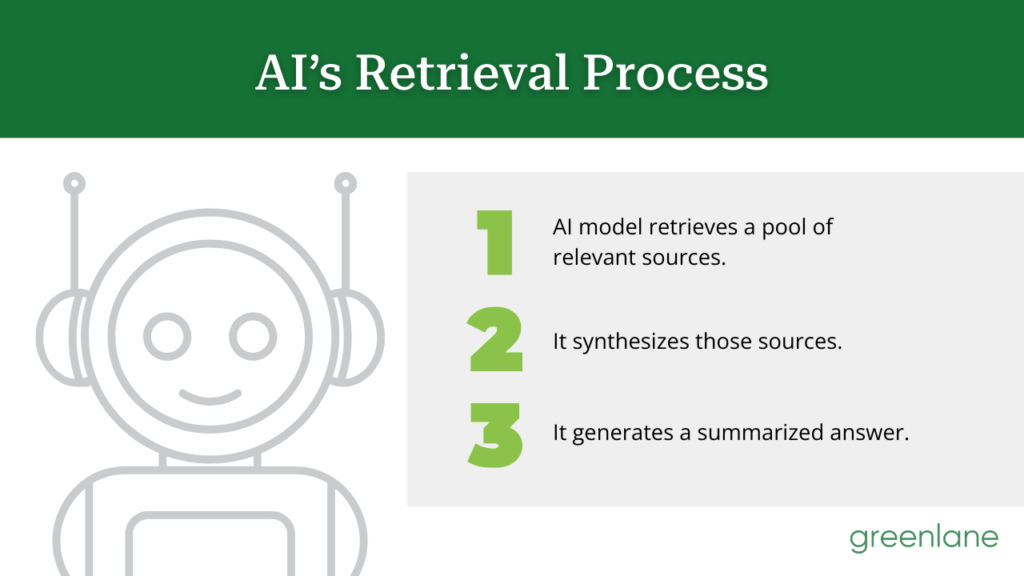
If you’re not retrieved in step one, you’ll never appear in the AIO summary.
You see, before an AI model generates an answer, it has to retrieve the right information. If your content isn’t in that initial “retrieval set,” you’re invisible in search results.
That’s why ranking online in 2026 isn’t about chasing new acronyms like GEO and AEO that all mean the same thing. Ranking in AIOs and Google’s AI features in Search is about investing in proper Retrieval Optimization for your website.
While we’ve been used to blue link positions holding strong for days, weeks, months, depending on the query, these AI answers are different almost every time you refresh a search— even if it’s the exact same query asked only seconds later. They don’t pick the same stable sources to get these answers either.
But while these AI rankings are about as consistent as our worst ex, the new top position is one we want to show up in. It’s the new top spot for brand visibility as far as AI is concerned.
However, instead of asking, “Are we in position #1 on Google’s organic results page?”, we’re now asking, “Are we visible in AI search results?”
That answer can only be found by first answering the question, “Is our site retrievable?”
What’s Actually Changing & What’s Not
There’s been an explosion of new acronyms: AEO (Answer Engine Optimization), AIO (AI Optimization), GEO (Generative Engine Optimization), etc.
But when you strip away the buzzwords, the tactics look familiar:
- Keep your technical health tip-top.
- Use clear page structure.
- Write concisely.
- Demonstrate credibility.
The core SEO fundamentals haven’t changed. There’s not a tremendous difference between ranking in AI-powered search vs the SERPs of old.
If your content is easy to crawl, parse, and genuinely valuable to both humans and AI, LLMs will retrieve it. And when you’re retrieved consistently, visibility follows.
6 SEO Strategies to Improve Brand Visibility in Google’s AI Overviews
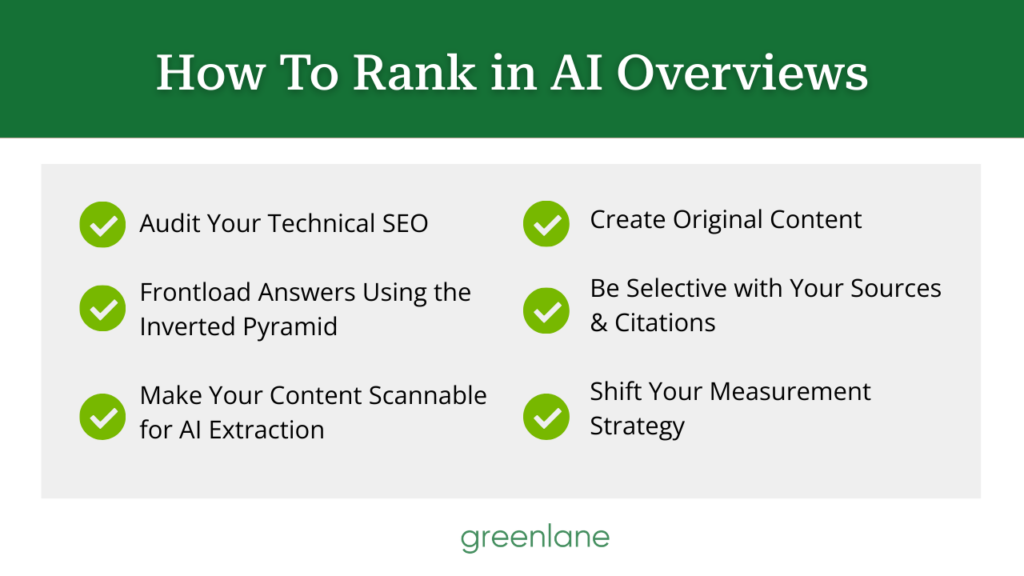
I wrote an article breaking down six SEO strategies we’ve been using for years that make a great base for optimizing for artificial intelligence search engines and AI in Google. It’s reinforcing what’s worked for algorithms for years — and details what still applies to AI logic.
Let Us Help Optimize Your Content for AI Retrieval
In 2026, organic leaders won’t be the brands chasing every new acronym. They’ll be the ones mastering Retrieval Optimization.
AI search is here. Let’s make sure you’re cited. Better yet, let’s make sure you also stand apart from the AI-generated trash being produced today.
AI referral traffic may be lower in volume, but those users often convert at 4x the rate of traditional searchers. We’ll help you restructure your content to be scannable, authoritative, and perfectly primed for LLM discovery. Learn more about our AI Search Optimization Services.