
6 SEO Strategies to Improve Brand Visibility in Google’s AI Overviews
The SEO experts I know are struggling with the changes to the SERPs in 2026, laser-focusing on new AI features as their shiny new target for proving their organic success.
While we love cracking the code on new algorithm changes or SERP updates, some of Google’s AI features are giving us whiplash. They’re inconsistent about who they pick for answers, seemingly hallucinogenic about how they answer the same query twice, and somewhat messy in what they serve. Not to mention, the SEO industry’s current obsession with flashy new acronyms like “GEO” and “AEO.”
If you ask me, the “new” reality of search is just the old reality with a different name, which I dissected in another blog focusing on Retrieval Optimization.
The fundamental SEO mechanics of how brands earn visibility in Google’s AI Overviews haven’t undergone a radical transformation. Even the AI mechanics used in answer engines like Perplexity and ChatGPT seem to favor many of the same SEO principles we know by heart, according to findings from a generative AI study.
Here are six strategies you probably already do for foundational SEO, but should consider doubling down on to be retrievable by artificial intelligence and rank in AI Overviews and LLMs’ AI results:
1. Audit Your Technical SEO (You Can’t Be Retrieved If You’re Not Indexed)
Google itself says explicitly on its AI Features webpage that:
“To be eligible to be shown as a supporting link in AI Overviews or AI Mode, a page must be indexed and eligible to be shown in Google Search with a snippet, fulfilling the Search technical requirements.”
The linked Google Search technical requirements page goes on at length about Retrieval Optimization. Why? Artificial intelligence retrieval starts with crawlability.
If your site has technical issues — site errors, slow load times, broken redirects, poor structure — AI systems may never properly access your content.
Check out Google’s link on the topic above. Focus on:
- Crawlability and indexation, like crawl budget and your Search Console data
- Clean navigation menus and internal linking
- Structured HTML on pages (more about making pages easily scannable for AI further in this article)
- Schema markup, where appropriate
- Fixing site error codes
If you haven’t audited your site’s technical health in a few years, you’re well overdue. Pages can disappear, become obsolete, or get deindexed as the best practices for SEO structure evolve
If AI can’t read your pages (or doesn’t like what it reads), you’re not getting considered for visibility in AI Overviews or AI Mode to begin with. This first step is foundational to the AI retrieval optimization tactic I’m pushing throughout this article. Don’t skip it!
2. Frontload Answers Using the Inverted Pyramid
A few years back, HubSpot popularized the concept of creating long-form content in the form of Pillar Pages. These 5,000+ word web pages are often marketed as “Complete Guides” or robust resources for everything you need to know about a topic. You can see a few examples of pillar pages here.
The logic was that search engines would deem this Pillar Page as the one great source for many answers on that topic. Users would link to it a lot as an online reference. All the SEO stars would align to make it a powerhouse-ranking page for numerous search queries.
But these types of pages would often “drag out” the process of getting your answers… A reader would have to dig through many nuanced sections to gain a full understanding, or cherry-pick what they needed.
Now, AI is shaking up our previous ranking strategies.
Today, AI uses “attention mechanisms” that weigh the beginning of a text block more heavily than the end.
That means AI models prioritize content at the beginning of sections. If the actual answer is buried at the bottom of a 2,000-word guide, the AI might miss it entirely during its research phase.
However, to make this even more confusing… Google discusses in its Search Central a technique that both AI Overviews and AI Mode may use when selecting and serving brands online called “query fan-out.” During this process, its AI looks for related searches and queries to thoroughly answer a Google search question by anticipating additional questions they may have about the topic.
So Google’s telling us that it cares about thoroughly covering a topic, but at the same time, not being too loquacious? Does it want a Pillar Page or a short-form answer from us? Yes… *dripping face emoji*
Finding a Balance Between Too Long & Too Short
In 2026, SEOs are shifting their focus from long-winded, thousands-of-words pillars to concise, straightforward answers on webpages. Instead of having to find an answer buried in clunky, wordy paragraphs, users can get what they need in one or two short sentence summaries.
But if we have too few pages, this goes against SEO ranking best practices we’ve come to know and love. A page with fewer than 300 words, for example, has often been viewed as needing optimization.
My opinion is that not all questions can be answered properly in one line, or even one paragraph. So we don’t want to only create concise content for every page on our site that’s only a few hundred words. There’s a time and a place for expansion, and the concept of thoroughly covering a topic is not dead.
Instead of making your website too-light, here’s what you can do to structure your content for visibility by artificial intelligence and still ranking organically in the top 10 blue links:
- Group your content with structured data and headers.
- Start each major section with a 2–3 sentence direct answer.
- Then expand with supporting detail.
- Avoid burying the lede.
Think like a journalist: summarize the important information first, then elaborate on the details. You may recall learning about the Inverted Pyramid journalists use to stay focused:
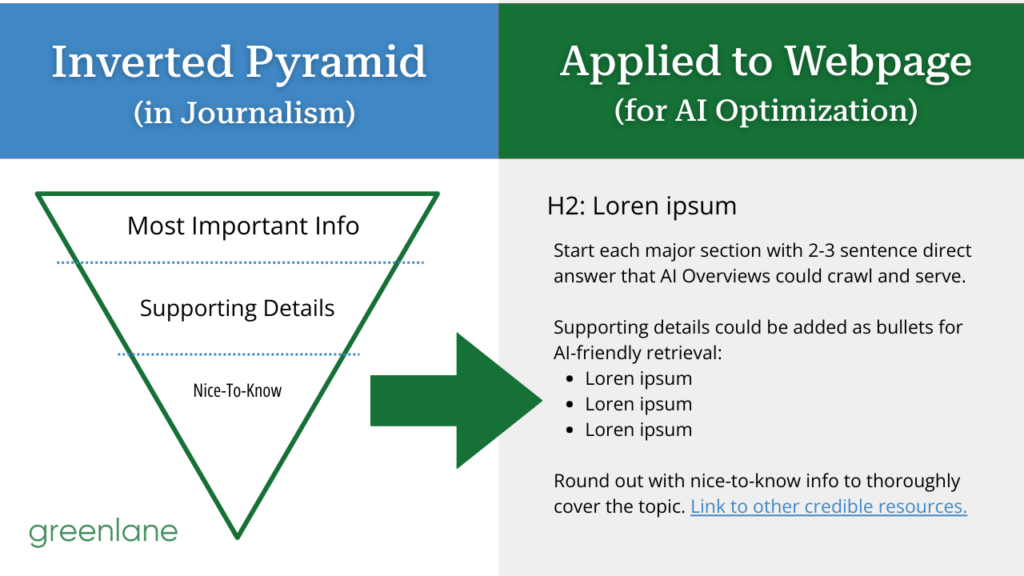
This improves AI extraction, human scannability, and on-page engagement. It’s an AI and UX double-whammy win.
You might say, “But, Jenn, you’re not starting every section with a direct answer in this article.” To that I’d say, “You’re right!” I still believe in writing for humans first and presenting a problem/concern, followed by a solution. I’m just saying the approach above is what AI likes. I am not AI. I also am an old-school SEO who still believes in showing my expertise by expanding on a topic (maybe sometimes at too much length). Sue me.
TLDR: Long-form content isn’t dead — but rambling introductions are when it comes to ranking in AI Overviews and LLMs. Think of it like a news story — don’t bury the lede. This approach ensures that even if an AI only “reads” the first paragraph of a section, it still gets what it wants.
3. Make Your Content Scannable for AI Extraction
This leads me to my next point. No one — human or bot — wants to dig through dense blocks of text. Scannable content is easier for a person to read on a phone or small screen, and it’s significantly easier for an AI “crawler” to parse and serve as a Snippet or SERP Feature.
AI Overviews and answer engines often pull information from 6 to 10 different sources to summarize a single answer. To be included in that summary, your content needs to be “chunked” in a way that is easy for a bot to parse, since it’s running through many pages and doing a query fan-out to get what it needs.
Here are some tips that SEOs have used for years to make content scannable and are still important for AI retrieval today:
- Use Descriptive, HTML-Coded Headers: Make sure they’re coded as H1, H2, H3, etc. for technical weight and that they’re used with the proper hierarchy. Make them punchy and concise. Get your keywords in there.
- Chunk by Topics: Ensure those headers focus on one core point. From an SEO perspective, each header and its sentences could be ranked for similar semantic keywords and search queries. If an AIO were to pull from that section, could it grab a sentence or two that summarizes multiple organic search queries?
- Embrace Bullets: They break up the “meat and potatoes” of your info so the most important facts stand out. Short and sweet, just like Sabrina. It’s important to note that using bullets isn’t only to “stand out” to AI; SERP features will often generate bulleted lists in their answers. So, if your content is already bulleted out, it has a better chance of being cited.
- Keep Paragraphs Short: Our eyes glaze over when reading 7+ sentence long chunky paragraphs. There’s no set rule here, but I like to keep paragraphs 2-3 lines long for the web.
- Show Visual Shortcuts For People. Words are just words. If something can be better visualized in a graphic or image, include pictures between headers or within them for mental shortcuts that humans need to understand. A good user experience can lead to longer page time and engagement, which eventually leads Google to see it as a well-liked page and rank it. Just be sure that the images are properly compressed and sized for SEO.
Capture Conversational & “Intent-Heavy” Traffic
Another way to make content more easily scannable for real human eyes is to stop stuffing keywords in stiff or awkward sentence structures and, instead, speak more conversationally.
What we’re seeing more and more from Search Console data is that people aren’t searching for short keywords; they are asking full, complex questions. In fact, traditional two-to-three-word search volume is predicted to decline by 25% by mid-2026 as users pivot toward “Answer Engines” like ChatGPT and Claude and “speak to text” to get answers.
Part of making your content more digestible is writing longer-form question prompts, such as “ranking in the AI Overviews in Google SEO.” This is a real phrase that has decent search volume, and I’m trying to get this article to rank for it on Google. Years ago, the tactic may have been to shove the term “AI Overviews” in this article an obnoxious amount of times, but in 2026, the approach is more nuanced.
4. Create Primary, Original Content that AI Can’t Find Elsewhere
Large Language Models (LLMs) are trained on common knowledge found across the web. If your blog post simply summarizes what is already on Wikipedia or top-ranked pages for your queries, the AI has no incentive to cite your brand as a source.
You need to add value by giving the AI something it hasn’t seen before. This means creating truly unique content that only your brand can produce, not simply summarizing what others have previously shared online.
You can create original content by sharing proprietary data, internal studies, or unique client case studies that competitors cannot replicate. Learn more about generating primary content here.
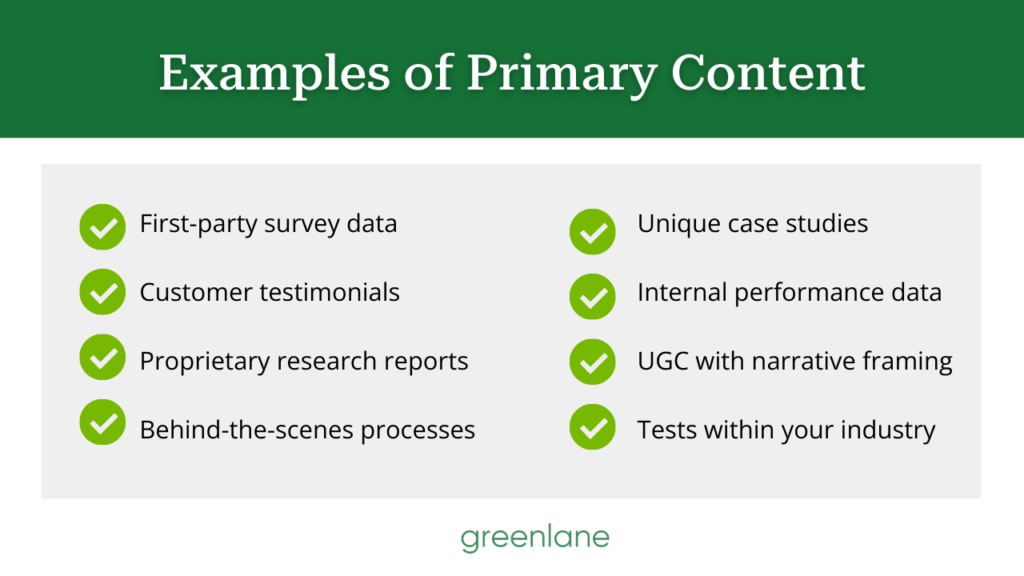
Unique content gives the AI a reason to reference you specifically, as you are providing “new” information that doesn’t exist elsewhere in its training data.
Text is Cool, But Have You Tried Video?
The second consideration is how you package that primary content you collect.
Making a blog or webpage that’s primarily text-based is a fine default communication mode. However, there’s a lot of research by SEO leaders that video content is being favored by AI. Ahrefs found that 18% of non-ranking citations come from YouTube in its study. Shocked? You shouldn’t be. Google loves promoting its own products, and since it owns YouTube, of course, it would be sampling from and promoting its animated child.
Here’s a YouTube video of me talking about using primary content to give you an idea of how you may leverage video marketing in 2026 to rank in AI search:
5. Be Selective with Your Sources & Citations
Over two years ago, in late 2023, a major academic study on “Generative Engine Optimization” (ugh, there’s that buzzword, GEO, again) found that LLM visibility improved significantly when content:
- Cited authoritative sources.
- Included verifiable statistics.
- Used expert quotes.
- Linked to reputable domains.
To any active SEO expert, this “discovery” is not shocking at all. In fact, I’d argue it was a no-duh moment. It’s a core technique used in traditional search engine optimization.
However, it does just add fuel to the fire we’ve been stoking for a handful of years. Google’s been reinforcing its E-E-A-T principles as of late. I’ve seen the proof in the pudding in a recent case study I was involved in that connected missing author bylines and bios to a loss of rankings.
Google wants to see that your facts are legitimate by linking to trustworthy domains and URLs. AI is quick to glean if a source has bad blood online and questionable authority.

Is your source truly trustworthy?
Remember, not all outbound links are equal. Ask:
- Is this domain authoritative? Has it been around for years? Is the brand considered a leader in the industry amongst its niche?
- Is this brand credible? Does it cite other trustworthy sources or have many spammy backlinks? Does the brand have good reviews online? Am I linking to the original source of the information, or is this brand just resharing?
- Is the info quotable? How can I directly quote this brand’s valuable insights and appropriately credit it? Who are the individual influencers representing this brand, and what are their credentials?
This reminds us that showing up for AI Overviews in 2026 involves external factors, not just your on-page SEO. We need to be linking to top dogs in the industry — sharing their studies, leaning into testimonials, and riding the wave of their long-standing SEO juice.
6. Shift Your Measurement Strategy (Rankings Aren’t the Whole Story)
SEO experts need to prove value — and we’ve been conditioned to assign a metric to our efforts. Many metrics. So it’s no surprise that terms all around “how to track brand mentions in AI search” are dominating Google searches right now.
Just take a look at a few:
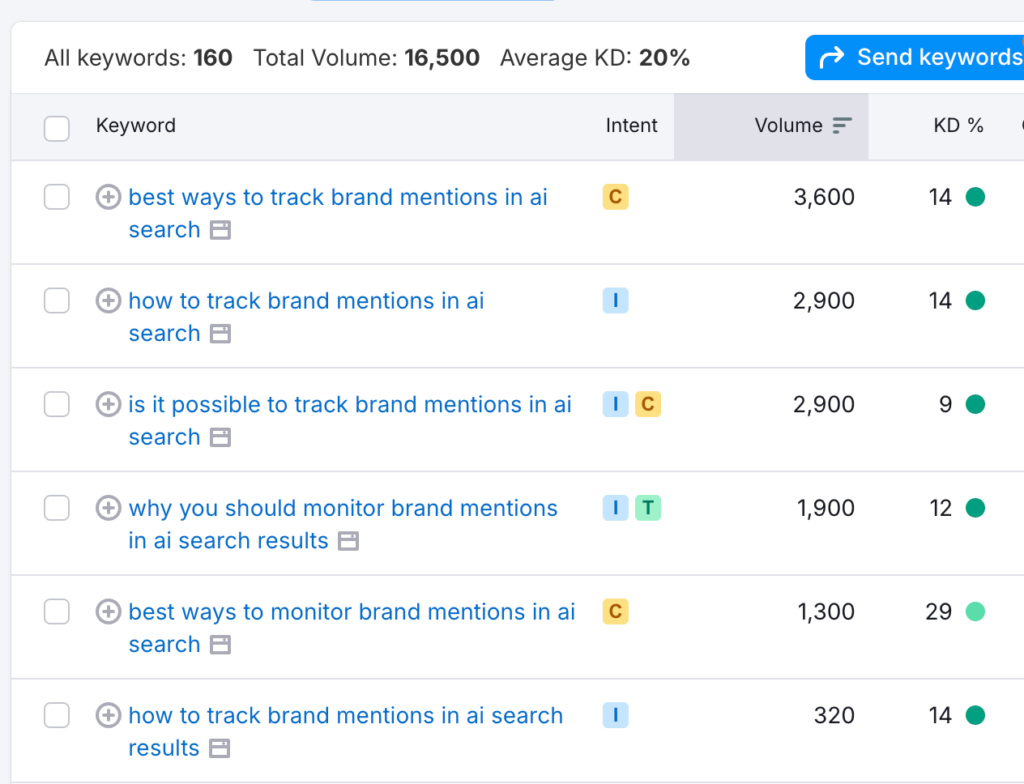
But tracking your brand mentions or appearance in AI search is inaccurate.
Why? The ranking position in AI responses isn’t stable. Studies show that when the same question is asked 100 times, there’s less than a 1% chance the AI returns the same brand list twice.
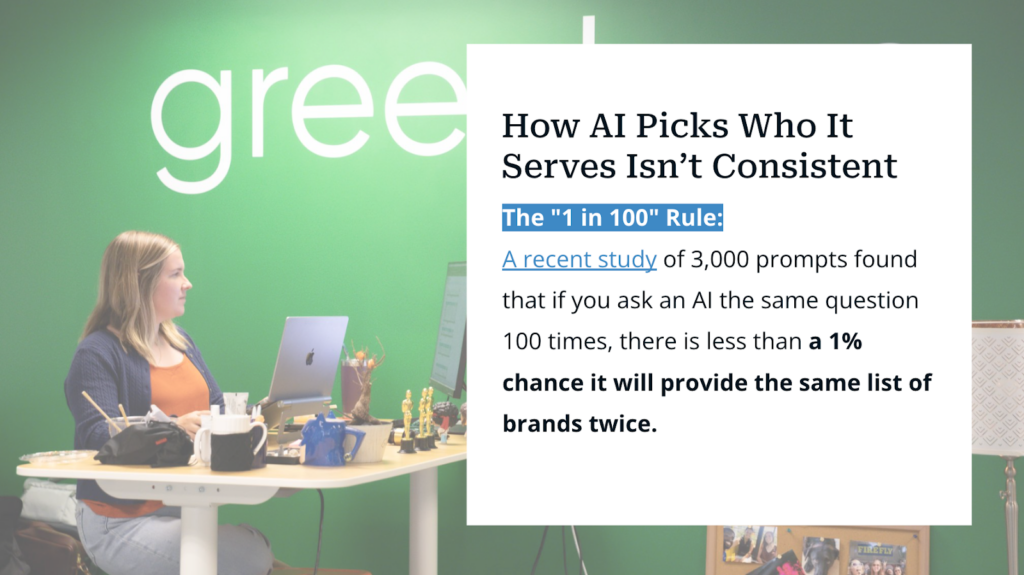
That means “AI position tracking” is largely unreliable, as it isn’t consistent about which sites it favors.
While we’ve been used to blue link positions holding strong for days, weeks, months, depending on the query, these AI answers are different every time you refresh a search — even if it’s the exact same query asked only seconds later. They don’t pick the same stable sources to get these answers either.
So, for one, what we’re tracking is not stable and leads to inaccurate forecasting.
The second headache is that no matter what any tool provider tells you, as of March 2026, there’s no specific way from Google itself to track your site’s “rankings” (or position tracking, as we’re used to reporting on) in AIOs — so we’re relying on third-party solutions. These third-party tool makers are still trying to figure it out, too, and given how inconsistent the AI is in how it serves results in AIOs, the data they report isn’t accurately reflecting your appearance even 5 seconds later. So it’s a massive waste of time.
It’s Time to Invest in “Retrieval” Optimization for AI Visibility
If you’re exhausted by the 2026 obsession with “GEO,” “AEO,” and whatever other acronym the SEO industry is trying to sell you this week, you aren’t alone. While Google’s AI Overviews and answer engines like Perplexity have certainly changed the look of the SERP, the underlying “secret” to ranking hasn’t actually shifted. We’ve been optimizing for Featured Snippets and zero-click searches for a decade; AI is simply the latest iteration of a familiar pattern.
The game hasn’t changed, but the terminology has: it’s no longer just about being “Position #1,” it’s about Retrieval Optimization. If an LLM can’t find, parse, and trust your data, you’re invisible to the AI models synthesizing answers for your customers.
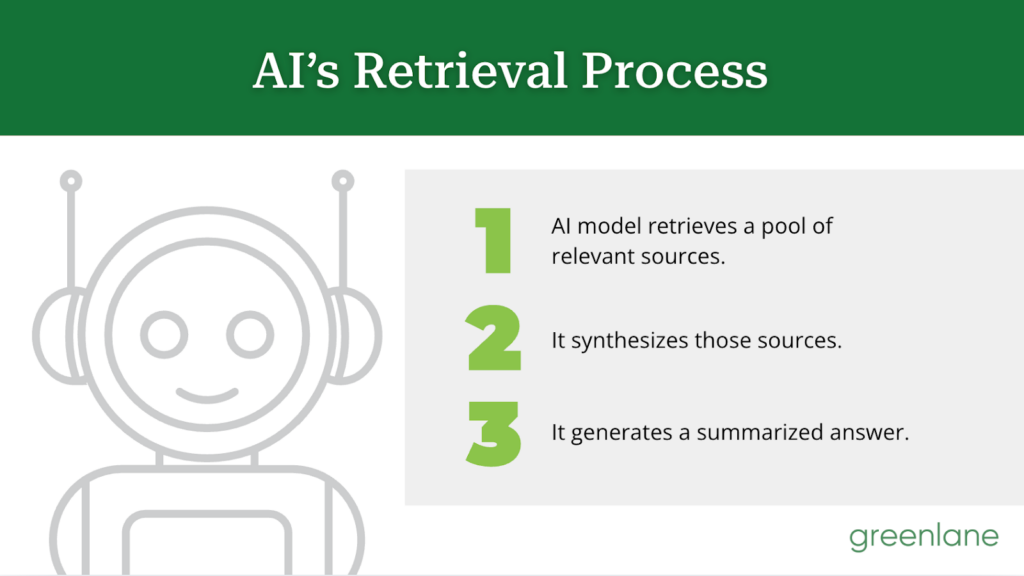
The good news? You don’t need a revolutionary technical overhaul to win in this “new” era. Optimizing for AI retrieval is really just a mandate to double down on the SEO fundamentals that have always worked: rock-solid technical health, clear page structure, and undeniable authority.
By focusing on making your content scannable and highly “retrievable” for AI agents, you aren’t just chasing a fleeting algorithm — you’re positioning your brand to be the primary source that AI tools cite. While AI referral volume might look different from the blue links of old, the traffic it sends converts at a significantly higher rate. It’s time to stop overcomplicating your strategy and start mastering the art of being found. Learn more by checking out my tandem blog on this topic: Improve Your Brand Visibility in Google’s AI Search By Focusing on “Retrieval” Optimization.
The Same SEO, with a Deeper Focus on the Things AI Likes
The hard truth about SEO in 2026 is that “Position #1” is no longer a static trophy you get to keep on your shelf for months at a time. AI-generated results are fluid, inconsistent, and — frankly — a nightmare to track with traditional tools.
But don’t let the lack of a “rank” number to track discourage you. By focusing on Retrieval Optimization, you are playing a bigger game. You’re building a site that is so technically sound, so well-structured, and so rich with original, authoritative data that AI models have no choice but to cite you.
Learn more about how you can stand apart from the AI-generated trash being produced today. If you’re looking for expert help, explore our AI Search Optimization Services.