

If you’ve been wondering how to rank in Google’s new AI Overviews or AI Mode, or how to optimize your website for the latest AI-powered searching changes — hi. So have all our clients! It’s a question our SEO Account Managers have been asked a few times in the last quarter.
Artificial intelligence is changing how users search and how Google presents information. People are looking for answers using platforms like ChatGPT. However, even in Google’s infrastructure, people are using Gemini and AI features to get quicker, more detailed answers beyond traditional search engine results pages (SERPs) as we’ve known them.
But while the surface-level user experience looks different thanks to artificial intelligence search integrations, the core principles of SEO remain the same today.
I wrote this to address the common pain points we’re hearing, share my perspective being in the SEO space for nearly a decade, and give you actionable steps to stay visible on the now AI-diluted SERPs.
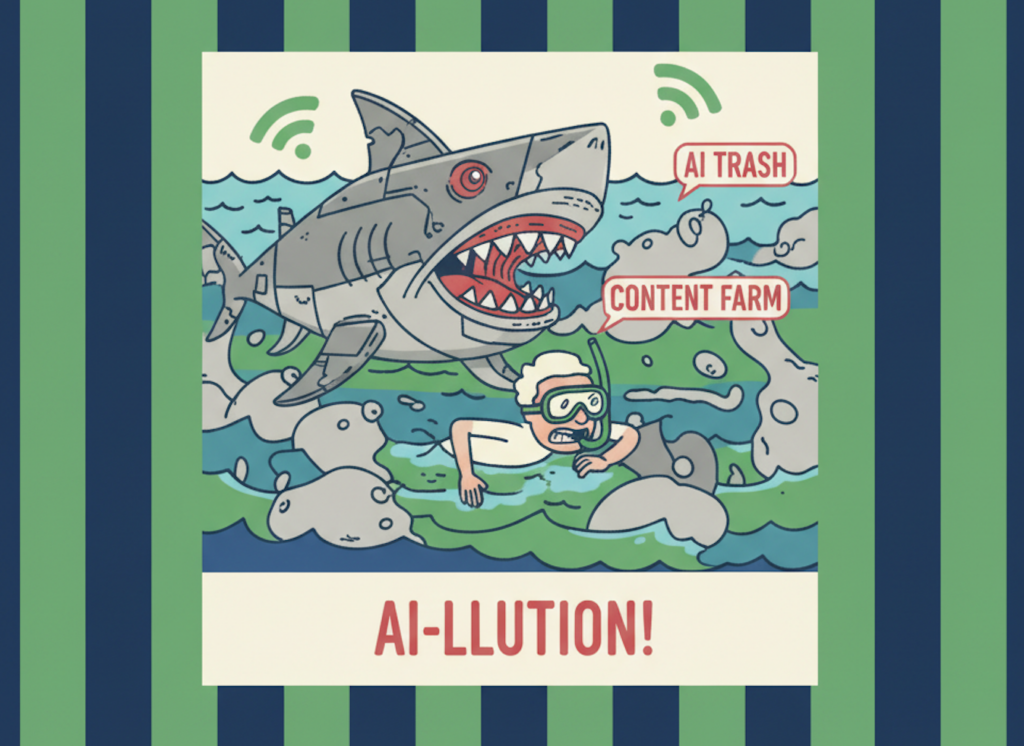
Here are six things you can do in 2026 to play nice with AI on Google, as well as not become just another fish in a big, trashy SERP sea. We’re talking about ways to differentiate your brand from the artificial intelligence pollution — and even still rank in features like AI Overviews, strategically.
1. Diversify Your Content Beyond What AI Can Easily Replicate
If your content strategy only revolves around text-based blogs or service pages, it’s time to expand.
Generative AI is already decent at summarizing written text (as I’m sure you’re well aware of by now) — but it still struggles to recreate authentic, multimedia content made by real people.
Produce Graphics & Video
While AI today can spin words around pretty quickly into a readable passage, images and other visuals still need work. A lot of work.
For instance, you can ask AI like Gemini to produce a graphic for you: specifying brand colors, image size, and purposeful depictions, and it’ll likely give you MAYBE 60% of your original request.
If you can hire a human graphic designer in 2026, you’re making a good business call, in my opinion. They can help solidify consistent brand messaging and create unique visual content that artificial intelligence currently struggles with.
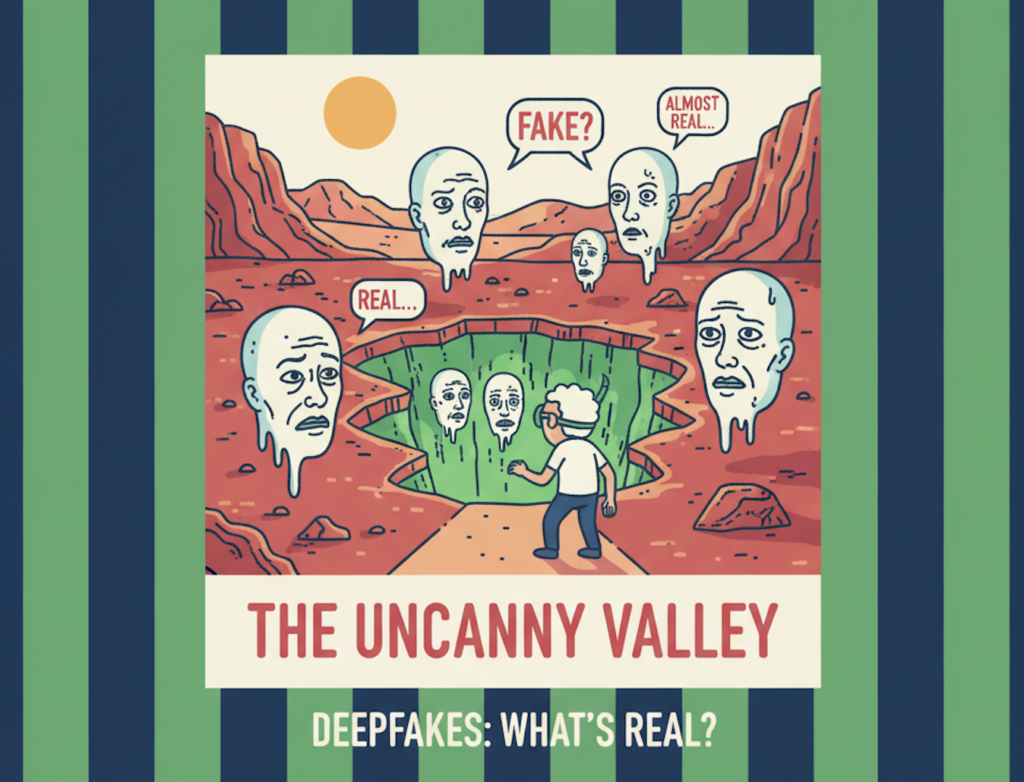
Don’t even get me started on AI producing video for the everyday person/brand. Sure, we’ve had DeepFake technology for years — and some big brands are training AI on large datasets to produce video — but we’re still able to see through the Uncanny valley creepiness in most instances. It’ll be many years until people like you and me can use AI to make decent images.
Case in point:
In 2026, branch out beyond just writing webpages and blogs.
Try incorporating:
- Short-form videos or webinars that demonstrate your expertise, where you actually film people and not just use generic b-roll
- Podcasts or audio snippets that capture your voice and personality
- Visual content like infographics, tutorials, or product demos that add context that AI can’t imitate as easily.
Show the Humans Behind Your Brand
People (and search engines) want to see that there are real humans behind your business, not AI generation. Feature faces whenever possible — your team, happy clients, founders, or recurring brand personalities.

The more human fingerprints your content has, the harder it is for artificial intelligence to flatten your story into something generic.
Check out this video of me (a real person) sharing more tips for diversifying your content strategy in the new year. Devoting some time and resources to making people-focused videos can really give you a leg up over others on search engines like YouTube and beyond.
Strongly consider giving your authors a byline at the top of a page that links off to their author bio, displaying their E-E-A-T signals and full expertise. We even wrote a powerful case study about how adding well-developed author pages helped promote a client’s SERP visibility and clicks!
2. Focus On Bottom-Of-The-Funnel Content That Only You Can Create
AI search can summarize the “what” and “why” behind an industry — but it can’t replicate your proof or your process. That’s where you stand out.
These are the assets that help potential customers decide, not just learn. They demonstrate what makes your solution different, trustworthy, and worth the investment.
Here’s where to focus:
Case Studies & Success Stories
Show measurable outcomes — revenue growth, time saved, conversions improved. Even better, include quotes or short video snippets from real clients talking about their results.
Here are some of our case studies to demonstrate this example:
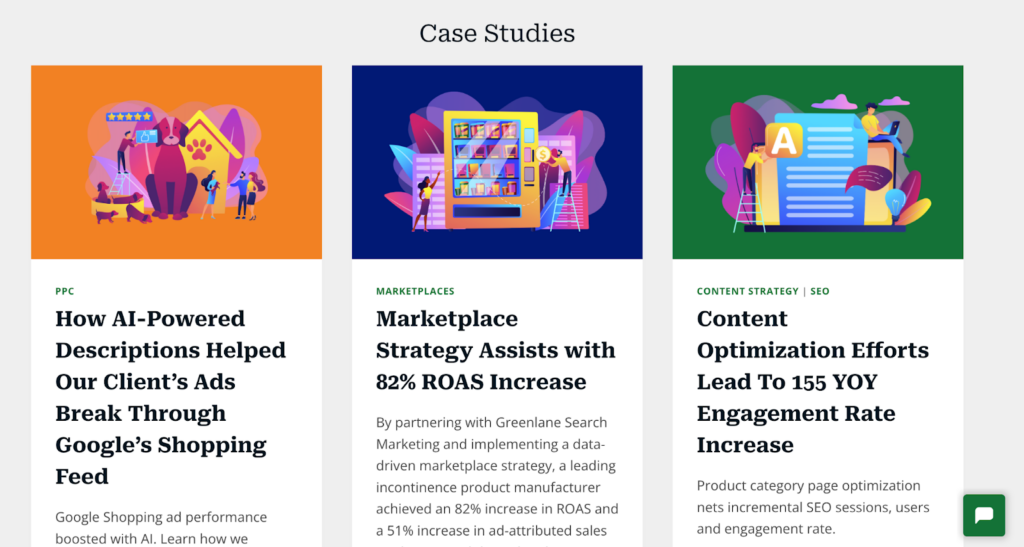
This BOFU content shows the results you or your company produced. You can use AI as a base to help write these, but the data and the impact you made have to be the rocket fuel to launch its creation.
Product or Service Deep Dives
Go beyond the overview page. Create detailed breakdowns of how your product works, who it’s best for, and what sets it apart.
Record video demos or comparison charts that AI can’t easily paraphrase. These clips walking through your platform or service are golden BOFU assets.
Interactive Experiences
Think free tools, ROI calculators, or product selectors. Interactive content not only engages users but also provides data you can use later for personalization or follow-ups. For instance, in our one article, we have a ROAS Target Calculator as an interactive feature.
Testimonials & Social Proof
Aggregate reviews, before-and-after photos, customer videos, or UGC that show real people using your product or service. AI can’t fake authenticity like that.
Pricing & FAQ Pages
Many businesses hide pricing behind contact forms, but transparent pricing pages — even with ranges — build trust and convert curious visitors faster. Combine that with a clear FAQ section that addresses objections, concerns, and hopes. Get these from review sites, common questions your team receives from customers or clients, etc.
Control the Pricing Conversation — Or Lose It
Clients tend to push back on putting their prices for services, in particular, online on their website. I get that this is a challenge for expensive services and we don’t want to deter customers with a scary price tag. However, AI pulls in information from all kinds of sources to try and find a price point… so if you aren’t upfront about your pricing, it’s going to look at Reddit threads and other sources, and you’re going to lose control of the narrative.
We can recognize that it’s not always as easy as saying “this costs $249,” but to say “customizable plans start at $89 and the total cost will depend on features” is better than saying nothing or “call us.” There’s a recent study showing how Pricing and Cost pages were seeing more traffic than ever.
_____
When you strengthen your BOFU library, you’re building the kind of content AI can’t replace — because it’s grounded in your customers’ real experiences and your unique offering.
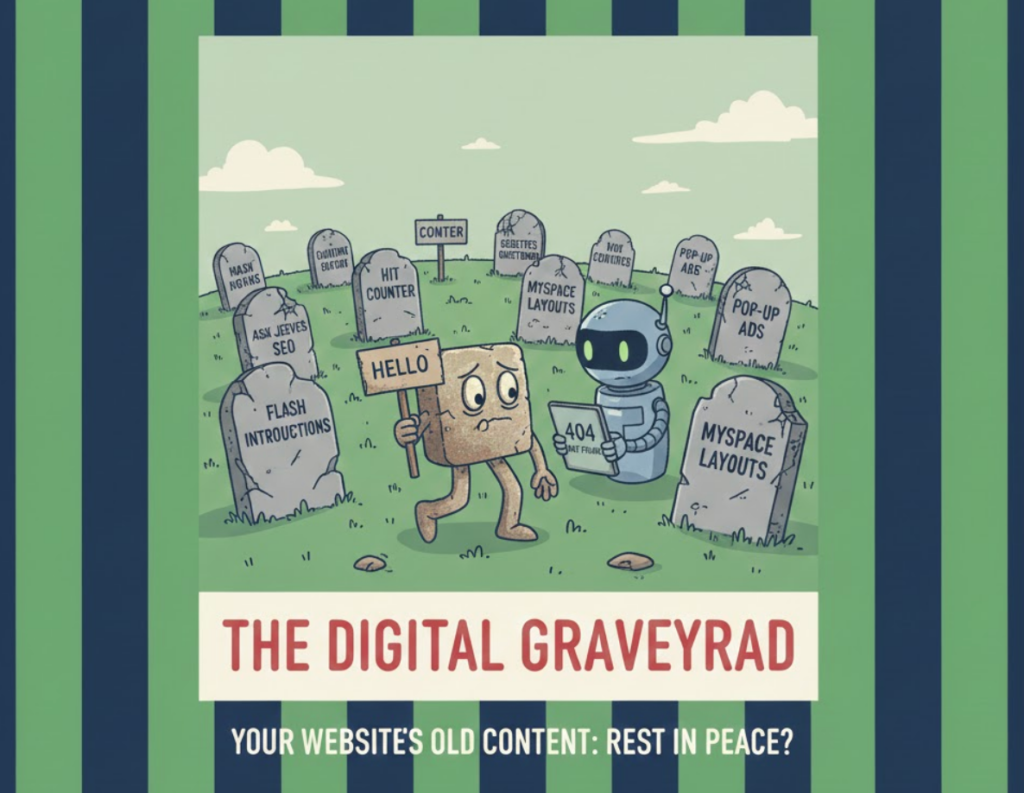
3. Refresh Stagnant Content for Relevance & Freshness
Content older than about two years tends to suffer from the phenomenon of “content decay,” in my experience. While this number varies heavily based on the industry, persona, and type of content, this dip in organic traffic and clicks on “older” published content is often because Google and users can perceive 2+ year old content as old and outdated.
If you’ve got pages that were once solid performers but haven’t been touched in a while, start prioritizing which to revisit.
How To Execute Your Refresh Audit
Refreshing content is more effective when it includes meaningful changes (new data, updated keywords, added sections, new internal links, etc.) rather than just a date tweak.
If your case study still references 2016 data with no new revisions, AI may decrease ranking it as outdated, depending on the industry.
But a refreshed bottom-of-the-funnel (BOFU) page with 2026 data, a recent testimonial video, and an updated offer stands out as current, credible, and conversion-ready. Also, ensuring it reflects your brand values and core brand identity of today.
Because the SERPs are so flooded with AI-produced new content, it often makes more sense to look at what you already have and modernize it. New blogs or pages can still be important (and necessary), but adding brand new pages for the sake of adding them isn’t always the most cost-effective and achievable way to maximize your visibility in AI features and on Google in general.
Start BOFU When Revisiting Content to Update
Identify pages that are BOFU-relevant (service pages, case studies, demo/trial pages, pricing pages). Despite any of the algorithm updates Google’s been making with AIOs to answer top-of-the-funnel or even middle-of-the-funnel questions right at the top of the SERPs, your bottom-of-the-funnel content is something that’s not as easy to answer in a feature.
Updating BOFU content will always be a worthwhile investment for both SEO and just overall business value, and it’s why I recommend my clients start here when reviving outdated content online.
Look for Performance Declines in Content At Least 1 Year Old
Use GA4, Search Console, or other analytics to find pages with declining organic traffic or impressions, declining conversions or bounce rates, and older publish dates (≥ 1-2 years). For each page, ask:
- Is the content still accurate (facts, stats, features)?
- Are we linking out to new supporting content?
- Do we have fresh visuals/testimonials?
- Does the metadata reflect current intent and year-relevance?
- Is this page credited to someone who passes the E-E-A-T sniff test?
After Choosing Your Optimizations, Focus on Impactful Additions
Refresh the pages that have the most need for updating or are attached to your highest ROI services or products:
- Update copy and visuals, add new sections if needed
- Adjust metadata (title, description) to reflect the updated value
- Fix any broken links, update internal links pointing from these pages
- Note “Updated [Month Year]” or redirect and republish if it has no traffic
- Revisit the keyword targeting. Are there new variants to consider? Has the priority of phrases shifted? How aggressive is the targeting of more successful pages from competitor websites?
Make a Note to Loop Back & Analyze Results
Lastly, don’t forget to learn from your success, or adjust where you’re not seeing results. That means giving yourself a reminder to loop back in 3-6 months (note: some studies found full impact often takes 6-10 months) to see performance metrics in traffic, impressions, rankings, and conversions for the updated pages.
4. Strengthen Your Site’s E-E-A-T Signals (Experience, Expertise, Authoritativeness, Trust)
One would argue that in 2025 (and likely leaning hard into 2026), Google was putting extra emphasis on showing you’re an expert in what you talk about online. That’s why they’ve been surfacing “community sentiment” domains high on organic results, such as Reddit and other forum-style sites.
We actually wrote a case study late 2025 about how one client saw increased SERP visibility and clicks on blogs just by updating their author’s bio pages to reflect their latest accreditations, previous employers, past accolades, etc.
While “authority” and “expertise” come in many forms depending on your field, E-E-A-T is not just important in health care or a people-first industry — like Google has talked about emphasizing the importance of in the past.
With changes to the algorithms, we’ve been seeing clear value in ensuring you’re showing off your trust.
You can reinforce your authority by:
- Adding author bios with credentials and experience, and adding a byline to articles or relevant sources
- Publishing original research, data, or thought leadership
- Highlighting certifications, partnerships, and awards
- Building backlinks from reputable sources
- Engaging with and showcasing reviews on Google and external rating websites, as well as forums
- Responsibly using AI-generated content that abides by Google’s stance
Your credibility tells both users and search algorithms that your content deserves to be surfaced — whether by traditional results or AI-generated ones. This point in the blog is not one to skip if you want to improve your rankings.
5. Don’t Forget the Basics of SERP Feature Optimization
It’s tempting to think AI has rewritten the rules, but most of the core SEO fundamentals still apply. AI Overviews, Featured Snippets, and People Also Ask boxes are still built on clear, relevant, and well-structured information.
AI isn’t replacing SEO — it’s rewarding brands that already follow best practices like clarity, structure, and topical depth.
Optimize For “Answerable” Content & Clear Structure
One of the easiest ways to improve visibility in both AI Overviews and traditional SERP features is to make your content more “answerable.” That means formatting it so search engines can easily identify and pull concise, helpful information.
Here’s how:
- Use question-based headers (H2s) that mirror search intent (“What is…”, “How to…”, “Why does…”)
- Include short, direct answers immediately below those headers — ideally 1–3 sentences long
- Add lists, bullets, and tables where possible (Google loves data in easy-to-read formats)
- Wrap up each section with a short takeaway or call-to-action to keep users moving deeper into your content
For example, a section titled “What is Schema Markup?” followed by a quick answer (in 2-3 sentences max) and a tight bulleted list of types could help your page qualify for both Featured Snippets and AI Overview citations.
Good format and structure help humans skim — and it helps search engines (and AI) understand and promote your content. That’s because LLMs use tokenization. By organizing text in a way that’s easy for the tech to process, you’re giving yourself a leg up. Plus, it’s a helpful practice that humans also like. Don’t make anyone’s eyes glaze over with large, clunky blocks of text.
6. Improve Crawl Efficiency & Technical Health For AI-Readiness
AI-driven search is built on structured data, clean site architecture, and accurate crawling. If your site is difficult for Google to understand, it’s even harder for AI to interpret it correctly.
Make sure your site’s technical foundation supports the new search environment by:
- Reviewing your schema markup (especially for products, FAQs, and reviews)
- Fixing crawl errors and removing outdated redirects
- Ensuring your sitemap is updated and accurate
- Prioritizing fast load times and mobile performance
- Using HTML and server-side rendering instead of JavaScript for key page elements
Think of this as the hygiene step: before you optimize for AI, make sure your website is communicating clearly with Google’s systems in the first place.
The Truth: AI Isn’t Reinventing the SEO Wheel
There’s a lot of noise right now about AI “changing everything,” but the reality is — good SEO has always been about adapting.
The fundamentals that helped brands rank ten years ago — relevance, authority, technical health, and audience-first content — are still what drive visibility today. What’s changed is the presentation layer: AI is summarizing more information, surfacing new SERP features, and reshuffling how users find what they need.
But underneath all of that, the same signals still matter.
There’s no secret hack, no shortcut to “rank in AI Overviews.” The best path forward is the same one that’s always worked:
- Create genuinely useful content for your audience
- Make it unmistakably human and demonstrably trustworthy, using AI for ideation but not the full author
- Update what’s outdated
- Follow the standard rules for optimization for SERP Features
- Diversify your formats (text, video, audio) and where you’re posting
- Keep your site technically clean and crawlable
The difference now is that those who execute these basics really well — and add a layer of creativity and authenticity — will rise above the noise in an AI-diluted search landscape.
Stay Ahead Organically in the Era of AI-Fueled Search
AI is changing how information appears in search, but it’s not rewriting what works. Staying competitive means leaning into what makes your brand human, staying technically sharp, and keeping your SEO playbook strong.
At Greenlane, we’re helping businesses adapt to this AI-powered shift — ensuring your brand stands out, no matter how the SERP evolves.
Let’s make sure your content doesn’t get lost in the noise, and that you’re adapting strategically to the AI search landscape.
Explore our AI Optimization Services to see how our senior experts can help you stay visible where it matters most.
Share This: