

We are currently living through the “Landfill of Content” era. AI tools can now churn out thousands of pieces of content for thousands of brands in the time it takes to eat lunch. Unfortunately, “good” content has become a commodity. Studies show most brands could disappear tomorrow without consumers caring. What is rare right now is companies writing content with meaning.
With the rise of ChatGPT, many marketing directors are asking: Does Google penalize AI content? The answer is nuanced, but one thing is clear: if brands want to survive the current content saturation, they need to stop focusing on creating SEO filler and start focusing on purpose.
The difference between content that just informs versus content that impacts an audience and leads to loyal customers is simple.
It starts with mission-driven marketing.
What is Mission Driven Marketing? (The Ultimate Brand Differentiation Strategy)
Mission-driven marketing is the layer above the product or service you sell. True brand differentiation isn’t just about a new logo. It communicates why your company exists, who it serves beyond the transaction, and the difference you are trying to make. It turns passive consumers into active participants in a story.
“Mission-based marketing centers around a higher purpose, showcasing your values, social responsibility, and how you contribute to the greater good.”
Moving toward mission-driven content isn’t gimmicky marketing. If you’re an authentic mission-driven organization, you’re sitting on a content strategy with significant SEO potential.
You can only write so many blog posts about how to use your product or service. But when you position your content around a mission, you unlock four competitive advantages that generic competitors can’t touch.
Solving Content Fatigue: Developing a Content Strategy That Lasts
When developing a content strategy, most brands hit a wall. They struggle to find trending topics for their blog after exhausting their product feature list. A mission creates an infinite content wheel. Because a mission is based on a belief system rather than a feature set, it allows you to launch multiple content pillars that are independent of what you sell but highly relevant to your audience.
For example, if you sell coffee, a product-focused content strategy limits you to “roasts” and “brewing.” A mission-focused strategy could be on “fueling creativity.” From here, you can write content on productivity, morning routines, workspace design, and creative wellness, while still positioning your coffee as an essential in these topics. Just from this switch alone, you go from having hundreds of potential keywords to thousands.
The Semantic SEO Advantage: Building a Topic Cluster Strategy
Google no longer just looks for keywords; it looks for Topical Authority. Google wants to see that you understand a topic holistically, not just that you mentioned a phrase a few times. A mission-driven approach is the foundation of a successful topic cluster strategy.
Since all these diverse topics stem from the same core belief, they naturally link to one another. This internal linking structure tells Google you’re an expert on this entire ecosystem of ideas. This creates a semantic web of relevance that is difficult for competitors to replicate with AI-generated content.
E-E-A-T
When you position your content around a higher mission, you lean into creating things that are genuinely helpful and authoritative. This directly feeds into Google’s E-E-A-T (Experience, Expertise, Authoritativeness, and Trustworthiness) guidelines. Google rewards depth because it signals that you are credible and taking ownership of your industry rather than acting like another typical surface-level vendor.
Branded Search & Backlinks
A strong mission powers backlinks and branded mentions. If you are doing things that better your community, ideal consumers, and industry, sites will want to talk about it and link to it. This will also lead users to type your brand name in search, which helps with non-branded phrases. When users type broad commercial keywords, Google is more likely to favor the brand that is most recognized.
How to Differentiate a Brand in a Crowded Market: The RIBS Framework
I realize that while we all want a mission, it’s hard to know if you actually have a strong mission to build content from. So, I made an acronym to help us stress-test our brand mission.
To see if your brand is truly ready for mission-driven marketing, you need to see if it passes the RIBS test. Here’s a framework for testing if your brand actually has one.
R is for Revolutionary
Revolutionary means you’re not just selling your product, but you’re selling a belief system. It redefines what is possible or “right” in your category and challenges the world’s assumptions about your space.
From an SEO perspective, this anchors your content around helpful, thoughtful information rather than just transactions.
When your content system flows from belief, not product, you create infinite topic potential. You gain authority in Google’s eyes because real expertise is rooted in a strong point of view.

Look at Warby Parker’s mission. They believe everyone should have access to clearer vision. That is a revolutionary stance on a medical necessity. Ultimately, they believe in “vision for all,” and they execute that belief through content just as much as they do through commerce.
They write their mission on their website and in external media sources. It’s consistent, and even Google’s AI Overviews can find it.

Once your mission is revolutionary, the next step is ensuring it’s independent of your product so it can live anywhere your belief applies.
I is for Independent
Your mission should stand without your product. A true mission exists even if your product disappeared tomorrow because it connects to human desires, not just SKUs.
This independence lets your brand join broad cultural conversations rather than get stuck in narrow product ones. This is why you can have endless content topics to write about.
Even without selling a single pair of glasses, Warby Parker’s belief in “vision for all” could power an entire media company focused on education, accessibility, and philanthropy. The mission lives on its own.
Because of this foundational belief system, Warby Parker is able to create over 200 diverse pieces of blog content.
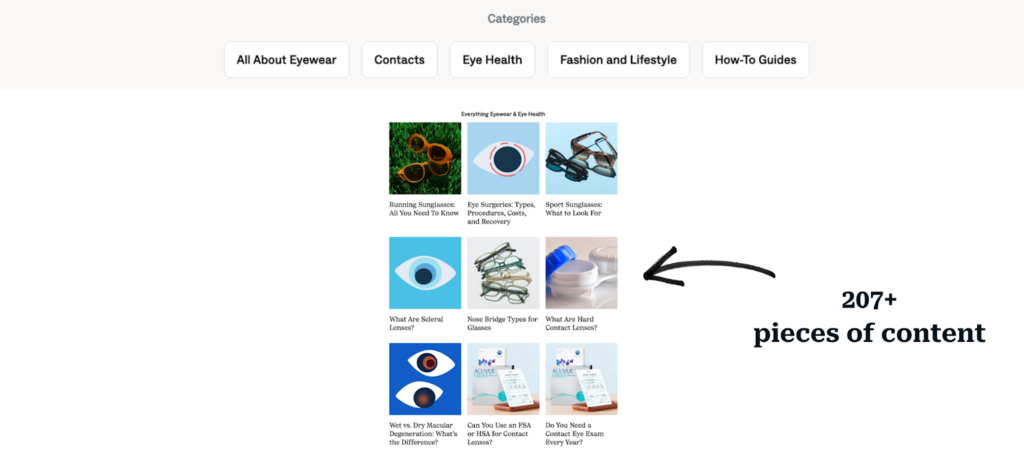
They don’t just write about “buying glasses.” They write about eye health, fashion and how-to guides, and their initiatives to make vision care accessible to people who can’t afford it. A single, strong mission enables endless content clusters that don’t need to be tied directly to a product feature.
B is for Bigger
When your mission is bigger than your product, you stop talking to customers and start talking to people. That is when content starts to travel.
You move beyond the features list and tap into emotions, aspirations, and culture. You stop selling things and start sharing feelings.
For Warby Parker, they aren’t just selling eyewear; they are helping people see possibilities. This allows their blog content to range from serious eye health to the joy of self-expression, without ever feeling off-brand.
S is for Service
Finally, your mission should serve before it sells.
Great missions produce helpful content, not promotional content. When you serve first, trust and authority follow. Google rewards brands that make users’ lives easier. Service means your mission shows up through content that genuinely helps people, even if they never buy.
This is the ultimate SEO hack: When your audience feels helped, Google sees it too. Longer engagement, organic backlinks, and branded searches are all proof to the algorithm that your mission matters.
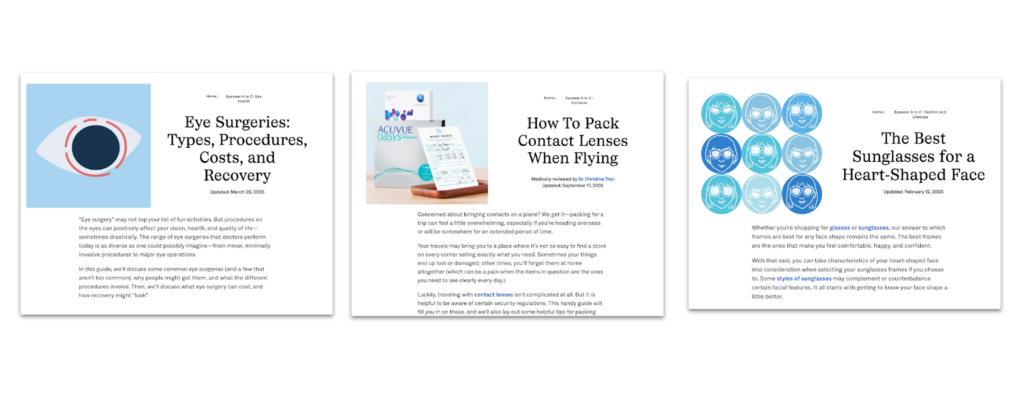
Look at different blog examples that Warby Parker is creating and think through how well they serve the audience they’re writing for.
The Reality Check: Why Brands Fail at This
If this is so effective, why doesn’t everyone do it?
Well, it’s hard. In our experience working with various clients, very few brands have done the homework necessary to truly understand who they are and why they are doing what they do.
Many brands fall into common traps that dilute their mission:
- Confusing Visuals with Mission: Many companies think a rebranding exercise (new logo, new design guidelines) equates to a new mission. They lack the core editorial value system that should drive those visuals.
- The Bureaucracy of Boring: As companies scale or get acquired, their missions often get hijacked. Beautiful concepts turn into generic copy after five different departments and legal teams review them.
- The Leadership Burden: A mission requires constant reinforcement. As a marketing lead for your company, your job is to hold the vision, which sometimes means being boringly repetitive about the same values over and over again to keep the team aligned as tactics change, but it’s essential not to overlook this.
The temptation right now is to use AI to speed up content production. But if you speed up the production of noise, you just get ignored faster.
Mission-driven content requires doing the hard homework upfront. But once you define that belief system, everything else you do becomes easier, more cohesive, and vastly more effective.
Drive Revenue Through Mission-Driven SEO
Let’s be clear: Mission-driven content isn’t just about brand sentiment. It is a high-performance SEO strategy designed to dominate search results.
By anchoring your content in a true mission, you create the semantic depth Google craves and the user engagement signals that drive rankings. The result? More organic traffic, stronger domain authority, and higher conversion rates.
But bridging the gap between “brand mission” and “search performance” requires a strategic partner.
At Greenlane, we help brands translate their purpose into positioning. We don’t just write stories; we build SEO frameworks that drive measurable results and revenue.
Stop competing on volume. Start winning on value. Contact us, today.
Share This: