
Your monthly breakdown of the biggest news in search.
Welcome back to the Greenlane Index, our monthly recap of the biggest stories in SEO and search. If Google’s results page feels mostly AI these days, September’s data backs you up. AI Overviews now show up on nearly four in ten US desktop searches, People Also Ask is almost entirely AI-written, and even business listings now open with an AI summary.
It wasn’t all about Google’s AI ambitions, though. A spam update started rolling out, ChatGPT turned out to be quietly building its own search index, and Search Console picked up new reporting for image-based search. We also got fresh click-through data, a change to how Google’s result links work, and a test that brings AI summaries to Discover.
As always, we’ve grouped everything by impact level so you can focus on what matters most for your business. Let’s get into it.
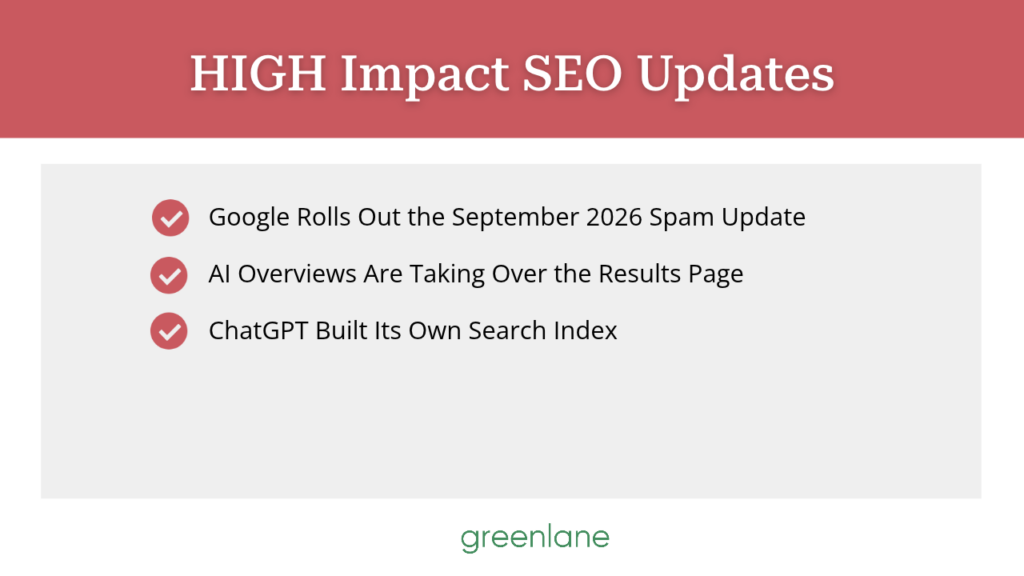
Google Rolls Out the September 2026 Spam Update
Google started rolling out its September 2026 spam update on September 24 and said it could take up to two weeks to finish. It applies globally and to all languages, and it was still rolling out when we wrote this.
Spam updates go after sites that break Google’s spam policies: scaled low-quality content, link schemes, expired domain abuse, site reputation abuse, and similar tactics. If you play it straight, this one should mostly pass you by. If you’ve seen a sharp ranking or traffic drop starting in late September, check whether the timing lines up with the rollout before changing anything. Wait until the update finishes, then compare performance before and after. And if you’ve been buying links or publishing thin content at scale, this is a good moment to be honest with yourself about the risk.
AI Overviews Are Taking Over the Results Page
Several stories, one theme. Comscore’s Q2 2026 AI Intelligence Report found AI Overviews appeared on 39.4% of US desktop searches in June, up from 25.8% a year earlier. Google also started expanding some AI Overviews to full length automatically, so searchers no longer have to click “Show more,” and organic results get pushed further down the page. AlsoAsked found that 97% of People Also Ask answers were AI-generated in early September, compared to about 12% fourteen months ago. And Google is now putting an AI Overview at the top of local knowledge panels, the Google Business Profile listing that appears when someone searches for a business.
That last one stings. Your business profile is supposed to be where you control how you’re described. Now Google summarizes you first, possibly using outdated pages from your own site.
What to do: keep your Business Profile complete and current, and audit your site for stale details about hours, services, and locations, because that’s what the AI is reading. On the organic side, expect lower click-through rates on informational queries even if rankings hold, and track visibility in AI Overviews as its own metric instead of judging success by clicks alone.
Read more on Search Engine Land: Comscore’s AI Overviews data
Read more on Search Engine Land: AI Overviews expanding automatically
Read more on Search Engine Roundtable: People Also Ask goes AI
Read more on Search Engine Roundtable: AI Overviews in local knowledge panels
ChatGPT Built Its Own Search Index
For a long time, the working assumption was that ChatGPT search was basically Bing with a nicer interface. That assumption is out of date. Research from Peec AI found that OpenAI runs its own retrieval index, called Labrador, with 12 vertical categories including shopping, local, news, YouTube, and PDFs. Testimony from Google’s antitrust trial showed OpenAI started building it in 2023, and Peec found live tests that favor the in-house index over search engine results in 8% to 20% of shopping chats. ChatGPT also pulls from at least eight sources, including its own crawler, third-party data providers, Yelp, and TripAdvisor.
Ranking well in Bing no longer guarantees you’ll show up in ChatGPT. Make sure OpenAI’s crawlers can reach your site (check robots.txt and any firewall or CDN bot rules), and know that ChatGPT often serves cached copies of pages, so updates can take a while to show up. Also, your Yelp and TripAdvisor listings now matter well beyond Yelp and TripAdvisor.
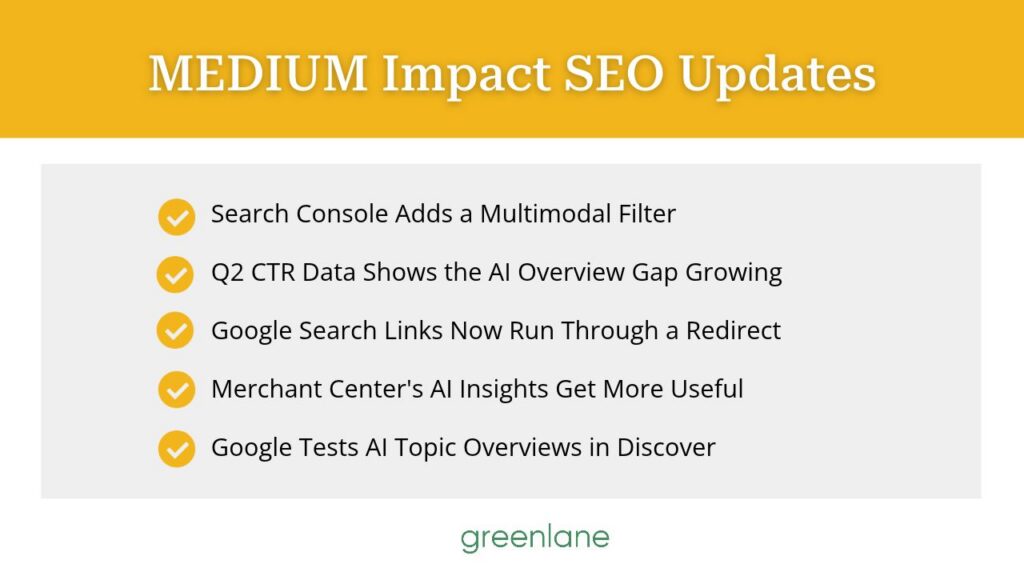
Search Console Adds a Multimodal Filter
Google added a multimodal filter to the Search Console performance report. It separates traffic from image-based searches (Google Lens, Circle to Search on Android, image uploads to Google Search, and Chrome’s “Search this image” option) from standard text searches. You get impressions and clicks for pages that showed up in those results. You don’t get queries, since people searched with a photo instead of words.
Worth knowing before your next report: some sites saw web impressions dip when the filter launched, as this traffic was split out. If you see a drop in late September, check the multimodal view before assuming the worst. If you sell products people photograph, like apparel, home goods, or auto parts, this report is worth checking monthly. Clear product images, descriptive file names, and good alt text all help here.
Q2 CTR Data Shows the AI Overview Gap Growing
Advanced Web Ranking’s Q2 2026 report found desktop click-through rate for positions one and two fell a combined 5.27%, while mobile rose 6.59%. The more telling number: on US desktop, positions one and two earned a combined 29.05% CTR on results pages without an AI Overview, versus 10.04% on pages with one. That 19% gap grew by 6% from Q1.
Take the quarter-over-quarter swing with a grain of salt. Most Q1 data fell inside the window of Google’s Search Console impression logging error, which was fixed in April, and most Q2 data came after it. CTR depends on impressions, so some of that swing is likely measurement, not behavior. The AI Overview gap is the more reliable signal, and it lines up with everything else this month. If you report on CTR, separate queries that trigger AI Overviews from those that don’t.
Google Search Links Now Run Through a Redirect
This one started in late August, but it’s worth flagging. Google began routing search result clicks through a google.com/goto redirect instead of linking straight to the destination site. Hover over a result in a logged-out or incognito window and you’ll see a Google address, not yours. Nozzle data showed the change reached nearly 100% rollout. Google framed it as protection against abuse, and it lines up with Google’s lawsuit against SerpApi over scraping.
For most people, this doesn’t change how visitors arrive. But it can confuse anyone checking rankings by hand (“why don’t I see our URL?”), and it may cause problems for rank tracking tools that rely on reading result links. If your ranking data looked odd in late August or September, ask your tool provider whether they’ve adjusted. It’s also worth a quick check that organic search traffic is still being attributed correctly in your analytics.
Merchant Center’s AI Insights Get More Useful
Google expanded the AI Performance Insights report in Merchant Center, which launched in July, with three new sections: AI search intent, AI search terms, and AI attributes. The intent section shows how your products match what shoppers ask in AI search. The other two recommend search terms to add to product descriptions and missing product attributes that could improve visibility in Google’s AI features.
This is a rare case where Google tells you directly what they think they want. Most AI visibility work involves inference and some guesswork. Here, you get a list. If you sell through Merchant Center, start with reviewing the attribute recommendations, since filling in missing product data is usually quick and tends to help across Google’s shopping surfaces. Use more judgment with the search term suggestions. Keyword-stuffed product descriptions read poorly to people, too.
Google Tests AI Topic Overviews in Discover
Google is testing a “Dive deeper” button on Discover cards. Tap it and you get a short AI-generated topic overview with links to related stories, community reactions, and original reporting. Robby Stein, Google’s VP of Product for Search, announced the test on X and said it starts with videos, with multiple designs to follow in the coming weeks.
If Discover sends you traffic, this one is worth watching. On paper, it gives more publishers a chance to be linked. In practice, the button sits on someone else’s card and leads to a Google page, not a publisher’s. You also won’t be able to measure it cleanly, because Search Console groups all generative AI features in Discover together with no breakdown for this one. For now, watch your Discover clicks and impressions over the next few months, and keep investing in original reporting, since that’s one of the link types Google says the overview highlights.
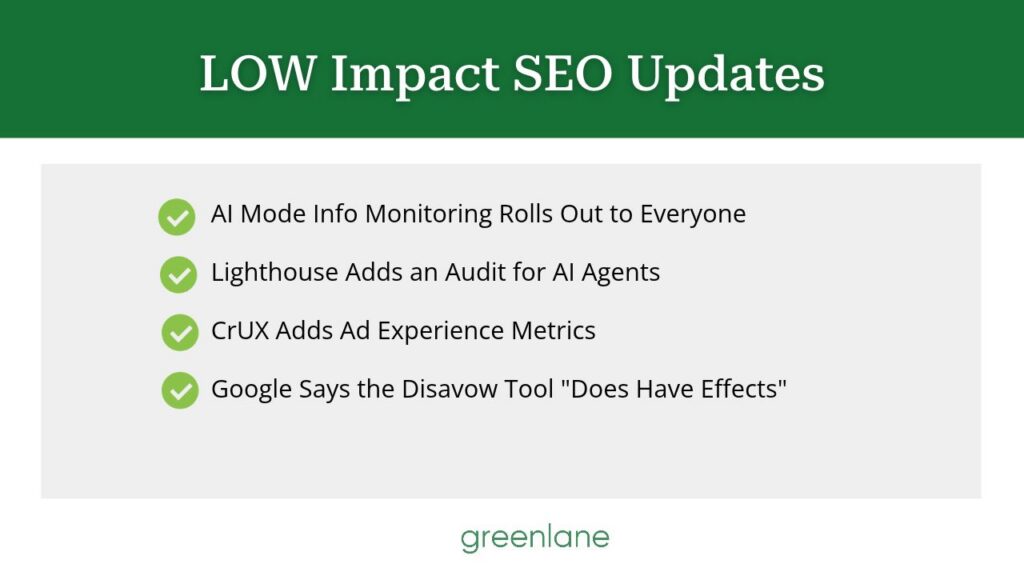
AI Mode Info Monitoring Rolls Out to Everyone
Info Monitoring, previously limited to Google’s paid AI Pro and Ultra plans, is rolling out to all users globally. You tell AI Mode what to watch, like weekend pop-up events in your city or a price drop on a product, and Google keeps checking websites, forums, social posts, and its Shopping Graph, then lets you know when something changes.
It’s a small feature with a big idea behind it: searches that keep running without anyone typing them. The early use cases are local and shopping. That means fresh, accurate information on your site, your Business Profile, and your product feeds matter more when Google is checking for changes on someone’s behalf. Price changes, new inventory, and events should show up quickly in places Google can read them.
Lighthouse Adds an Audit for AI Agents
Lighthouse added an experimental audit for Agentic Resource Discovery, a proposed standard that helps AI agents find a company’s tools and services through a catalog file on its site. It sits in Lighthouse’s experimental Agentic Browsing category next to the existing llms.txt check, and it’s expected to show up in Chrome DevTools and PageSpeed Insights shortly.
Don’t drop everything for this. It’s a proposed spec, it’s experimental, and it has no direct tie to Google Search. It’s still a useful signal about where Google’s developer tools are heading: toward a web where AI agents, not just people, visit your site and try to get things done. File it under “watch,” not “do.”
CrUX Adds Ad Experience Metrics
Google added four experimental metrics to the Chrome User Experience Report (CrUX) that measure how on page display ads affect real visitors: ad count, ad density, and how much CPU and network load ad scripts add. The data comes from real Chrome users and is available now through the CrUX API and Chrome DevTools.
There’s no hard indication these feed into rankings, but if your site runs display ads, this is free, real-world data on whether those ads are slowing pages down or crowding out content. Both hurt the experience for visitors, which is reason enough to look. If your Core Web Vitals scores have been stubborn, ad weight is a good place to start.
Google Says the Disavow Tool “Does Have Effects”
Google’s John Mueller confirmed on Reddit that the disavow tool “does have effects,” responding to someone who accidentally disavowed good backlinks and then saw rankings drop. He added that disavowing a handful of links won’t make a site drop out of search, and suggested checking the disavow file first, then looking at other causes like spam updates or technical issues.
The takeaway hasn’t changed in years: most sites don’t need the disavow tool. It’s meant for cleaning up links that you or a past vendor built in clear violation of Google’s policies, not for every spammy domain that shows up in a backlink report. If someone else has managed your SEO in the past, check whether a disavow file exists in Search Console and what’s in it. You might be surprised.
That’s the Wrap for September 2026
September made the direction of search hard to ignore. AI Overviews now cover more of the results page, more of People Also Ask, and even business listings. ChatGPT is building its own index instead of borrowing someone else’s. And Google keeps adding ways for AI to answer, monitor, and summarize on a searcher’s behalf.
None of this means SEO stopped working. It means the job got wider. Rankings still matter, but so do accurate business listings, clean product data, pages that every major crawler can reach, and visibility you can measure beyond clicks. The basics haven’t gone anywhere. There are just more places they need to show up.
Have questions about how any of this affects your business? We’re always happy to talk it through. Reach out to the Greenlane team.
Share This: