

Why Ranking #1 Doesn’t Guarantee Visibility Anymore
For years, SEO had a simple goal: rank #1.
If you owned the top spot for competitive keywords in Google, you captured massive traffic. Get the high ranking, get the click, get the exposure. End of story.
Throughout the years, fewer people clicked on the second page of search results. Then, soon, fewer people even scrolled down on page one. A top position was the only thing that mattered to SEOs, virtually guaranteeing visibility, authority, and usually revenue (as long as your copy matched the intent of the search query).
But the SEO world changed quickly.
Today, ranking #1 does not guarantee that people will actually see your brand. Search results are no longer just a list of blue links. Google’s Search Engine Results Page (SERP) is highly dynamic, making the results page a crowded interface with features competing for attention. Paid ads, AI Overviews, videos, shopping results, maps, featured snippets, and “People Also Ask” boxes often appear before the first organic result.
In many cases, the traditional #1 ranking is pushed far down the page. Even when you technically hold the top position, users may never scroll far enough to see it. This is why rankings alone are becoming a misleading metric for success.
The Rise of AI Answers

The most recent shift is the biggest. That is, of course, AI-generated answers in the form of AI Overviews. As of July 2025, AI Overviews had over 2 billion monthly users across more than 200 countries. It’s only grown since.
Google’s AI Overviews and similar tools are designed to answer questions directly on the results page. Instead of sending users to websites (and earning you a click), the search engine summarizes information from multiple sources and presents it immediately.
Your page might rank first for a query, but if the AI answer appears above it and satisfies the user’s question, the user may never click through to your site.
In other words, the search engine becomes the destination rather than a pathway.
The demand for information still exists. But much of the traffic that used to flow to websites is now being absorbed by the results page itself.
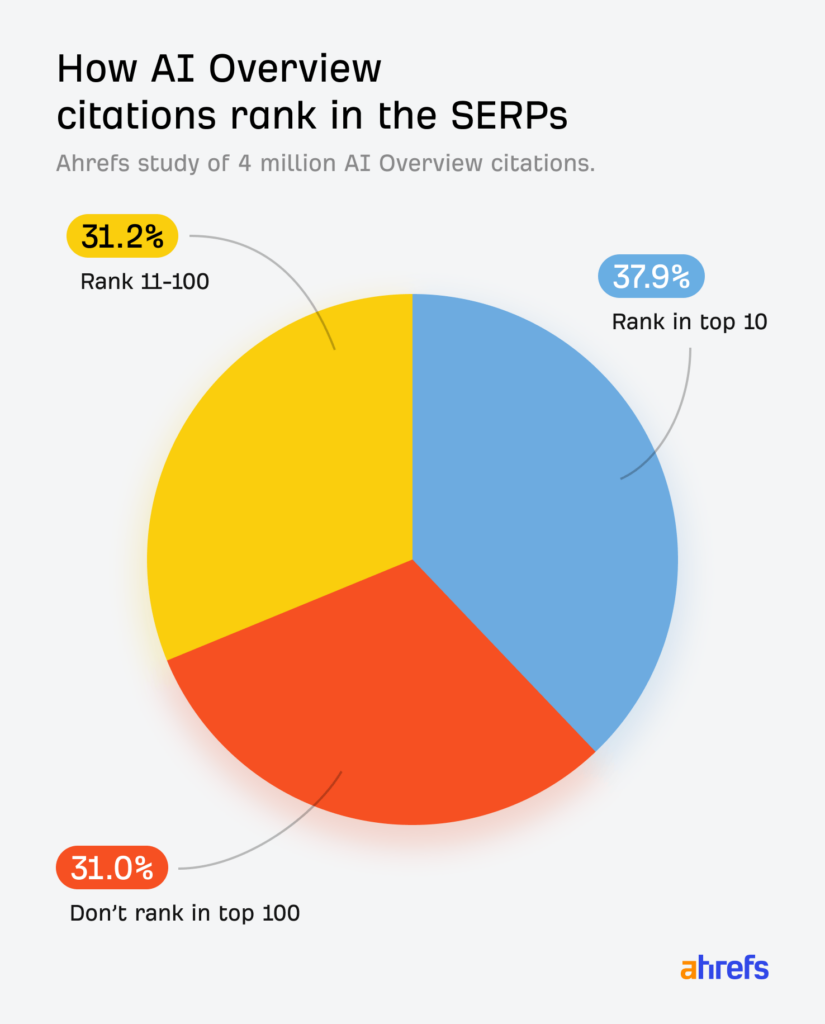
A recent study by ahrefs.com found that only 38% of AI Overview Citations pull from the first page of Google results. ~32% could be on deeper pages. 31% don’t rank in the top 100 at all.
The SERP Is Now a Multi-Channel Environment
Another reason rankings matter less is the sheer number of competing elements on the search page. A typical results page might include:
- AI-generated answers
- Featured snippets
- Videos
- News results
- Shopping results
- Local packs
- Knowledge panels
- People Also Ask boxes
Each of these features takes up screen space and user attention. The result is a fragmented environment where the traditional organic listings represent only one part of the experience.
Owning a blue link is no longer the same as owning the page.
Visibility vs. Position
Because of these changes, SEO success needs to be measured differently. Ranking position tells you where your link sits in a list. But visibility tells you how often users actually encounter your brand across the entire search experience.
Those two things are no longer the same.
A brand that appears in AI answers, video results, featured snippets, and organic listings may dominate attention even without holding the #1 traditional ranking.
Meanwhile, another brand might technically rank first but remain largely unseen because the results page is crowded with other features.
The difference between ranking and visibility is now one of the most important shifts in modern search.
The Rise of Citation-Driven Search
AI systems also evaluate brands differently from traditional search engines.
Instead of simply ranking pages by relevance and links, using the traditional models Google is known for, AI models often assemble answers by pulling information from multiple trusted sources. This means brands now compete to be cited as sources in AI-generated responses.
Being included in those citations can be valuable, but it introduces another layer of competition.
If an AI response mentions ten different companies, each brand technically gains visibility. But that visibility may be weak. Users rarely remember long lists of brands inside large paragraphs.
The real advantage occurs when your brand becomes the primary example or the trusted source associated with the answer.
In this new environment, eligibility is not the same as preference.
Authority and Brand Signals Matter More
Because AI systems aggregate information, they tend to favor brands that show strong authority signals across the web.
AI models are trained on massive datasets. If 500 reputable sites (like news outlets, industry journals, and high-authority blogs) all say that Brand A is the best provider of solar panels, the AI views that as a “fact.” Because the AI’s goal is to be helpful and accurate, it will favor (aggregate) the brand that the rest of the web already agrees is the leader.
That means you need:
- Consistent brand mentions
- High-quality content
- Expert authorship
- Clear topical focus
- Reputation signals across multiple platforms
The stronger your brand’s presence across the internet, the more likely AI systems are to treat you as a reliable source.
In other words, SEO is expanding beyond page-level optimization. Search visibility now depends heavily on broader brand authority.
SEO Is Becoming a Visibility System
These shifts are forcing a change in how SEO should be approached.
The goal is no longer just ranking individual pages. The goal is to design a system that makes your brand visible wherever search engines and AI systems look for answers.
That means thinking about:
- How clearly search engines understand your brand
- Whether AI systems consider you a credible source
- Where your brand appears across the entire results page
- How often users encounter your name during research
This is why I believe SEO is evolving from a ranking discipline into a visibility discipline.
What This Means for Businesses
For marketing leaders, this shift has a clear implication. Ranking reports alone no longer tell the full story. They still have their place, but it’s a more limited role in terms of your complete visibility.
A company can technically rank well while losing share of attention on the search results page. At the same time, another brand might capture more awareness by appearing across multiple search features and AI answers.
The companies that win in modern SEO will focus less on individual rankings and more on overall presence.
They will build authority, create strong content ecosystems, and ensure their brand appears wherever search engines and AI systems assemble information.
Because in the new search environment, the real question is no longer: “How do we rank?”
The real question is: “Are we visible where decisions are being made?” This is the question we help our clients with every day.