Greenlane Index: April 2026
Welcome back to the Greenlane Index, our monthly recap of the biggest stories in SEO and search. If March was about big swings (a core update kicking off, AI features showing up everywhere), April was about the dust settling and a few important details coming into focus.
We saw the March Core Update finish its rollout with some winners and losers, Google quietly admitted to a year-long Search Console reporting bug, fresh data on where AI traffic actually stands today (spoiler: still tiny), and a steady stream of new tools and policies aimed at making sense of an increasingly AI-driven search landscape.
As always, we’ve broken everything down by impact level so you can prioritize what matters most for your business. Let’s get into it.
March 2026 Core Update Wraps Up
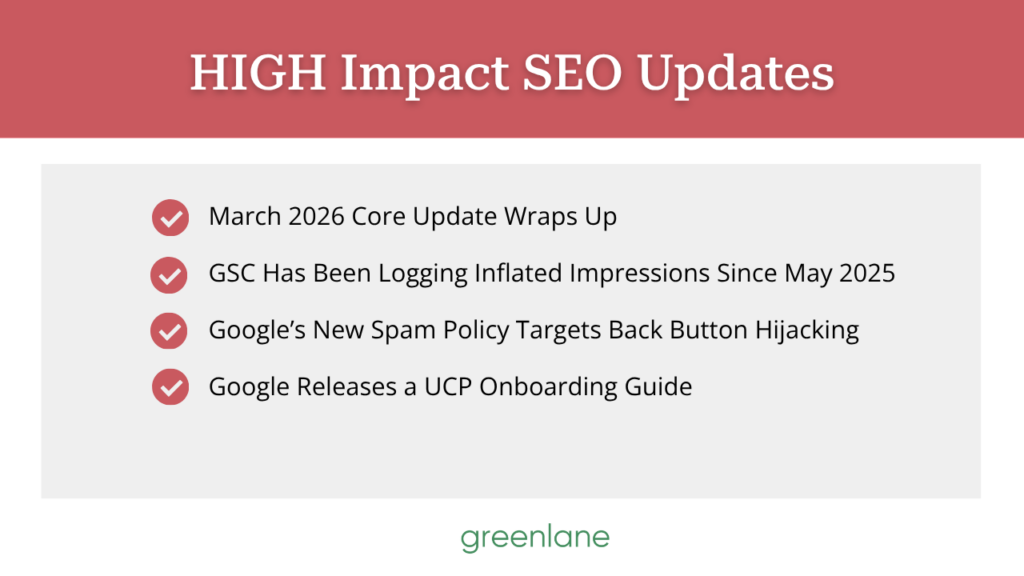
The March Core Update officially finished rolling out in early April, and the verdict is in: this one was more volatile than December’s update. The pattern of winners and losers tells a pretty clear story. Sites that took a hit were largely aggregators and pages that mostly comment on, or rehash, other people’s content. The sites that came out ahead? Strong, recognizable brands publishing first-party information, original data, and genuine expertise.
If you’ve been wondering whether Google’s E-E-A-T messaging is just lip service, this update is another data point suggesting otherwise. The takeaway is the same one we’ve been hammering for a while: invest in original research, primary sources, and the kind of content only your brand can produce. Recycling other people’s takes isn’t a strategy that’s aging well. If you saw movement (good or bad) in late March or early April, it’s worth digging into your top-affected pages and asking honestly whether they pass the originality test.
Google Search Console Has Been Logging Inflated Impressions Since May 2025
Here’s a frustrating one. Google confirmed this month that Search Console has been recording inflated impression numbers across many sites since May of last year. That’s nearly a year of data which doesn’t reflect reality. The fix is now in place going forward, but the historical data won’t be revised, so the bad numbers are baked in.
If your impressions dip in the coming months as the corrected data normalizes, it might not be a real performance issue. While you should still add a footnote in your reporting to flag the discrepancy, focus your KPIs further down the funnel (leads, revenue, etc) and use impressions as a secondary or tertiary guidance metric.
Google’s New Spam Policy Targets Back Button Hijacking
Google rolled out a new spam policy this month aimed at sites that hijack the back button. You may have encountered it in the past: you tap the back arrow to leave a page and instead get pushed to a different URL, an ad, or a pop-up that wasn’t anywhere near where you came from. Google is cracking down, and warning notices have already gone out to sites they’re targeting.
For most legitimate businesses, this is a non-issue. But if your site uses any third-party scripts, ad networks, or pop-up tools, it’s worth doing a quick audit to make sure none of them are messing with browser navigation. Test your site on mobile, hit the back button from a few different pages, and confirm it does what users expect. Better to catch it yourself than get a notice or manual action from Google.
Google Releases a UCP Onboarding Guide
Google published a new onboarding guide for the Unified Commerce Platform (UCP), providing merchants with a roadmap to prepare their sites for the upcoming UCP integration with Google Merchant Center (GMC). This is one of those quiet releases that signal bigger things coming; in this case, the documentation is going up in advance because the integration is on its way.
If you run an e-commerce site, this is the moment to start the prep work rather than wait. Getting ahead of the rollout means a smoother transition and potentially better visibility once UCP integration goes live in GMC. Walk through the guide, audit your product feeds, and identify any gaps now while there’s runway to fix them.
Organic CTRs in AI Overviews Are Bouncing Back
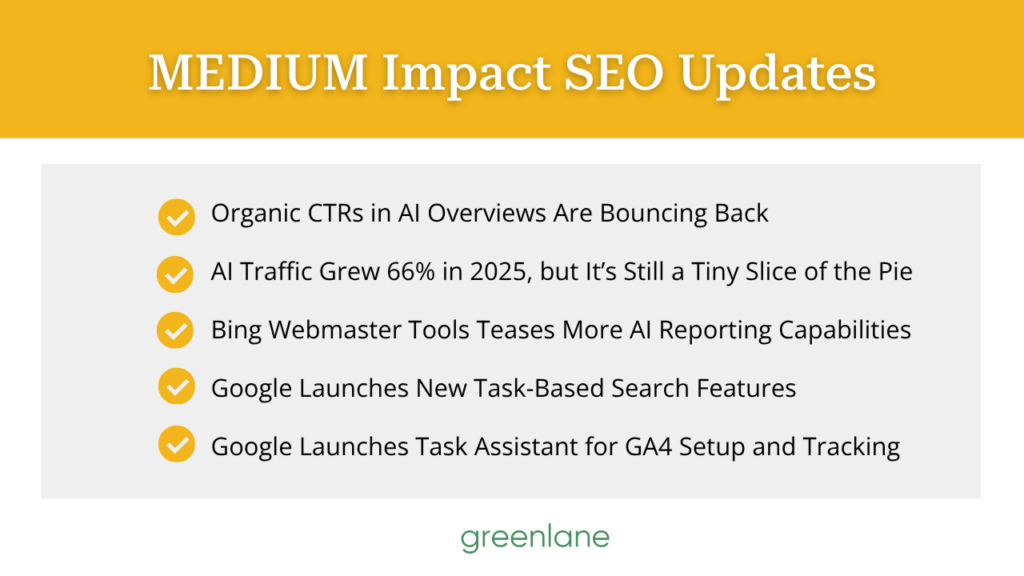
After a rough end to 2025, Seer Interactive published fresh data showing that organic click-through rates on SERPs with AI Overviews are recovering. It’s a small but meaningful shift, and one of the more encouraging data points we’ve seen for organic performance in AI-driven results.
There are a few reasonable theories here. Users may be getting more comfortable with AI Overviews and clicking through when they need deeper answers. Users may be less comfortable with AI Overviews and clicking through to real websites for answers. Google may be tuning the experience to better surface citations. Whatever the cause, it’s a reminder that the AI-impact-on-organic story isn’t a straight line down. Keep optimizing for visibility within AIO citations, and don’t write off the click value of those positions just yet.
AI Traffic Grew 66% in 2025, but It’s Still a Tiny Slice of the Pie
Semrush published a traffic channel mix study in April with one stat worth tattooing on every marketing dashboard: AI traffic grew 66% during 2025, yet still accounts for less than 0.15% of total web visits. That’s not a typo. Less than two-tenths of one percent.
This is the data point to keep handy when leadership asks why you’re not pivoting your entire strategy to AI optimization. Yes, AI search is growing fast and it absolutely deserves attention. But traditional channels still drive the overwhelming majority of business outcomes. The right play is to invest in AI visibility as part of a broader strategy, not as a replacement for what’s actually generating revenue today. Stay measured, prioritize accordingly, and don’t let the hype cycle distort your roadmap.
Bing Webmaster Tools Teases More AI Reporting Capabilities
Building on March’s AI performance report, Bing announced more AI reporting features on the way, including Citation Share, Grounding Query data (with intent), and GEO-focused recommendations. None of these are live yet, but they should be rolling out soon.
Bing is quickly becoming the most transparent search engine for AI visibility data, and it’s a development Google should pay close attention to. Citation Share in particular would be a huge unlock, finally a clean way to see how often your content is being referenced in AI responses versus competitors. Keep an eye out for these in your Bing Webmaster Tools account, and make sure someone on your team is checking in there regularly. The data gap between Bing and Google on AI reporting is widening in Bing’s favor.
Google Launches New Task-Based Search Features
Google rolled out a batch of new “task-based” search features this month, most of them aimed at travel-related queries. These features lean heavily on AI to help users plan trips, compare options, and complete multi-step tasks within search itself, rather than bouncing across multiple sites.
Travel is the testing ground, but the broader strategy is clear: Google wants to keep more of the user journey inside Search. If you operate in travel, hospitality, or any vertical where users complete multi-step research, this matters now. For everyone else, treat it as a preview of where things are heading. Structured data, clean information architecture, and content that directly answers task-based questions will continue to become more important.
Google Launches Task Assistant for GA4 Setup and Tracking
Google introduced a new Task Assistant designed to help users configure GA4 and set up tracking. On paper, this is great: GA4 setup has a learning curve, and an AI-guided assistant could help newer users avoid common pitfalls.
A word of caution: be very careful with this one. Automated suggestions for analytics configurations can have ripple effects across reporting, attribution, and historical data continuity. Before accepting any changes the assistant proposes, talk to your account manager or analytics lead. A misconfigured event or property can quietly break reporting, making it painful to untangle later. The tool is helpful, but it’s not a substitute for understanding what’s happening under the hood.
Google Outlines Best Practices for the “Read More” SERP Feature
Google published guidance this month on how to earn the “Read More” deep-link feature in search results. The headline best practices: make the relevant content immediately visible on the page, avoid JavaScript-driven page positioning on load, and keep hash fragments preserved in your URLs.
This SERP feature is a small but valuable win when you can earn it, especially for long-form content where users are looking for a specific section. The recommendations also reinforce broader good-hygiene principles: don’t hide content behind JavaScript, keep your URL structure clean, and make sure the section you want users (and Google) to land on is actually accessible without extra friction.
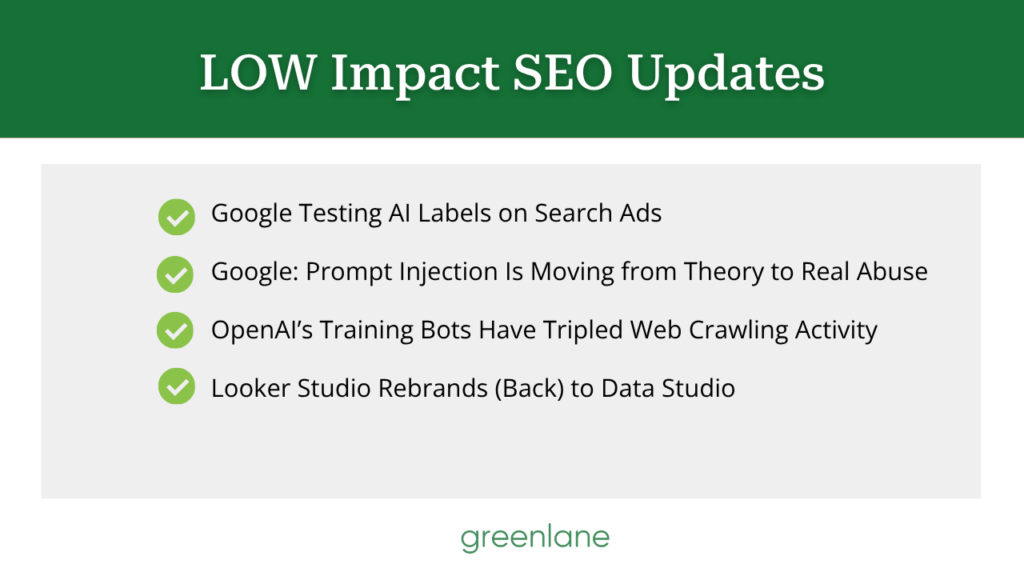
Google Testing AI Labels on Search Ads
Google has been spotted testing an “AI” label on certain search ads. The exact placement and rollout details are still unclear, but the test itself is significant: how search ads are generated has been largely invisible to users, and an AI label could change how users perceive (and click) them.
If this rolls out broadly, expect some impact on click-through rates as users build new mental models around what “AI-driven” advertising means to them. It could go either way; some users may engage more, others may distrust the label. If you run paid search at scale, this is worth watching closely and planning for in your testing roadmap.
Google: Prompt Injection Is Moving from Theory to Real Abuse
Google published findings from a recent study showing that prompt injection attacks on AI crawlers are no longer just a theoretical risk. People are actively trying to inject instructions into AI systems through web content, attempting to manipulate how AI agents read and respond.
For most marketers, this isn’t an immediate action item, but it’s an interesting signal about where AI safety is heading and why platforms are going to keep tightening how AI agents handle web content. The safe play, as always, is straightforward: publish high-quality, trustworthy content. Anyone trying clever manipulation tactics is likely going to find an increasingly hostile environment.
OpenAI’s Training Bots Have Tripled Their Web Crawling Activity
Botify reported that OpenAI’s training crawlers have tripled their activity recently, an unusually steep ramp-up that often precedes a major model release. Whether that’s a new ChatGPT version, a specialized agent, or something else entirely, we’ll find out soon enough.
If you haven’t reviewed your stance on AI crawlers in a while, now is a reasonable time. Decide whether you want OpenAI’s bots to access your content, configure your robots.txt accordingly, and ensure your team is aligned on the policy. There’s no single right answer, but it should be an intentional decision rather than a default one.
Looker Studio Rebrands (Back) to Data Studio
In a move that surprised approximately nobody who lived through the original rebrand, Google is renaming Looker Studio back to Data Studio. The product is the same, the name is just reverting.
Update your internal documentation, reports, and any references in proposals or onboarding decks. It’s a minor housekeeping task, but those little inconsistencies have a way of multiplying if you don’t get to them early.
That’s the Wrap for April 2026
April was a month of receipts. The Core Update rewarded brands building original, first-party content, the GSC bug reminded us to double-check our data assumptions and Semrush’s traffic study put a healthy reality check on the AI hype. The teams that win in this environment are the ones that stay grounded in fundamentals while staying curious about what’s next.
Have questions about how any of this impacts your business? We’re always happy to talk it through. Reach out to the team at Greenlane – we’re here to help.