
We’re excited to launch a new blog series: a monthly breakdown of the biggest news in search.
Each month, our account managers will summarize some of the most trending SEO articles to drop in the latest four weeks, consolidating all the community buzz into one, easily skimmable resource. It’s something we’re calling the Greenlane Index.
March was a big month. Between Google’s first core update of the year, a flurry of AI-driven features rolling out across Search and Maps, and some genuinely useful data drops from the SEO community, there’s a lot to dig into.
I’ve broken down everything our team discussed by impact level, so you can prioritize what matters most to your business. Let’s get into it.
Google March Core Update Begins Rollout
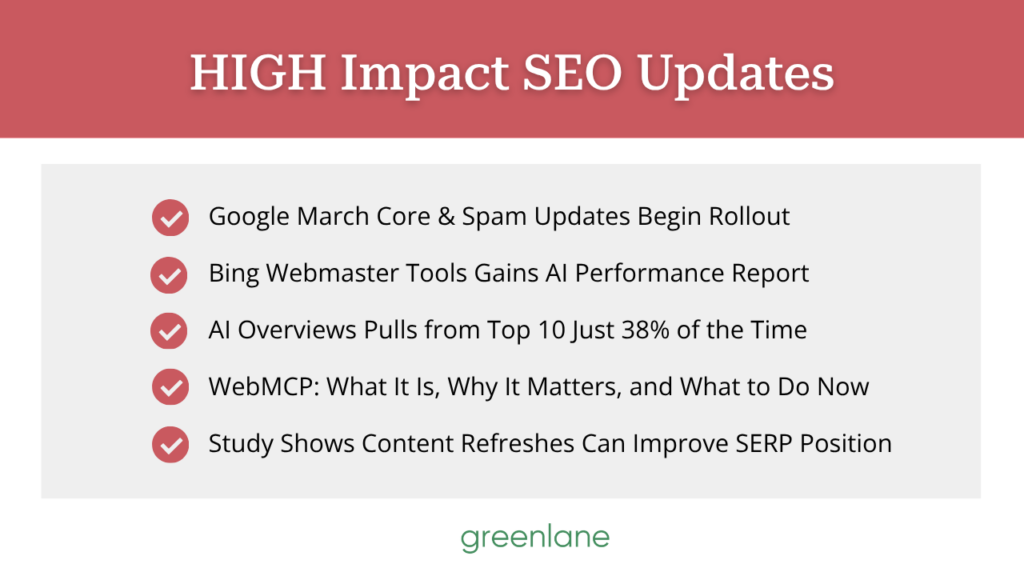
Google’s first core algorithm update of 2026 started rolling out on March 27th, and there’s a lot of buzz around what’s under the hood. The big talking point? TurboQuant. Google published research earlier in the month on this new compression framework, and Marie Haynes (SEO industry staple) is theorizing it could be baked into this core update. TurboQuant essentially speeds up AI-based retrieval to near-instant response times while using significantly less processing power and improving accuracy at the same time.
So what does that mean for you? If TurboQuant goes live, content that genuinely matches a user’s specific intent could surface more reliably. But it also means we may see more AI Overviews, since Google would have greater confidence in their quality. Personalized search and agentic systems would get a serious boost too. We’re keeping a close eye on this one as it has the potential to reshape how search works at a fundamental level.
Google March Spam Update Rolls Out in Record Time
Just prior to the core update, Google also pushed a spam update that completed its rollout in just 20 hours (a pretty wild turnaround). The response from the SEO community has been relatively quiet, which likely means this was a narrow, surgical update targeting specific spam patterns rather than something broad.
Spam updates are part of Google’s ongoing cleanup of link spam, cloaking, scraped content, and other manipulative tactics. The speed here might signal that Google’s spam detection systems are getting more efficient and confident in their targeting. If you’re playing by the rules, there shouldn’t be much to worry about.
Bing Webmaster Tools Gains AI Performance Report
Here’s something I’m genuinely excited about: Bing has added an AI performance report to its Webmaster Tools. This gives site owners actual data on how their content performs within AI-driven Bing search experiences, an area where we’ve basically been flying blind (or using 3rd party tools) across Google and most other platforms.
This is a meaningful step. Understanding your visibility in AI-generated answers is becoming critical as these features eat into traditional organic clicks. And honestly, it puts some pressure on Google to offer something similar in Search Console. If you haven’t been paying attention to Bing Webmaster Tools, now’s a good time to start.
AI Overviews Pulling from Top 10 Organic Results Just 38% of the Time
Ahrefs dropped a study this month showing that Google’s AI Overviews cite sources from the top 10 organic results only 38% of the time. Another 18% of citations come from YouTube. That leaves a big chunk coming from sources outside what we’d traditionally think of as “ranking content.”
The data also suggests that query fan-out is happening quite a bit, meaning Google’s AI is reformulating and expanding the original query to gather information, and those sub-queries may not be closely related to what the user actually typed. The takeaway for us? Ranking on page one for a keyword doesn’t guarantee you’ll show up in AI-driven experiences. Your content strategy needs to account for how AI discovers and references information, not just how traditional rankings work.
WebMCP: What It Is, Why It Matters, and What to Do Now
Semrush published a great breakdown of WebMCP this month, and if you’re not familiar with it yet, you should be. WebMCP is a protocol that could change how AI agents interact with websites. Think of it as a standardized way for AI systems to read, understand, and act on web content, going well beyond simple crawling.
For our clients and anyone building a digital presence, preparing for WebMCP now could give you a real first-mover advantage. As AI agents become a bigger part of how people discover content, having your site ready for structured, machine-readable communication is going to matter. The Semrush article offers practical steps to get started.
Study Shows Content Refreshes Can Improve SERP Position
New research this month confirmed what a lot of us have been preaching: refreshing your existing content works. Pages that received 30-100% net new content saw an average improvement of +5.5 ranking positions. Meanwhile, pages that weren’t updated actually dropped an average of 2.5 positions over the same period.
But here’s the catch, and this is important, pages that only added 0–30% new content saw no measurable improvement versus not updating at all. So if you’re going to invest in content refreshes, make them substantial. Swapping out a few sentences or adding a paragraph isn’t going to move the needle. Go deep, add real value, and make the update count.
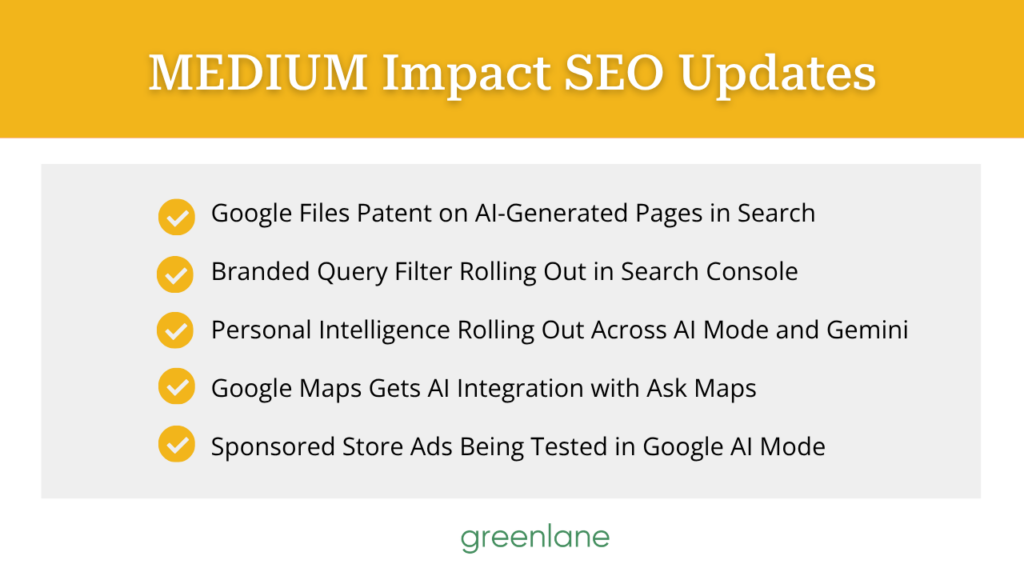
Google Files Patent on AI-Generated Pages in Search
A recently published Google patent outlines a system for generating real-time, custom landing pages for e-commerce queries based on user context. New visitor? Returning customer? Price sensitive? Brand loyal? Google could theoretically create tailored pages on the fly without the retailer doing anything.
Patents don’t always become products, but this one tells us where Google’s head is at. If implemented, it could place a Google-generated page between the searcher and the merchant’s actual website, which has huge implications for e-commerce SEO and how brands control their shopping experience.
Branded Query Filter Rolling Out in Search Console
Google has started rolling out a dedicated branded query filter in Search Console. This is one of those features that sounds small but makes a real difference in day-to-day reporting. Separating branded traffic from non-branded performance has always been a bit of a hack job with regex filters.
Having this built natively into Search Console should help improve reporting workflows and give teams a much clearer picture of their organic acquisition efforts versus searches driven by existing brand awareness. If you’re managing SEO reporting for clients, you’ll appreciate this one.
Personal Intelligence Rolling Out Across AI Mode and Gemini
Google is expanding “Personal Intelligence” to all users across AI Mode and Gemini. This means Google’s AI can now search your personal Google apps (Photos, Gmail, and more) to build richer context and serve up personalized recommendations right within search.
The potential here is massive, if it becomes a default setting or more widely adopted. Imagine searching for restaurant recommendations and having Google factor in your past dining photos, reservation emails, and dietary preferences it’s picked up from your history. It’s a powerful personalization play, though it’s going to raise plenty of privacy questions. However, currently it’s not on by default and AI Mode currently doesn’t seem to drive a large amount of traffic, meaning that the effects are likely to be limited for the time being.
Google Maps Gets AI Integration with Ask Maps & Immersive Navigation
Google Maps picked up two major AI-powered upgrades this month. “Ask Maps” introduces a conversational interface where you can ask complex, multi-layered questions, the kind that used to require three or four separate searches. Think: “Where can I park near a kid-friendly Italian restaurant that’s open late downtown?”
On top of that, navigation is getting a 3D, Street View-style overhaul with better guidance as you approach your destination. For local businesses, these changes mean how your business shows up in Maps (and how well-structured your information is) just got even more important.
Sponsored Store Ads Being Tested in Google AI Mode
Google has been spotted testing “Sponsored Stores” ads within AI Mode, giving us an early look at how the company may plan to monetize AI-powered search. The ads appear as promoted store placements within AI-generated shopping responses.
This is worth watching closely. As AI Mode becomes a more prominent part of the search experience, paid placements are coming with it. Traditional search advertising models aren’t going away, they’re being adapted for the AI era. If you’re running paid campaigns, start thinking now about how your strategy might need to evolve.
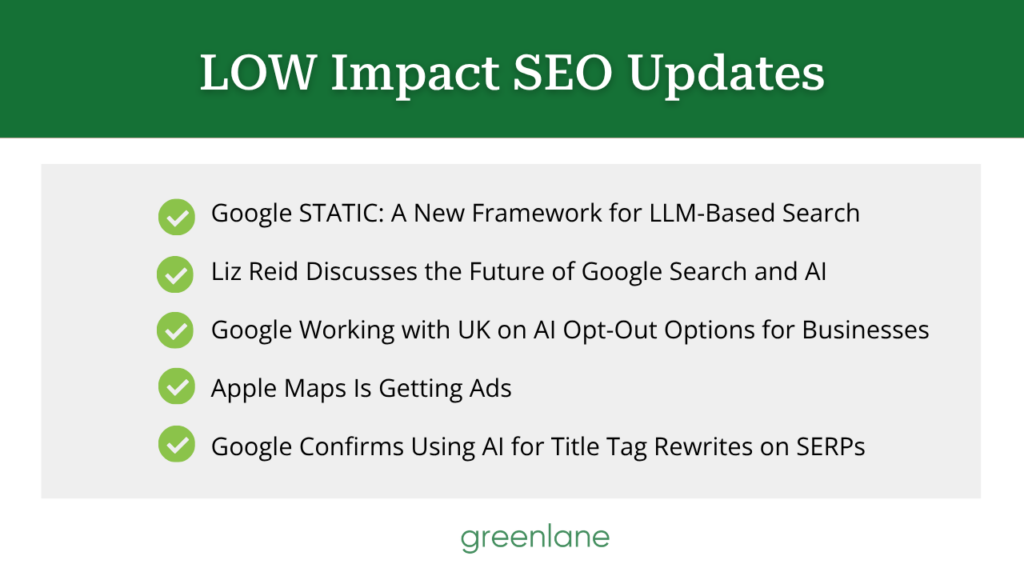
Google STATIC: A New Framework for Faster LLM-Based Search
Google published a research paper introducing STATIC (Sparse Transition Matrix-Accelerated Trie Index), a framework designed to speed up decoding for LLM-based search and recommendation systems. It’s still in the research phase, but it signals where Google is investing to make AI-powered search faster and cheaper to run.
For most of us, this is a “watch this space” item. The technical details are dense, but the strategic signal is clear: Google is building the infrastructure to make AI-first search experiences the default, not the exception.
Liz Reid Discusses the Future of Google Search and AI
Google’s VP of Search, Liz Reid, gave an interview this month covering the relationship between Search and Gemini. She didn’t commit to whether the two products will eventually merge into a single experience, which is interesting in itself. What she did make clear is that personalization is a major strategic priority.
As AI gets more deeply embedded in search, expect the results you see to increasingly reflect your individual history, preferences, and context. For marketers, that means our approach to audience targeting and content strategy needs to keep evolving alongside these changes.
Google Working with the UK on AI Opt-Out Options for Businesses
Google is collaborating with UK regulators to build new opt-out mechanisms for businesses that don’t want their content appearing in AI-powered search experiences. For now, this seems limited to AI features within traditional Search (no word yet on AI Mode or Gemini).
Businesses that are worried about AI summarization replacing their clicks may welcome the option, though opting out could also mean reduced visibility as AI features become more dominant. It’s a tradeoff worth thinking through carefully. All that said, while this could set a precedent for other markets, it’s more likely that Google will only roll this out in markets where it’s required by laws and regulations.
Apple Maps Is Getting Ads
Apple is reportedly planning to introduce advertising into Apple Maps as early as this summer. Details are still thin, but this would bring Apple Maps more in line with Google Maps’ existing ad model and open up a new channel for local businesses to reach users right when they’re looking for directions or nearby services.
For teams managing local campaigns, that’s another platform to keep on the radar. It’s also another sign of Apple expanding its advertising business well beyond the App Store.
Google Confirms Using AI for Title Tag Rewrites on SERPs
Google officially confirmed this month that it’s using AI to rewrite title tags as they appear in search results. We’ve known for a while that Google frequently overrides title tags, but the explicit acknowledgment that AI is now driving these rewrites is a departure from their usual tight-lipped approach.
The practical takeaway hasn’t changed: write clear, descriptive, accurate title tags. Not because Google will always use them verbatim, but because a well-crafted title gives the algorithm and AI a better foundation to work from. Vague or misleading titles are more likely to get rewritten in ways that don’t align with your intent.
That’s the Wrap for March 2026
The theme this month is clear: AI continues to permeate the industry and make its way into Google’s core products. From Google’s core algorithm update, potentially introducing TurboQuant to personalized search, expanding across the board, the ground is shifting fast. The brands that stay curious, keep testing, and invest in genuinely helpful content are the ones that’ll come out ahead.
Have questions about how any of this impacts your business? We’re always happy to talk it through. Reach out to the team at Greenlane; we’re here to help.
Share This: