
Welcome back to the Greenlane Index, our monthly recap of the biggest stories in SEO and search. If March was about big swings (a core update kicking off, AI features showing up everywhere), April was about the dust settling and a few important details coming into focus.
We saw the March Core Update finish its rollout with some winners and losers, Google quietly admitted to a year-long Search Console reporting bug, fresh data on where AI traffic actually stands today (spoiler: still tiny), and a steady stream of new tools and policies aimed at making sense of an increasingly AI-driven search landscape.
As always, we’ve broken everything down by impact level so you can prioritize what matters most for your business. Let’s get into it.
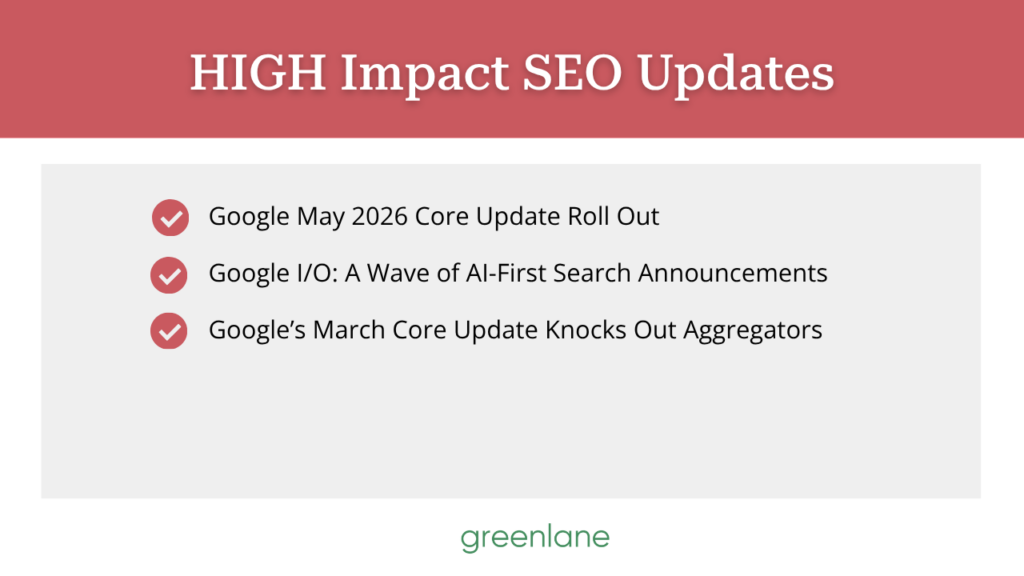
Google May 2026 Core Update Begins Rolling Out
Google’s second core update of 2026 began rolling out on May 21, just after I/O and the Marketing Live events. The rollout just finished on June 2. The early community chatter was relatively muted compared to March’s volatility, but the rollout finished with a bang and some of the highest volatility we’ve seen in months.
Timing matters here. Google often ships major changes alongside or just after big announcement cycles, and this one falls squarely after a flood of AI-driven feature reveals. If you saw any movement in late May, document it and start looking for patterns to the data. The playbook hasn’t changed: focus on original, useful content from authoritative sources, and let the data settle before you react.
Google I/O 2026: A Wave of AI-First Search Announcements
Google I/O 2026 was the dominant search story of the month. Three announcements stood out as the most consequential for marketers and SEOs: AI agents arriving inside Search itself (alongside a redesigned Search Box), a new AI content verification system surfacing trust signals on results, and a Universal Cart that lets users check out across multiple retailers without leaving Google. Taken together, these moves point toward a search experience that’s increasingly agent-driven, trust-mediated, and transactional inside Google’s own surfaces.
Each of these deserves its own attention, so we’ve broken them down individually below.
1. AI Agents Come to Search
Google introduced AI agents directly inside Search (for their premium, paying users), alongside a redesign of the Search Box itself. These agents can carry out multi-step tasks on behalf of users, comparing, booking, and completing actions without users having to bounce across multiple sites or tabs. The redesigned Search Box reflects that shift, giving more room for conversational, task-oriented queries.
While the AI agents in Search are currently paywalled, this is still the biggest interaction model change Search has seen in a while. Traditional “look it up, click a result, read, decide” patterns will increasingly be supplemented (or replaced) by “tell the agent what you want done.” For brands, that means the surfaces where you earn visibility are shifting too. Structured data, clean APIs, machine-readable product and service information, and content that’s easy for agents to parse and act on are going to matter more than ever.
2. AI Media Content Verification Comes to Search
Google also announced a new AI media content verification feature at I/O. The system uses industry-standard signals to help users determine whether an image or video they’re seeing has been AI-generated or otherwise manipulated, with trust indicators surfaced directly within the Search experience.
3. Universal Cart Comes to Google Shopping
Google unveiled a Universal Cart for Google Shopping, allowing users to add items from multiple retailers into a single cart and complete checkout without bouncing between sites. Google is positioning itself as the connective tissue between users and merchants in a way it hasn’t quite done before.
For e-commerce brands, this is one of the bigger shifts. A Google-mediated checkout means more of the purchase journey happens inside Google’s experience, with real implications for attribution, branding, customer data, and post-purchase relationships. It also pairs neatly with the UCP onboarding guide we covered in April.
Google’s March Core Update Knocks Out Aggregators
As more people start looking back at the effects of the March Core Update, patterns are becoming more apparent. If prior updates were about filtering out low-quality AI spam, this one focused more on format. Industry data shows that the hardest-hit categories were comparison aggregators, reference sites, and multi-tier directory platforms. In industries like travel, jobs, and education, visibility shifted dramatically away from the digital middleman and moved directly toward official brand sites, employers, and government (.gov) domains.
Google is actively closing the loophole on content that merely organizes or rehashes information instead of creating it. If your business model relies on aggregating third-party listings, products, or reviews without adding a massive layer of proprietary value, the algorithm is viewing you as friction. High quality, first party information is the new baseline.
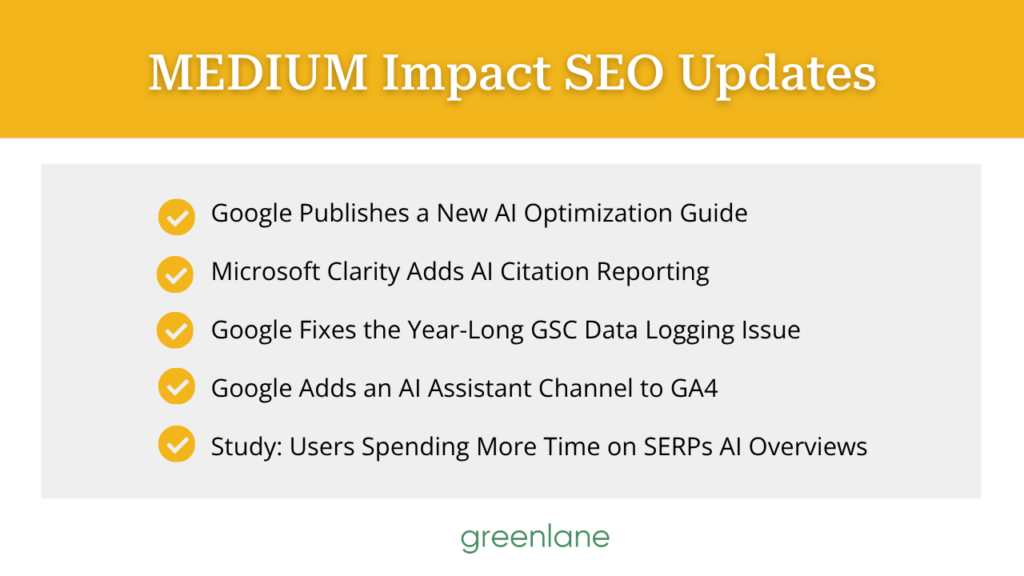
Google Publishes a New AI Optimization Guide
Google released a new AI Optimization Guide for developers and SEOs this month, consolidating many of the recommendations the team has made publicly over the past few years into a single resource. If you’ve been tracking Google’s AI guidance closely, much of this will feel familiar.
Take it with a grain of salt, though. Google labels LLMs.txt files “a myth” for improving AI traffic, they also recently added an LLMs.txt check to a new release of Lighthouse. Use the guide as a useful summary of best practices, but don’t treat every claim as the final word on what does or doesn’t work. The AI search landscape is evolving faster than Google’s public statements can keep up with, and their tooling sometimes tells a different story than their docs.
Microsoft Clarity Adds AI Citation Reporting
Microsoft Clarity rolled out AI citation reporting this month, giving site owners more visibility into how their content shows up in AI-driven search and chat experiences. This continues the trend we’ve flagged for two months running: Microsoft (across Bing Webmaster Tools and now Clarity) is making real moves on AI visibility transparency, while Google’s Search Console stays quiet on the topic.
If you’re already using Clarity for user behavior insights, you’ve now got another reason to keep that tab open. If you’re not, this is one more nudge to evaluate it.
Google Fixes the Year-Long GSC Data Logging Issue
Following last month’s announcement that Search Console had been logging inflated impressions since May 2025, Google confirmed this month that the fix is fully in place. Going forward, your impression data should be accurate. Historical data, however, still won’t be revised.
If you didn’t already adjust your reporting workflows to flag the discrepancy, now is the time. Pay close attention to year-over-year comparisons over the next several months as you’ll likely see what looks like impression declines that are really just the data normalizing post-fix.
Google Adds an AI Assistant Channel to GA4
Google added a new AI Assistant channel to GA4 this month, designed to help track traffic coming from AI-first sources like ChatGPT, Perplexity, and others. This addresses one of the biggest blind spots in current analytics setups: actually quantifying how much traffic AI tools are sending your way versus traditional channels.
Even with AI traffic still representing a small slice overall (Semrush pegged it at under 0.15% in April), having a dedicated channel makes that traffic much easier to track, trend, and report on. If you’ve been cobbling together custom UTMs or referral filters to capture AI traffic, you can start moving toward GA4’s native channel.
Study: Users Are Spending More Time on SERPs With AI Overviews
A new study published this month found that users are spending more time on SERPs when AI Overviews are present, with traditional user behavior breaking down notably for navigational intent queries. People are pausing, scrolling, and reconsidering before clicking, a meaningful shift in how they engage with results.
This has real implications for click-through expectations. If users are taking longer to evaluate results, the placement, framing, and trust signals on your listing matter more than ever. It also reinforces that ranking #1 isn’t the slam dunk it used to be. Your snippet, brand recognition, and presence within an AI Overview itself all factor into whether you actually earn the click. Treat SERP visibility as a multi-element problem, not a position contest.
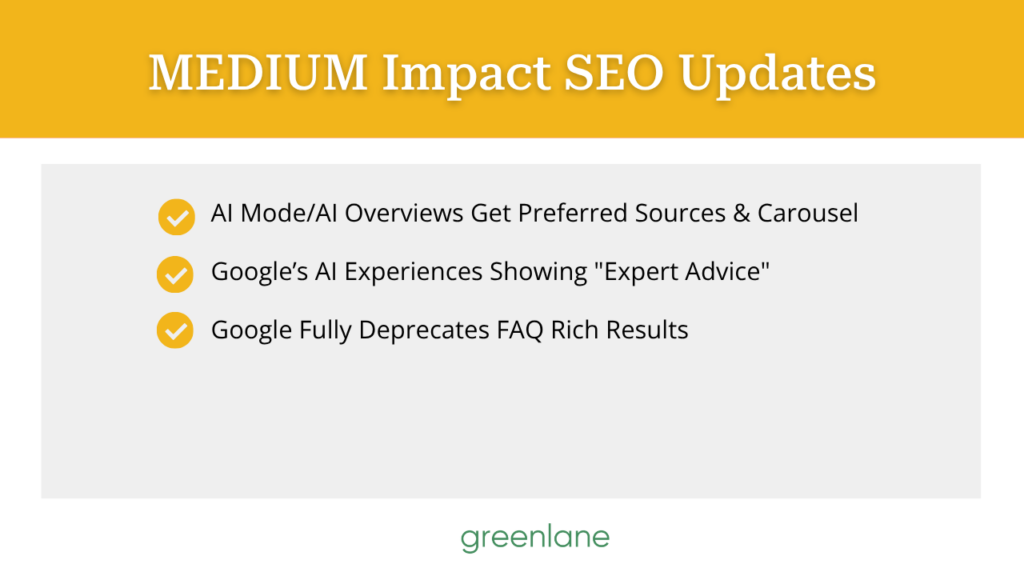
AI Mode and AI Overviews Get Preferred Sources and a New Carousel
Google added a “Preferred Sources” feature to AI Mode and AI Overviews this month, along with a new carousel format for displaying citations. Users can now indicate sources they want to see more (or less) of in AI-generated responses, and the carousel makes cited sources more visible within the AI experience itself.
This is meaningful for publishers in two ways. First, the carousel gives cited sources more visible real estate and, potentially, more clicks from inside AI responses. Second, Preferred Sources opens up a kind of organic “brand loyalty” optimization play. If users repeatedly choose to see content from your brand, that signal compounds over time.
Google’s AI Experiences Showing “Expert Advice” from Forums
Google is rolling out a series of updates to its AI Mode and AI Overviews, most notably a new dynamic section often labeled “Expert Advice” or “Community Perspectives.” This feature pulls quotes, firsthand experiences, and tips directly from social media, public forums (hello again, Reddit), and independent blogs, serving them right inside the AI block complete with the creator’s handle or community name. Alongside this, Google is trying to address user hesitation by making inline citations clearer, offering desktop hover-previews of cited links.
This is a double-edged sword. On one hand, Google is attempting to solve its AI “sterile corporate speak” problem by injecting real human lived experience into its summaries. On the other hand, it’s a direct attempt to keep users from clicking through to forums by lifting the best nuggets of human conversation and displaying them natively.
Google Fully Deprecates FAQ Rich Results
Google has officially deprecated FAQ rich results in search. The schema markup itself isn’t going away, but the FAQ rich result feature on SERPs is fully gone. Google had previously limited the visibility of FAQ rich results to a very select group of queries and is now expanding to remove it completely.
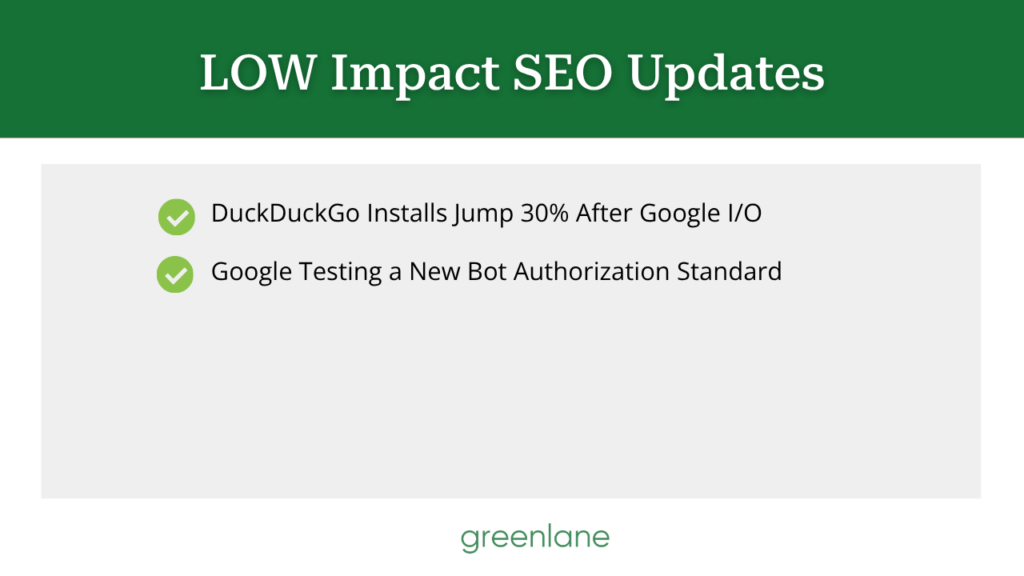
DuckDuckGo Installs Jump 30% After Google I/O
Following Google I/O, DuckDuckGo reported a 30% jump in installs. The pattern suggests some users are actively seeking alternatives to Google’s increasingly AI-saturated search experience.
Keep this in perspective: DuckDuckGo’s overall share is still tiny compared to Google. But the trend is a useful signal that not every user wants AI summarizing their search results, and that there’s still a meaningful audience for cleaner, traditional results. If your audience skews privacy-conscious or AI-skeptical, this is worth tracking. It’s also a reminder that diversifying visibility beyond Google (across Bing, DuckDuckGo, and AI tools themselves) is becoming more important, not less.
Google Testing a New Bot Authorization Standard
Google is testing a new bot authorization standard aimed at giving site owners more granular control over how AI crawlers access their content. It’s still in early testing, but the standard signals an industry move toward more structured ways of managing AI bot access, something the current robots.txt model wasn’t designed to handle. For now, this is a “watch this space” item.
That’s the Wrap for May 2026
May was Google’s month, full stop. Between I/O’s wave of AI-first announcements (agents, content verification, universal cart) and a Core Update launching just after, search is being reshaped around AI at every layer. The DuckDuckGo install bump is a small reminder that not every user is on board with where this is headed, but the broader direction is set. The teams that prepare now for an agent-driven, AI-mediated, trust-signaled search landscape will have a meaningful head start over those who wait for the dust to settle.
Have questions about how any of this impacts your business? We’re always happy to talk it through. Reach out to the team at Greenlane — we’re here to help.
Share This: