
Greenlane Index: July 2026
Welcome back to the Greenlane Index. July didn’t have a Core Update to argue about, which meant the conversation shifted to something arguably bigger: what search actually is now and where it may be heading. A scammer proved that AI Overviews will happily hand out a fake phone number if you let them, a fresh dataset gave us the clearest look yet at how AI may be redistributing search volume rather than simply destroying it, and Google has started to roll out new tracking for data that isn’t “directly” associated with your website.
As always, we’ve sorted this month’s stories by how much they should actually change what you’re doing, biggest first. Here’s what happened in search in July.
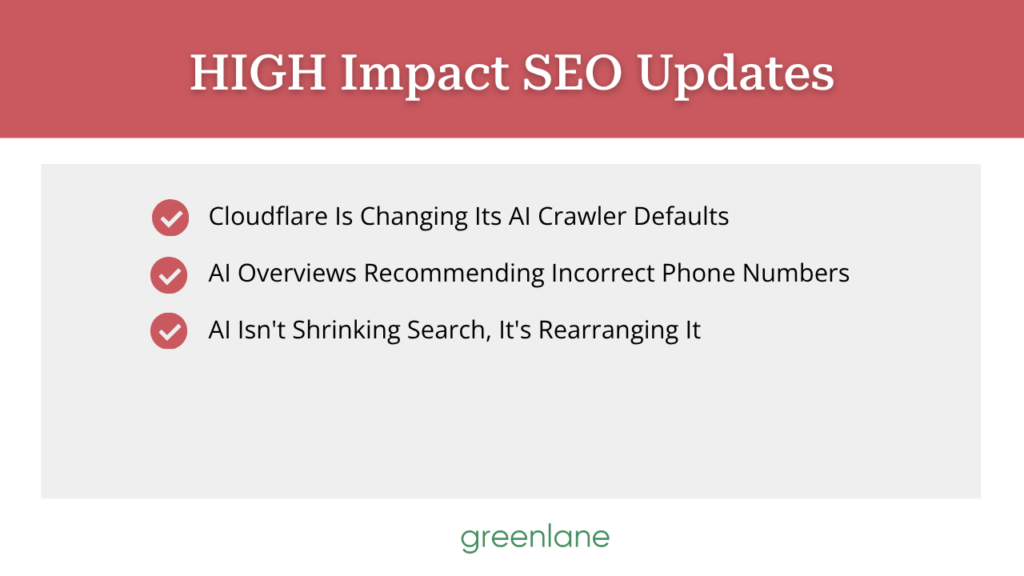
Cloudflare Is Changing Its AI Crawler Defaults, and Googlebot Could Get Caught in the Blast Radius
Cloudflare is replacing its simple “block AI bots” toggle with three categories: Search crawlers that index for later retrieval, Agent crawlers that act in real time on a user’s behalf, and Training crawlers that scrape to build models. Starting September 15, new customers and sites will have Training and Agent crawlers blocked by default on ad-supported pages, while Search stays allowed.
Here’s the catch. Cloudflare is applying the strictest rule to any crawler that does more than one job. Googlebot, Applebot, and Bingbot all crawl for both search indexing and AI training. Under the new defaults, blocking Training traffic can block those crawlers outright, since Cloudflare can’t (or won’t) separate the two jobs coming from the same bot. Unlike robots.txt, which a crawler can simply ignore, a Cloudflare block happens at the network level. There’s no working around it from the other side.
If your site runs through Cloudflare, this is worth checking before September 15, not after. Free accounts that don’t touch their settings will shift to the new defaults automatically. The fix is usually straightforward once someone actually looks at the settings, but “actually looks at the settings” is doing a lot of work in that sentence, so consider this your reminder to get ahead of it.
A Scammer Got an AI Overview to Recommend Their Phone Number Instead of Royal Caribbean’s
A customer searching for Royal Caribbean’s customer service line got a fraudulent number back in an AI Overview. They called it, spoke to someone who knew enough cruise terminology and pricing to sound legitimate, and lost $768 plus additional unauthorized charges. Royal Caribbean’s own systems were never touched. The scammer simply planted a fake number on an unrelated webpage and let Google’s AI do the rest of the work, pulling it into a synthesized answer that read as authoritative.
That’s the actual lesson here, and it applies well beyond one cruise line. A sketchy phone number on a random site looks sketchy. The same number, folded into a clean AI-generated answer, looks verified. AI Overviews compress information from multiple sources into one response, and a weak or malicious source can inherit the interface’s credibility along with everything else.
The practical takeaway: make sure your phone number, primary URL, and physical locations are stated clearly, consistently, and on crawlable pages across your own site, your Google Business Profile, and anywhere else you’re indexed. When your own information is unclear or hard to find, you’re leaving a gap for someone else, or something else, to fill it.
New Data Says AI Isn’t Shrinking Search, It’s Rearranging It
A large-scale analysis tracking roughly 1 million high-volume keywords found that 40.7% are in measurable decline, defined as losing more than 15% of their volume over the past year, with an average decline of 41% among the affected terms. That’s the headline most people will remember. The part worth actually sitting with is the other side of the ledger: 20.1% of keywords are growing by that same threshold. Add up the volume on both sides and they nearly cancel out, declining keywords account for roughly 10.29 billion in monthly volume, growing keywords account for roughly 10.31 billion, for a net change across the entire dataset of about positive 16.8 million searches a month.
In other words, demand didn’t shrink so much as relocate. Fewer keywords are growing than declining, but the ones that are growing carry more volume each, which is how the totals end up roughly even.
Some queries and industries are losing ground to AI answers, and others are picking up volume they didn’t have before. That argues for looking at keyword and category-level trends rather than assuming a blanket decline, and it’s a reasonable prompt to revisit how you’re grouping keywords by intent in the first place.
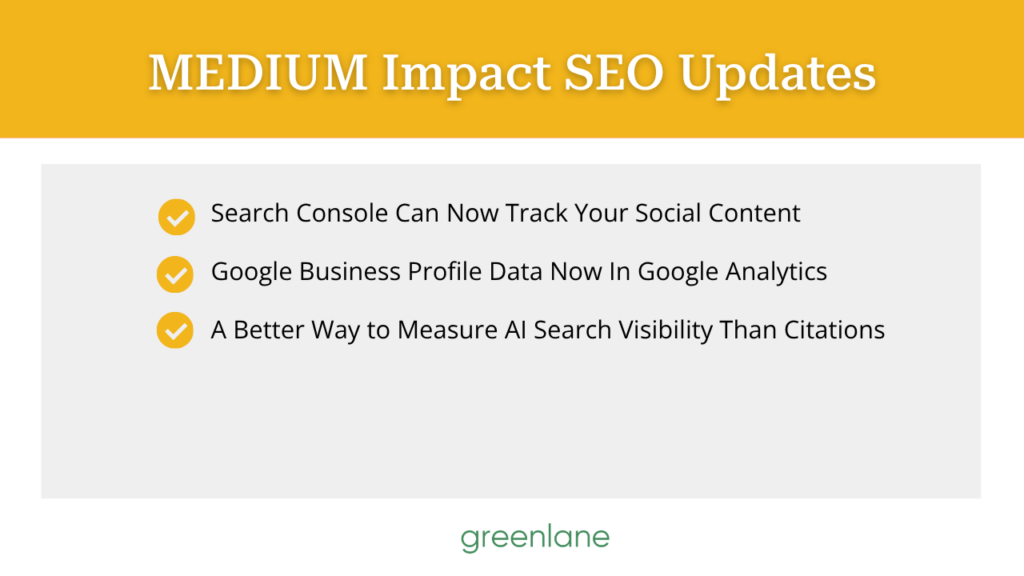
Search Console Can Now Track Your Social Content, and It’s Live for Everyone
Google’s new Platform Properties feature, which lets you verify Instagram, TikTok, X, and YouTube accounts as properties inside Search Console, rolled out to all users by the end of July. Once connected, you get three new views: performance reports showing clicks, impressions, and the queries driving traffic to your posts; insights reports on top-performing content and how people are discovering your account through Google Search; and achievement tracking for click milestones.
This is genuinely useful, not just a novelty. You can now see which search queries are sending traffic to your social posts and videos, catch content that’s suddenly gaining search traction with 24-hour filters, and export data across platforms into one spreadsheet to compare which channels are actually earning search visibility.
Set this up if you have an active social presence. It’s a five-minute verification process per platform, and the reporting is immediately useful for showing stakeholders where social and SEO strategies are actually connected.
Google Business Profile Data Now Flows Into Google Analytics
Google rolled out the ability to link Google Business Profile directly to Google Analytics, bringing local metrics, website clicks, calls, direction requests, bookings, messages, menu views, and total interactions into the Analytics reporting you already use. Data covers the trailing six months, and multi-location businesses get aggregated performance across every linked profile.
Setup happens through Analytics Admin under Product Links, where you select which locations to connect, and the data populates immediately in a new Business Profile section under Reporting. For businesses with a physical location or multiple locations, this closes a real gap: you can now see how local visibility actually translates into website traffic, all in the same dashboard where you’re already reporting everything else.
Stop Counting Citations: A Better Way to Measure AI Search Visibility
Most AI visibility dashboards borrow the logic of rank tracking and apply it to a completely different problem, and this piece makes a solid case for why that doesn’t hold up. A citation is not a recommendation. A model naming your page as a source doesn’t mean it’s actually telling someone to choose you, so counting citations alone tells you less than it appears to.
The more useful approach starts with brand accuracy: regularly checking whether AI systems get your basic facts right, founding date, location, products, and competitors, across every model you care about. From there, measure presence and recommendation share separately, and don’t trust a single prompt. AI answers vary enough between runs that a statistically meaningful read requires asking the same prompts repeatedly over time, not once and done.
If you’re running AI visibility reporting, this is a good gut check on whether your current dashboard is actually measuring something useful or just recreating a rank tracker with an AI label on it.
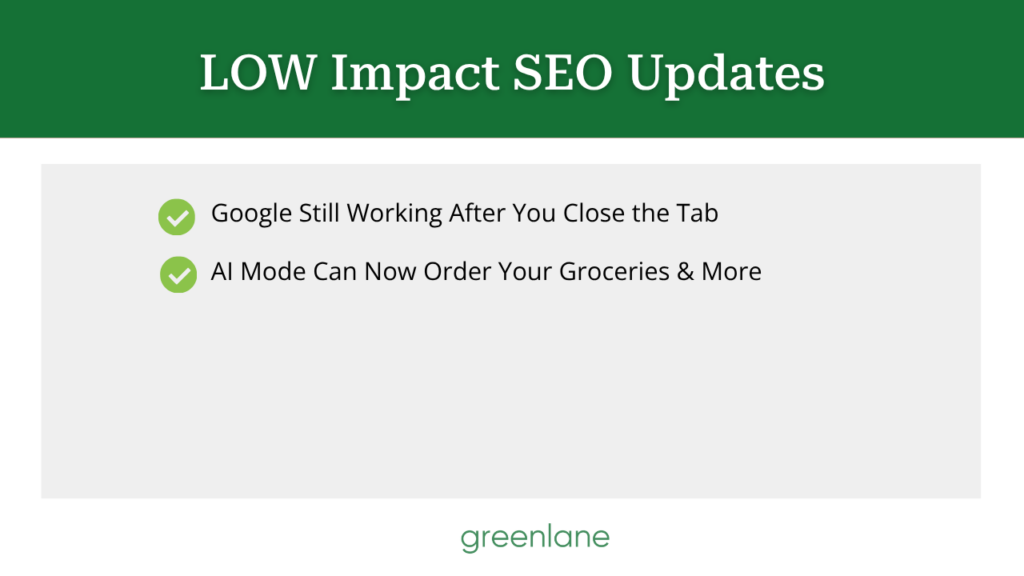
Google Is Building Search That Doesn’t Stop Working After You Close the Tab
In a Search Engine Journal interview, Google’s Liz Reid described a mode of search that stays active in the background after you ask a question, and pings you later when the answer actually exists. Her example: instead of repeatedly checking whether a local theater has announced its next show, you ask once, and Google tells you when it happens. She summed up the current problem plainly: with regular search, “you have to keep checking and checking and checking,” and most people just give up before they get an answer.
That’s a real shift in what search is for. Today, a search is a transaction: you ask, you get ten blue links or an AI summary, and the session ends. What Reid described is a standing request that Google keeps working on for you, across devices, until it has something worth telling you. It’s a logical extension of where Google has been heading all year, and it lines up with the company’s own framing of agentic, autonomous search as the next phase.
Nothing here is available to test yet, so there’s no action to take this month. But it’s worth understanding now, because it changes the unit of measurement. If Google starts treating a question as an ongoing task instead of a one-time query, “did we rank for this search” starts to matter less than “did we get surfaced when the answer became true.” Keep it on your radar.
AI Mode Can Now Order Your Groceries, Pull Up Your Playlists, and Browse Design Templates
Google is letting users connect apps directly to AI Mode in Search, starting with Instacart, Canva, and YouTube Music. Once connected, someone can add groceries to an Instacart cart, browse Canva design templates, or save a playlist to YouTube Music without leaving their search results. Google frames the distinction from its existing Gemini app integrations as one of convenience: instead of switching apps, the functionality now lives inside the search experience people already use, and the company says more partners are coming.
There’s no immediate action item here for most businesses, but it’s a preview of where commerce and search could be heading. If a site sells anything transactional, from products to bookings, this is the kind of integration that will eventually matter for how customers discover and complete a purchase without ever landing on the business’s own site. Worth revisiting once the partner list grows past three apps.
That’s the Wrap for July 2026
If there’s one thread running through July, it’s that everyone is still adapting to the current Search landscape. Tools are updating their crawling policies or connecting to new properties, scammers are finding new ways to adapt to AIO-dominated results, even the almighty Google is trying to determine the best path forward for SERPs and its core product. As everyone is adapting and trying to stay ahead of the curve, there will be growing pains and there will be folks who fall behind. Make sure that your strategies aren’t chasing all of the shiny new objects while also not being stuck in the past.
Questions about anything in this issue, or want help putting it into practice for your own site? Reach out to the Greenlane team; we’re happy to talk through it.