
How Missing Author Bylines Can Cause SEO Keyword Ranking Drops: A Healthcare Case Study
It’s not uncommon for brands to lose organic rankings after a site migration.
Oftentimes, a big culprit is broken page path links and improperly set up redirects: AKA technical errors. But what if losing footing on the SERPs is more closely related to missing expertise signals?
My coworker, Adam Wells, and I worked together on a project that showed this was the case! Our agency found a correlation between lackluster author information on a client’s website blog and lost keyword rankings. Let’s talk about the connection.
The Case of the Vanishing Expert
We recently published a case study involving a long-term project for a client in the pet care space. Here’s what happened.

A client made an executive decision to pivot and change how they structure their brand messaging online. They wanted certain topical content on a separate domain so their sub-brands could focus more exclusively on individual niches, and their main domain wasn’t a broad catch-all. Their plan was to move more vet-focused medical advice to a domain dedicated to veterinary use, and keep general pet wellness and lifestyle pieces with affiliate links on their main Big Dog (pun intended) domain.
During the site migration of moving medical advice to a new domain, the content (specifically, a large number of articles) was moved from one domain to another. While articles were retired and redirected, in the shuffle, links to author bio pages were either broken or never fully completed on the new site.
One author, Deidre, had written some of the highest-performing articles on the original domain: let’s call it Domain A.
But when her articles were removed from Domain A, and she published a new one on the new site — Domain B — her profile became a “ghost” on Domain B. There was no clearly executed plan for the treatment of old bios on Domain A, where the articles were removed. Beyond her individual profile, other writers’ bios remained unchanged (yet had no articles associated with them anymore on that domain), some still had a URL, but the info was scrubbed and just contained a name (see the example image), and others were redirected.
Additionally, some author bios were never completed on the new Domain B, where the articles were migrated to. While there was a clickable link on articles written by this person to take you to the author’s page, where you expected a bio, the user would be taken to a bio page with a faceless profile pic and no credentials.
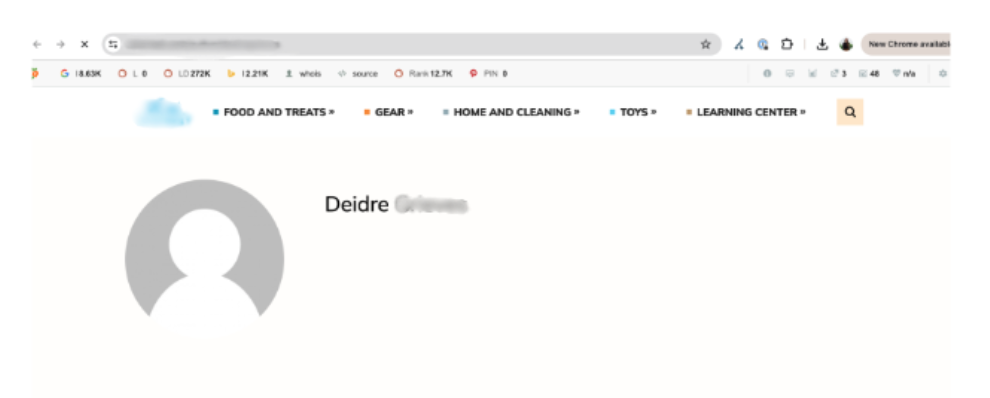
For a site providing medical advice within the veterinary space, this was a massive red flag to search engines. Google and similar search engines want to distinguish between a real human with medical credentials and AI that could inaccurately spin a bunch of words together.
Google’s Emphasis on Authority & Expertise in the Medical Space (& Any Industry)
In the world of SEO, we talk a lot about Google’s acronym, E-E-A-T (Experience, Expertise, Authoritativeness, and Trustworthiness). While Google doesn’t explicitly say these are direct ranking factors, the search engine says the signals are “improvements to consider,” because its ranking algorithm considers them when assessing content quality. Others have acknowledged this in a leak.
The search engine says these improvements help brands’ websites to “align” with “signals that our automated systems use to rank content.”
One of the most overlooked SEO trust signals is the Who from Google’s E-E-A-T guidelines. Below are the search engine’s suggestions for being crystal clear about who created your content.
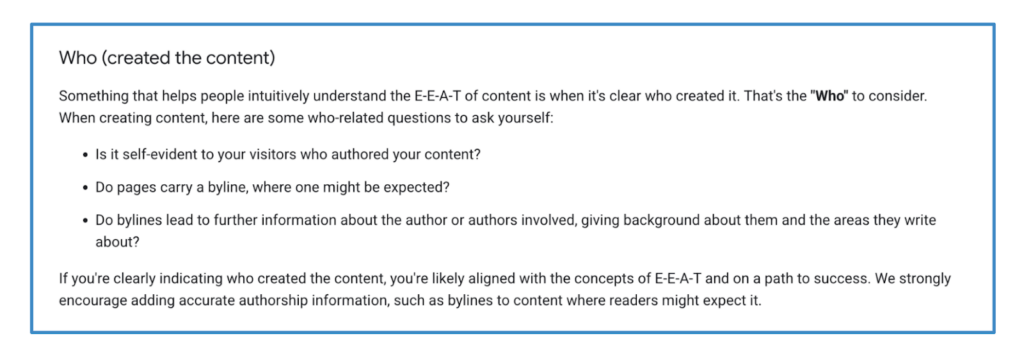
The fact that our client had inconsistencies across two domains about where its factual expertise came from led us to postulate that Google could be questioning their site’s credibility, and therefore, removing or pushing down their previous rankings. Here’s how we went about proving our theory about their affected SEO and dropped rankings post-sloppy migration.
The Audit: Proving the Cause of Decreased Rankings
We didn’t just guess that the bios were the problem causing the ranking drops on Google’s SERPs; we used data to back it up. To get buy-in from a big brand, you have to prove the value first. Here is the exact process we used:
Step 1: Competitive Analysis of Author Profiles
We didn’t want to reinvent the wheel, but we did want to review their competitors’ author bios to see what they were doing right (or wrong).
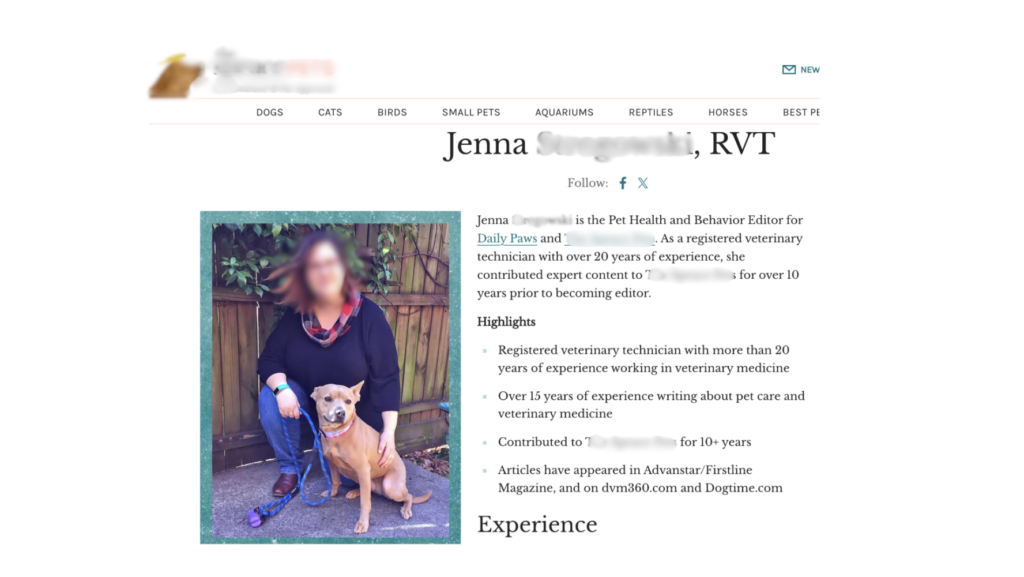
We found that top-ranking sites weren’t just listing byline names; they linked to author pages that were highlighting:
- Years of experience
- Links to other domains where they had edited or written in the past
- Professional credentials (like medical titles)
- Independent social media links (Facebook, Twitter/X) to prove they are a real entity
Below is just one example of an author profile seen on a rival pet health website:
Step 2: Author Performance Audit
Next, we wanted to see if there was evidence that well-built out author bio profiles on our client’s Domain A were attached to well-performing articles (prior to the messy site migration that disjointed things).
We used Screaming Frog to pull a report on how many articles each author had written, and matched that against which authors were seeing the highest impressions and clicks on Google in the year prior to migration.
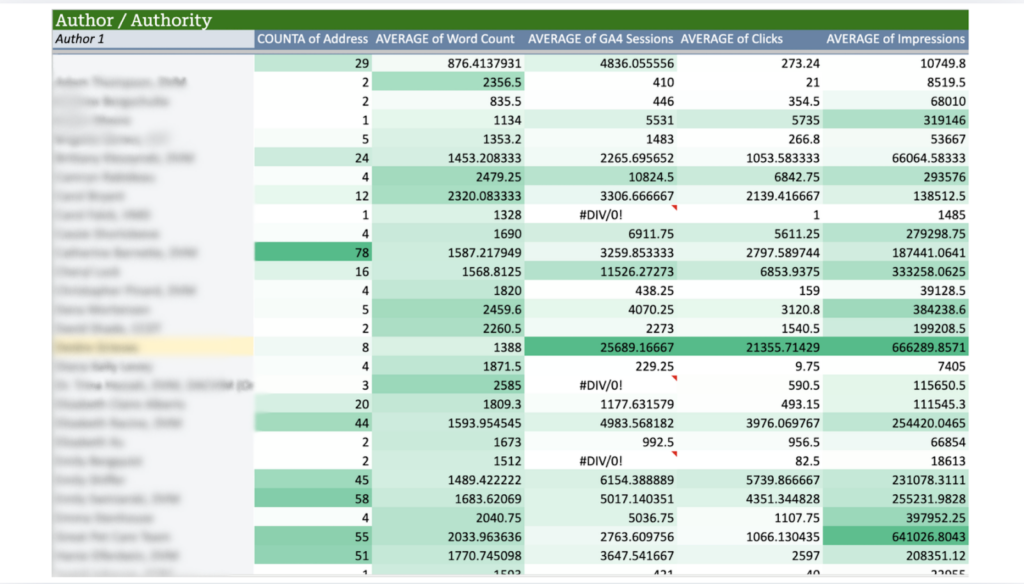
In this audit, we found that one author, Deidre (previously referenced above), had the highest number of impressions despite only having eight articles on the domain — compared to other lower-performing authors with dozens of content pieces. The catch? She still had a full profile on the old site (Domain A) that followed competitive best practices.
But Diedre’s profile page was a “ghost” on the new site (Domain B); AKA just had a blank picture with no info. During the migration, many of the author bios, including hers, never made it to the new site, even though default URLs were generated for them as authors.
We found that her same articles that once performed well on Domain A, with a fully fleshed out bio page, now performed poorly on Domain B without credentials attached. Same info: one had a trustworthy author to Google while the other did not. One ranked organically, while the other was throttled back or removed from the SERPs.

This data-driven evidence was the fuel we needed to stoke the fire for the need to update author bios on the new site. However, with handfuls of author pages that needed updating, this was anything but a small endeavor. It wasn’t just simply copying and pasting old bios from Domain A and putting them on Domain B. There was inconsistency across templates for a standard bio page, and some were never written to begin with.
Step 3: A Small-Scale Test
Getting a big brand to implement 30+ author bios in a short amount of time has historically proven difficult, so we didn’t ask for everything at once. We hand-picked a small sample of six targets to optimize and model our (surely eminent) success after.
By starting small and focusing on authors who already had high “brand entity recognition,” we were able to demonstrate the fruits of our labor and prove that these bios weren’t just a “nice-to-have” — they were driving the increase in ranking numbers.
The client agreed to follow our recommendations for standardizing their six test author bio pages, and drip published these updates over a 2-month period (as they completed the bios) so we could observe and proceed at a larger scale with proof.
The Test Results & Client Buy-in for Full Roll-out
The results were immediate. Within just a few short weeks, five of the six saw increases in article sessions, and four of the six saw clicks and impressions go up.
By simply proving to Google (and users) that a trustworthy human was behind the keyboard, we recovered the traffic.
Core Algorithm Update – Unexpected Test Variable
Even when the website as a whole started losing traffic after the December Core Update, the articles with optimized bios showed remarkable resilience. Control authors (unoptimized bios) saw session decreases between 23% and 36%, while none of the optimized authors saw more than a 10% decrease in sessions; one actually saw an increase.
Following the impressive initial results and resilience, the client decided to expand the project, optimizing another 19 authors throughout April of that year.
That year’s June Core Update sent clicks rising for all authors. Over half of the authors with optimized bios began seeing more article clicks than before the December Core Update. Even with industry-wide declines in impressions later in the year, over half of the authors with optimized bios continued to see increases in their articles’ impressions, bucking the overall negative trend.
Read the Full SEO Ranking Recovery Case Study
Impressed with what you’re reading? We broke down the entire project — from the initial audit to the final traffic recovery — in our E-E-A-T case study within the pet health care space.

Don’t Let Your Authors Go Anonymous & Lose Rankings!
If you haven’t dusted off your author bios or brand “About Us” pages in a few years, 2026 is the year to do it. Transparency and clear authorship aren’t just “nice-to-haves” anymore; it’s a competitive necessity for ranking on the SERPs.
At Greenlane, we’re inquisitive by nature — we don’t just suggest tactics because “everyone else is doing it.” We treat your team like a true partner, helping you navigate complex E-E-A-T signals to build long-term brand authority.
Would you like our team to audit your site and see where your authorship could use improvement? Let’s chat about how we can turn your experts into your biggest SEO asset. Explore our SEO Services and contact us today.