AI-Powered Creative Optimizations: Transforming Workflows & Marketing Performance
The days of slow, manual creative production are over. Artificial intelligence is no longer a futuristic concept; it’s a hands-on production partner, fundamentally changing how marketing teams generate, test, and optimize ad creatives.
For marketers, this is a profound shift: AI creative is not here to replace human creativity, but to automate tedious tasks and make hyper-personalization possible at scale.
Here is an exploration of how AI is being used across creative development — from copy to visuals — along with the essential benefits and potential challenges every brand must address.
Copywriting: From Slow Drafts to Scalable Personalization
If you still think AI is just for proofreading, it’s time to catch up. For copywriters, AI for ad copy is finally killing the blank-page panic and making personalization possible at scale.
Speed and Personalization: The New Copywriter’s Toolkit
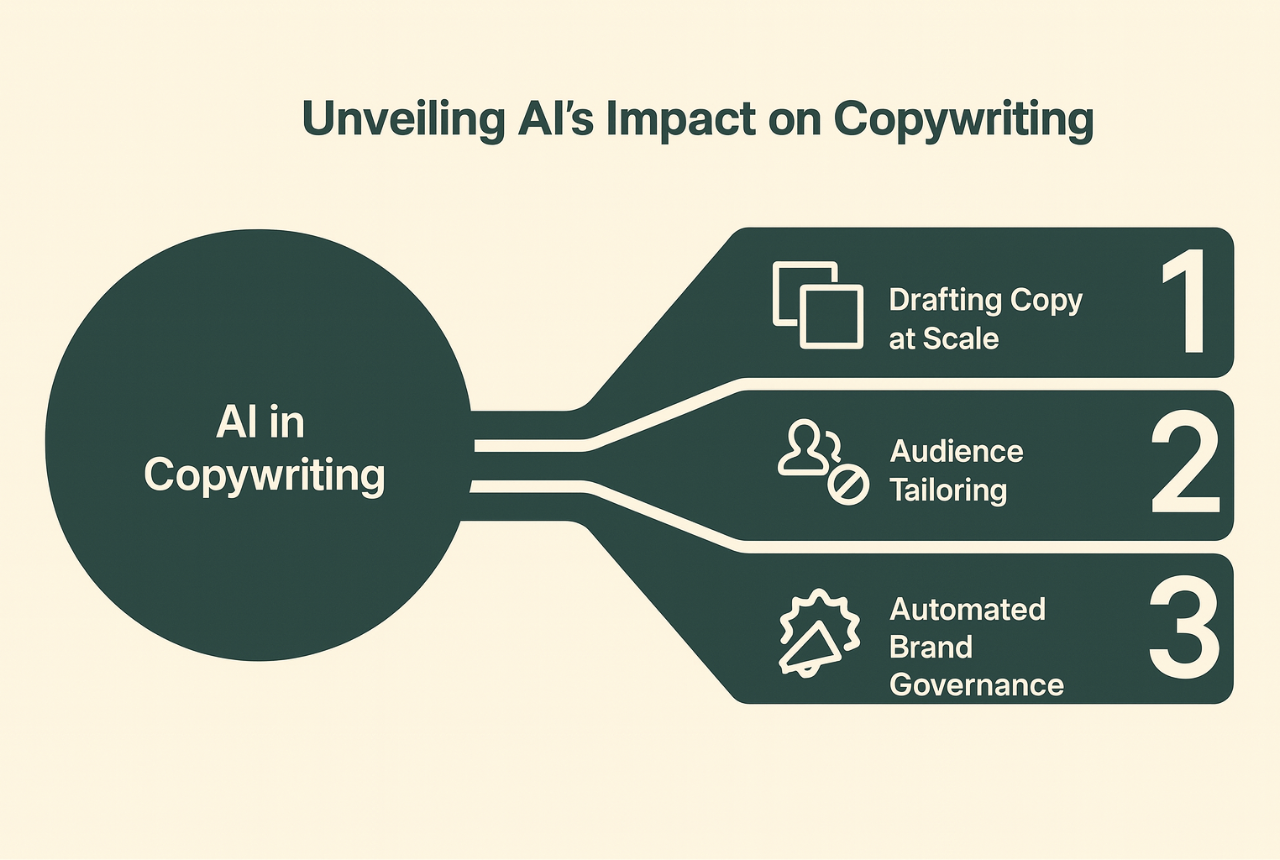
- Drafting Copy at Scale: AI can instantly churn out 50+ headline and description variations. The human copywriter’s job immediately shifts from tedious drafting to editing, refining, and selecting the best options.
- Audience Tailoring: AI allows you to automatically adjust the tone, reading level, and CTA to match specific user segments. (The catch? You still need to provide the segmentation data to unlock this super-power.)
- Automated Brand Governance: With proper initial prompting, AI can act as your always-on style guide, ensuring all AI ad copy adheres to brand guidelines and freeing the human team to focus on the high-level messaging and strategic narrative.
From Brainstorming to Prompt Engineering
The new creative workflow revolves around two critical steps.
The first, brainstorming, focuses on unconstrained idea exploration, allowing the human team to generate a wide range of creative concepts without limits.
The second step, prompt engineering, has emerged as an essential skill: it involves translating those creative ideas into structured prompts with clear constraints, ensuring that the output aligns with the original vision.
When designing your prompt, you must define the 3 Core Components:
- Persona & Role
- Desired Output Format
- Brand/Tone
Visual Creatives: Beyond Stock Photos & Basic Renders
If AI has transformed copy, it’s completely detonated the world of visual content. Marketers now have several powerful options for creating images, from quick deck adjustments to stunning, photorealistic ad creatives.
The Low-Hanging Fruit: AI in Everyday Tools
Look at the AI features already baked into tools like Google Slides.
- Quick Edits: Functions like background removal and image cleanup are standard.
- Generative Adjustments: The ability to adjust an image’s background through generation while keeping the main subject intact is a huge time-saver.
Image Generation: LLMs vs. Specialized Models
When generating images from scratch, there’s a clear quality spectrum:
| Tool Category | Quality & Output | Best Use Case |
| Basic LLM Generative AI | Good option, but often results in a cartoonish aesthetic. | Fast mock-ups, simple concepts. |
| Specialized Text-to-Image AI (e.g., Midjourney) | Superior: Lifelike, high-quality, and photorealistic images. | High-impact ad creatives, sophisticated brand imagery. |
The Takeaway: Specialized models are superior because image generation is their sole focus. If quality is paramount, the dedicated tool wins.
The Marketer’s Secret Weapon: Napkin AI
Tools like Napkin AI have become a marketer’s secret weapon, revolutionizing both internal and external communication. Designed specifically for business storytelling, it transforms existing text into compelling, professional visuals such as diagrams, flowcharts, and infographics. At the same time, it offers custom generation with full brand control, allowing marketers to manage colors, fonts, and iconography to ensure every output aligns with their marketing identity and the intended audience channel. Its versatility makes it ideal for fast-turnaround tasks, from adapting content for different social media platforms to quickly generating visuals for presentations.
Best AI Tools for Generative Creativity in Media Platforms 2025
The ultimate test of AI creativity is in the delivery. Platforms like Meta (Facebook, Instagram, Reels) have integrated advanced AI creative tools that optimize your ads in real-time to improve performance.
Meta Advantage+ Creative: Optimization on Autopilot
Meta’s Advantage+ Creative tools allow AI to make subtle, data-driven adjustments:
- Automatic Enhancements: The AI adjusts media elements like brightness, contrast, and aspect ratio cropping for optimal display across all placements (Feed, Stories, Reels).
- Dynamic Language: It serves the most relevant language, translation, or localized phrases based on the user’s inferred preference.
- Format Flexibility: The AI can turn static assets into simple video carousels or add subtle motion effects to still images.
While these optimizations are powerful, the key is knowing which levers to pull. Many marketers favor specific features that enhance quality without sacrificing creative control:
My most commonly used Meta Creative+ optimizations are Enhanced Images and Background Fill. These improve image quality without giving the AI too much latitude to change our core ad copy, which we create to be highly relevant to our topic.
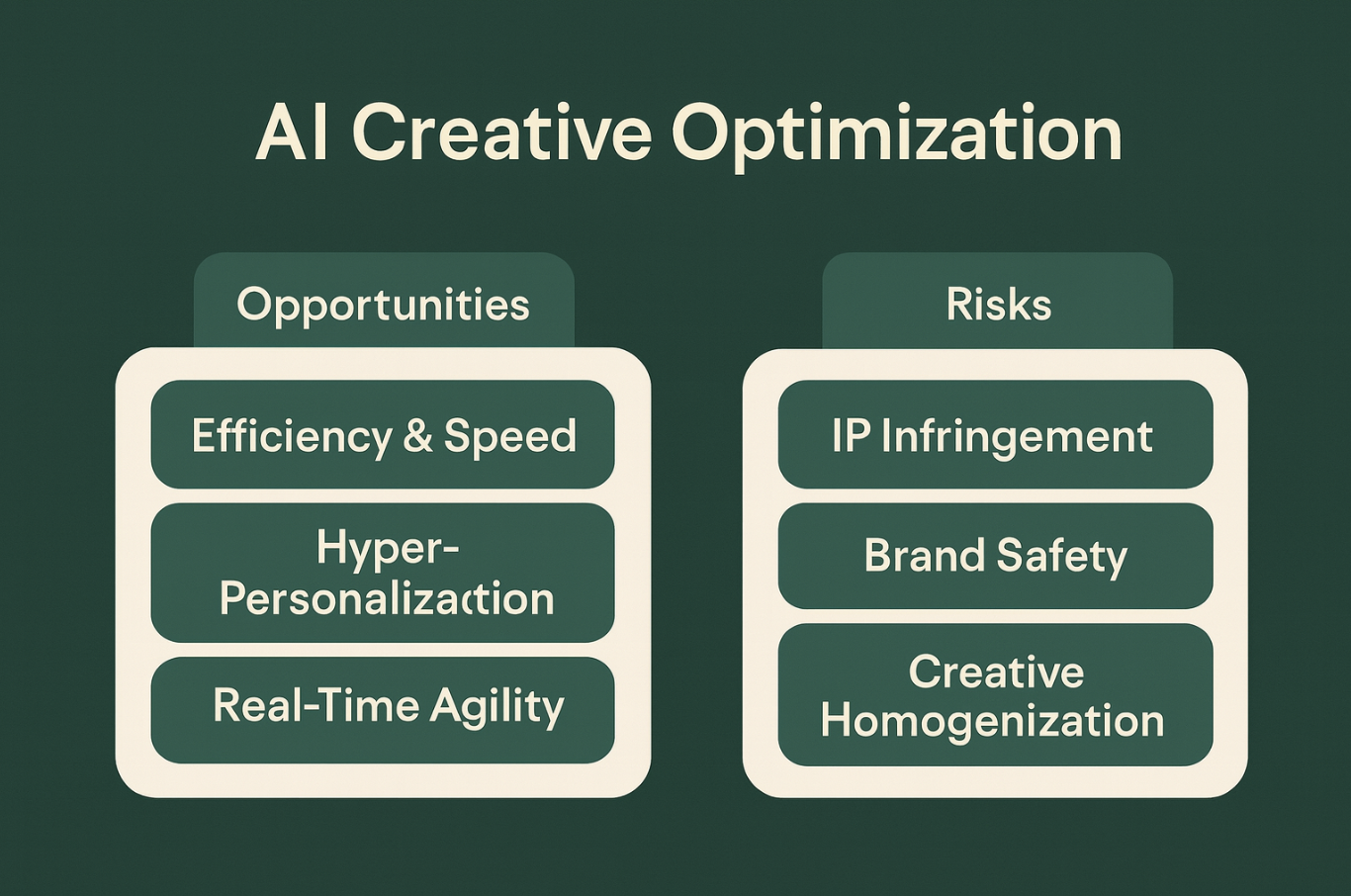
Risks & Opportunities
AI is a powerful tool that comes with both unprecedented upsides and some risks. To successfully leverage AI, marketers must engage with both.
The Risks in AI Creative Optimization
Caution is warranted, particularly concerning legal and brand integrity:
Inadvertent IP Infringement
AI models are trained on massive datasets, making it possible for the output to resemble copyrighted work. Brands are ultimately responsible for the AI’s output, necessitating a strict internal review. After all, 66% of major brands state that legal challenges (specifically IP and governance) are the main barrier to GenAI adoption.
Brand Safety & Trust
AI can produce content with factual errors or reinforce harmful stereotypes. Ads that consumers perceive as AI-generated may result in a 14% fall in purchase intent.
Homogenization of Creative
Over-reliance on AI without human refinement leads to a generic aesthetic often dismissively called “AI Slop,” which risks diluting a distinct brand voice.
The Opportunities: Efficiency, Scale, and Real-Time Agility
The potential for growth, however, is too significant to ignore:
- Efficiency & Speed: AI drastically reduces the cost and time of asset generation. Organizations using AI writing tools report an average of 59% reduction in content creation time.
- Dynamic Creative Optimization: The true long-term prize is hyper-personalization at scale. You shift from showing one ad to a broad audience to showing the ideal combination of asset, copy, and CTA to every individual user.
- Real-Time Market Responsiveness: AI constantly monitors data, allowing brands to launch reactive creatives based on breaking news or competitor actions within hours.
Optimize for AI with Help from Greenlane
AI-Powered creative optimizations are here to stay. Companies that leverage AI for creative purposes see an average uplift of 20% to 30% in overall revenue.
They redefine the creative workflow, shifting the human marketer’s role from execution to strategy and refinement.
The future isn’t about AI replacing the creative team; it’s about a creative team that masters AI.
Need help with your digital marketing? Contact us today.