


The Challenge
An online ceramics company selling kitchenware, dinnerware, and home decor came to us in April 2025. Ecommerce is their main source of revenue. Organic search was not contributing much of it.
Three problems sat underneath that:
- Branded queries drove most of their traffic, which meant search was recapturing demand the brand had already earned rather than creating new demand.
- Their highest-traffic content page was an informational article with no transactional intent, so the visitors it brought in were not shoppers.
- Their strongest non-branded commercial traffic came from flower pots, a category narrow enough that it gave shoppers no natural path into the rest of the catalog.
The pages that should have been carrying this work, their product category pages, were not indexed, sitewide.
The Goal
The client had used other SEO providers before us and found the performance lackluster. They still believed organic was their best return on investment. They came to our marketing agency to increase retail revenue from organic search, specifically.
The Strategy
Implementation started in the first week of July 2025. Here’s everything we did to move the need organically:
- We got the category pages indexed. Nothing else mattered until that was fixed.
- We recategorized the catalog and renamed the categories. The brand named things the way the brand talked, not the way shoppers search. Cups and mugs were filed under “Drinkware.” In the US, “ceramic mugs” draws roughly 3,500 searches a month. “Ceramic drinkware” draws about 200, according to 2026 Ahrefs estimates. That pattern repeated across the catalog. We restructured products and renamed categories around the language people actually use: mugs and cups, dinnerware, bowls, serving plates and bowls, dog bowls, kitchenware.
- We overhauled the header navigation so the new structure was reachable for shoppers and crawlable for Google.
- We added SEO-primed copy to the category pages. Before this, those pages were product grids with nothing for Google to read. We were not after long-form content, just enough supporting copy at the foot of each page to make its subject unmistakable.
- We ran content optimization across every category page and about 75% of products, covering metadata and on-page content. On products that meant stronger H1s and a few sentences of supporting text under the header, above the products themselves.
- We fixed a product naming issue that caused every product to appear twice on category pages. It read as spammy to shoppers and diluted the pages for search.
The Results
Comparing the twelve months after launch to the twelve months prior (GA4, organic traffic only):
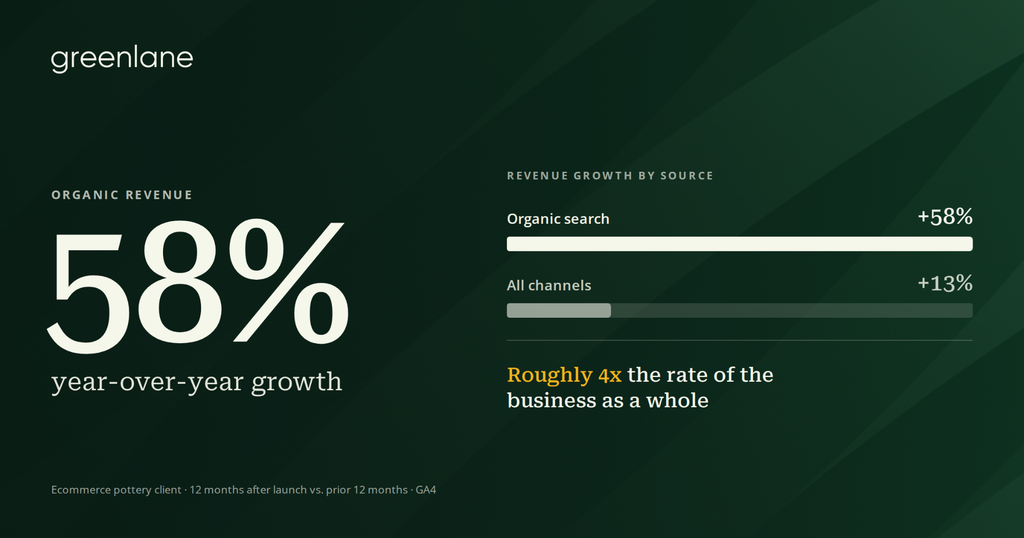
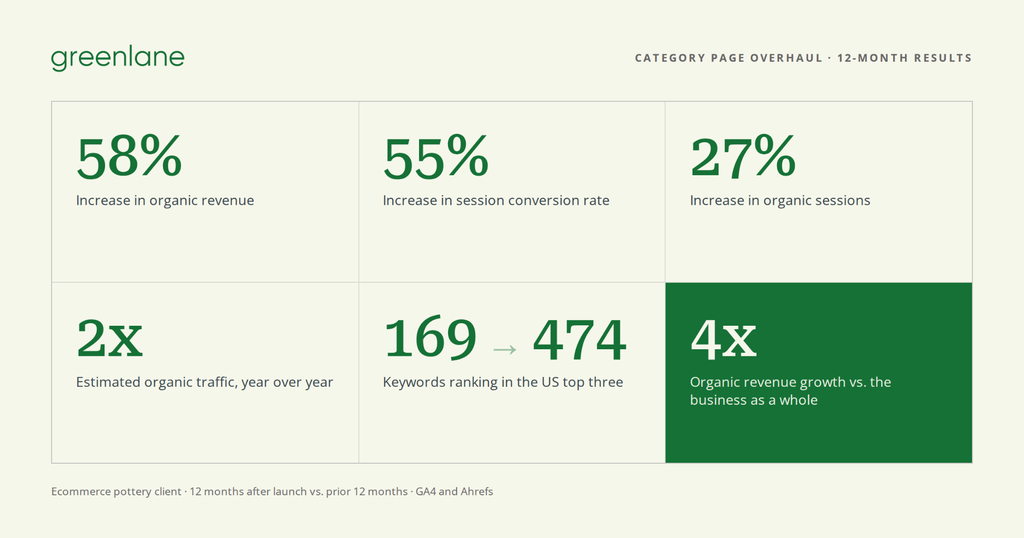
- 58% increase in revenue
- 55% increase in the rate at which sessions convert
- 27% increase in organic sessions
- 20% increase in active users
- 120% increase in tracked key events
Over the same twelve months, the store’s total ecommerce revenue across every channel grew 13%. Organic alone grew 58%, roughly four times faster than the business as a whole, and organic’s share of revenue rose with it.
This is not a traffic story that happens to mention revenue. Organic is where the ROI growth came from.
We did not just bring in more traffic. We brought in traffic that lands on pages built to sell.
Additionally, the client’s internal team reports the site is easier to navigate, and their own products are easier to find. That is not a coincidence. The structure that helps a shopper find a mug is the same structure that helps Google understand the page is about mugs.
The power of understanding how an audience searches and optimizing the site to speak their language is an SEO tactic that wins time and time again. Our pottery client sees the significance of it now and is looking forward to even more in-depth optimizations and increased sales to come while working with us.
Get Started with SEO Services from Greenlane
Share This: